
 Pat Host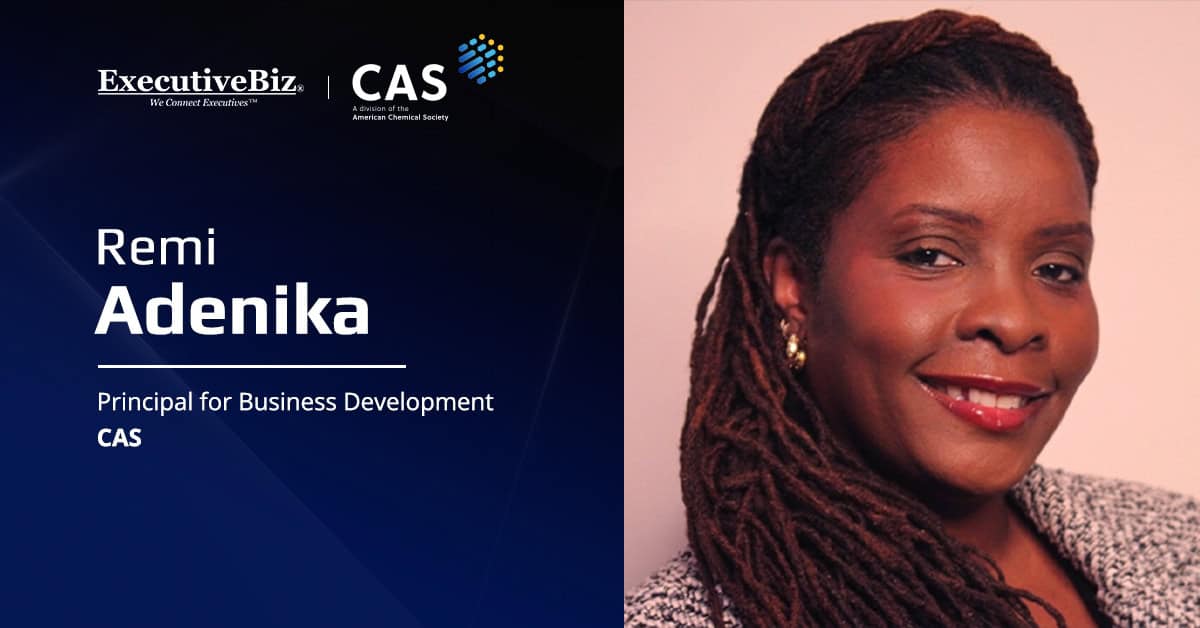
- Remi Adenika utilizes chemical scientific information solutions to provide supply chain insights
- The CAS principal for business development is a molecular biologist by training
- She sat down with ExecutiveBiz to discuss data access, AI, FEOC and supply chains
Remi Adenika is helping federal agencies better find supply chain vulnerabilities. Adenika, principal for business development at CAS, is leveraging the nonprofit’s expertise in chemical scientific information solutions to provide government customers with insights on hidden supply chain vulnerabilities at the chemical and materials level.
Traditional supply chain visibility can tell customers a lot about suppliers, price points and the movement of goods. But things get complex at the chemical and materials level, about how an item is related to other materials and where dependencies, and potential alternatives, exist. That’s where CAS comes in.
A molecular biologist by training, Adenika started her career performing genomics research around sickle cell anemia at the Washington Hospital Center. She later joined Battelle in 2020 and learned how to combine science, technology and capabilities for specific government missions and challenges.
Adenika sat down for her first Spotlight interview to discuss how AI is changing how government scientists and researchers use CAS data, how she navigates security and data access requirements around proprietary CAS information, foreign entities of concern and which agencies represent the biggest growth opportunities.
Dig into governing mission and operational data for AI with top intel officials and industry experts at the Potomac Officers Club’s 2026 Intel Summit on Sept. 24! Examine maintaining lineage, access control and interoperability and unifying data across classification boundaries at the No Mission AI Without the Data panel discussion. Learn of new requirements before your competitors and apply exclusive investment insights unavailable anywhere else. Secure your seat today!
As the Department of Energy builds the American Science Cloud and works toward creating a federated system for scientific information, we see a significant opportunity for CAS content and our chemistry knowledge to contribute to that cloud and the broader Genesis Mission.
ExecutiveBiz: How is AI changing the way government scientists and researchers use CAS scientific data and capabilities?
Remi Adenika: We’re seeing a fundamental shift in how customers want to interact with scientific information as a result of AI. There’s growing demand for curated data sets and authoritative scientific content that can serve as the foundation for the AI models and systems our customers are increasingly building.
It’s not just about providing access to data. It’s about making sure the data is structured and connected in a way that preserves scientific meaning and context. That’s especially important when customers want to bring together CAS content with their own institutional and experimental data.
We’re able to help them structure that content and connect data from different sources in meaningful ways, supporting everything from experimental workflows to decision support and operational improvements.
EBiz: How do you navigate government data security, data access and integration requirements given the proprietary nature of CAS databases?
Adenika: I’ll use supply chain as a jumping-off point for that question, since we’re seeing that capability resonate strongly in the federal sector for CAS right now.
We bring something differentiated to the market because we understand scientific content and how to structure and connect it. Supply chains, for instance, are incredibly complex, and the underlying information about chemicals and materials is often fragmented across different sources, naming conventions, suppliers, reactions, standards and systems.
CAS has spent decades organizing, curating and connecting scientific information, particularly around chemistry and materials. Now we’re looking at how that foundation can help organizations illuminate supply chains more effectively.
We’re not trying to replace traditional supply chain platforms. We’re providing a scientific knowledge layer that can make the broader supply chain picture more complete.
EBiz: Does CAS care about foreign entities of concern in supply chains?
Adenika: Absolutely. I mentioned at the top of the interview that we’ve been curating the world’s scientific content for over 100 years. In addition to curating chemical data from around the world, including China, Iran, Russia and elsewhere, we have in-house experts who read publications as they’re released in different languages and translate them into English before incorporating that information into our database.
We’re also curating patents in addition to non-patent literature. So we have patent and non-patent literature on a global scale that helps enable the discovery and connection of knowledge related to foreign entities.
We can really look across a chemical space or domain and identify patterns in the published scientific and patent landscape, including where we’re seeing significant research activity and innovation in countries such as China.
Emerging FEOC regulations are transforming DOW and IC business. Get an edge on your competition by attending the Potomac Officers Club’s 2026 Intel Summit on Sept. 24. Attend our Navigating the FEOC Frontier panel discussion and boost your expertise on how FEOC rule changes are impacting contract eligibility, teaming arrangements and subcontractor relationships.
Leverage exclusive insights from our all-star panel of FEOC experts, including:
- Dr. Adele Merritt, Univ. of Maryland Applied Research Laboratory for Intelligence and Security chief research officer (and former NIH and IC CIO)
- Leo Alvarez, Baker Tilly principal
- And more to be announced!
Walk away with actionable guidance to prepare your compliance posture for what’s coming next. Sign up today!
EBiz: How does CAS work with federal customers to integrate scientific data into their existing systems and workflows?
Adenika: We really start from the fact that CAS already has a footprint and long-standing relationships across the government through SciFinder, our software product.
As customer needs evolve, and we’re seeing a lot of that evolution right now, we’re increasingly looking at ways to extend access to the CAS content collection beyond the traditional software interface.
One way we do that is through application program interfaces and API integration, allowing customers to integrate CAS content into their own applications and workflows. Through our CAS Custom Services division, we can also work directly with customers to understand a specific mission need and determine the appropriate combination of data, technology and domain expertise needed to meet that mission requirement.
In the federal market, as I mentioned earlier, we don’t always have to be the prime or provide the entire solution. In most cases, actually, we don’t have the entire solution. A lot of what we’re doing now is partnering with other government primes and technology companies serving the government to combine our expertise and content with theirs and provide a more comprehensive solution to the government customer.
We’re not trying to replace traditional supply chain platforms. We’re providing a scientific knowledge layer that can make the broader supply chain picture more complete.
EBiz: What federal agencies represent the biggest growth opportunities for CAS right now, and how has that mix shifted in recent years?
Adenika: At a high level, I would point to the Department of War and the Department of Energy as two organizations where we see significant opportunity.
Both have significant scientific and technical missions and we’re seeing an increasing emphasis on areas that build naturally on our scientific content, including AI-enabled science, advanced materials and supply chain resilience.
What’s interesting to me, though, is less about one agency and more about how the nature of the opportunity is changing. We’ve supported government scientists and researchers for years through authoritative scientific information that enables research and development. Increasingly, we’re seeing opportunities for that same scientific foundation to address mission and operational needs beyond traditional research and development.
The shift is really an expansion of how scientific data and expertise can be applied to different government mission priorities. For us, that means pulling our content out of our software and working with government clients to combine it with their institutional data to drive decisions and feed into operational workflows.
EBiz: What’s specifically going on at the DOW and the Department of Energy that’s attracting your increased focus?
Adenika: For instance, at the Department of Energy, the Genesis Mission has been very interesting for us.
We have a significant footprint across the national labs, and many of them have historically been heavy SciFinder users. As the Department of Energy builds the American Science Cloud and works toward creating a federated system for scientific information, we see a significant opportunity for CAS content and our chemistry knowledge to contribute to that cloud and the broader Genesis Mission.