
 Charles Lyons-Burt
- Hurt says execution, not ambition, is federal AI’s biggest hurdle
- Armis and Veza buys extend governance to AI agents and connected assets
- The ex-Palo Alto federal sales chief has led ServiceNow’s public sector since 2025
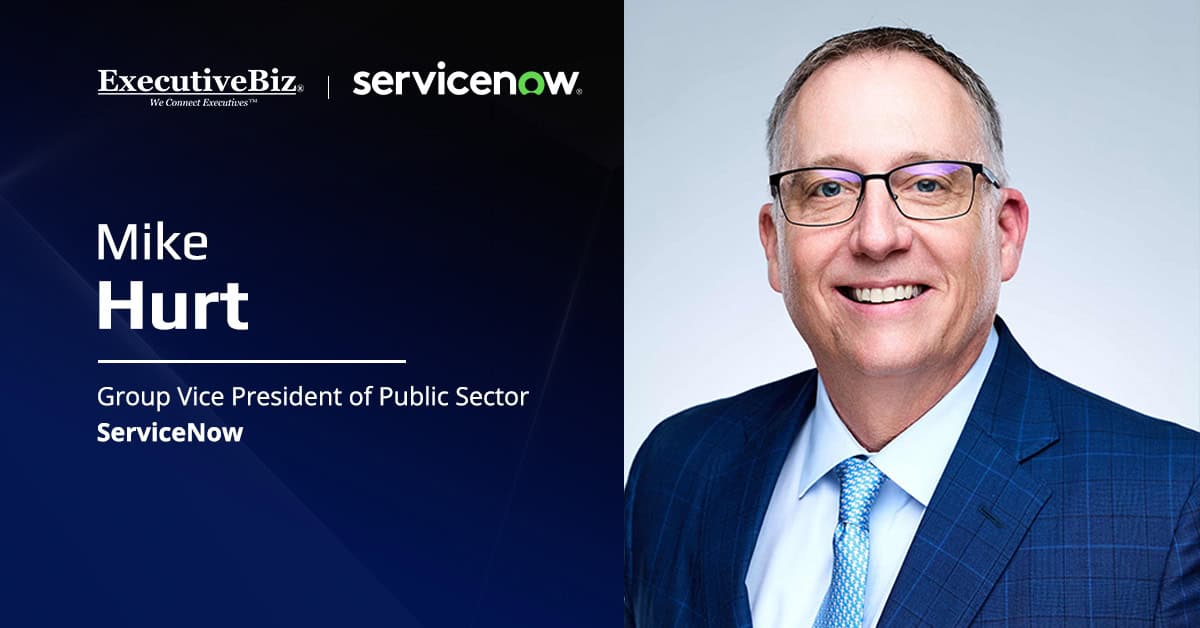
Mike Hurt has spent nearly 30 years selling technology to government. One conviction runs through his view of the current AI push: no algorithm can fix a broken process. Agencies are under pressure to show quick results from AI, but many still run on decades-old systems that were never built to talk to one another.
Hurt is group vice president of U.S. public sector at ServiceNow, a company whose AI platform orchestrates work across agencies’ existing systems. He oversees its federal, state, local and education business, joining in 2024 as vice president of state, local and education, or SLED. He was promoted to his current role in 2025.
Hurt’s time leading the public sector business has been a busy stretch for the company. ServiceNow struck a OneGov agreement with the General Services Administration in September 2025, offering agencies discounts of up to 70 percent on upgrades to its IT service management bundles. In February, its Moveworks conversational AI platform achieved FedRAMP Moderate authorization. That added to the core ServiceNow platform’s FedRAMP High authorization. In July, ServiceNow said nearly all 50 states are now using its AI platform. Most recently, Broward County, Florida, went live this month on ServiceNow IT Service Management and Workflow Data Fabric.
At Palo Alto Networks, Hurt persuaded leadership to invest in FedRAMP and Impact Level authorizations. In this Executive Spotlight interview, he names the one change he’d make to FedRAMP today. He also discusses how ServiceNow is answering the rising sophistication of cyber threats and whether Department of War open architecture policies are keeping pace with technology.
Want more on how GovCon leaders are taking agentic AI from pilot to practice? Hear from top industry executives at the Potomac Officers Club’s 2027 GovCon Executive Leadership Summit on Feb. 25. Registration is now open!
ExecutiveBiz: Many people are familiar with ServiceNow on the commercial side. Tell me how ServiceNow is helping to solve federal agencies’ problems with its products.
Mike Hurt: Federal agencies want to modernize, but the biggest barrier they’re facing right now is execution. They’re being asked to deploy AI and get real results fast, but they’re running their operations on decades-old, fragmented systems that weren’t designed to work together. You can’t bolt AI onto a broken process and expect transformation.
ServiceNow brings AI, data and workflows together so agencies can connect their existing systems and get work done across departments. That includes resolving IT issues, simplifying hiring and onboarding, improving constituent services and supporting the logistics and sustainment processes that determine military readiness.
The opportunity is to move beyond individual pilots and embed AI into how an agency operates to get tangible results. Routine work moves faster, while people focus on decisions that require their judgment and expertise. For example, at the Defense Logistics Agency, ServiceNow and AI-powered virtual agents reduced average customer service case resolution time by 60 percent.
With ServiceNow, federal agencies get less time navigating systems, faster service delivery and more capacity for the mission.
EBiz: What’s one change you’d make to FedRAMP?
Hurt: I would make continuous security validation easier to automate and use across the authorization lifecycle. Agencies need to adopt new capabilities faster and be confident that those remain secure as technology evolves.
ServiceNow has supported streamlining FedRAMP through automation and continuous authorization management. That means improving how organizations monitor, assess and share information about assets, configurations and vulnerability responses. Keeping that information current and making it easier to act on helps agencies understand their security posture and address risks as they emerge.
As agentic AI evolves, compliance processes must adapt while upholding FedRAMP’s strict security standards. The goal is to help agencies deploy secure technology faster while maintaining visibility into mission-critical systems.
EBiz: It’s being said cybersecurity is more critical than ever right now. How is ServiceNow dealing with the acceleration of threat sophistication?
Hurt: Threats move at machine speed, so security teams must quickly identify affected assets, understand what they support and know who needs to act. When answering those questions requires searching spreadsheets or contacting another department, valuable time is lost.
The acquisitions of Armis and Veza have strengthened our ability to secure and govern every AI agent, identity and connected asset. Armis delivers continuous asset intelligence across IT, operational technology, internet of things, medical devices, code and cloud, while Veza provides visibility into human and non-human identities.
Connecting this intelligence in the same platform where teams already work helps them understand which exposures matter most, assign responsibility and move faster from detection to remediation. For government, that connection is especially important when a cyber incident can disrupt essential services or mission operations.
As agents take on more work, organizations need visibility into what they’re doing, control over what they can access and a clear audit trail. Our approach brings policy enforcement, human oversight and accountability into the workflow, with clear boundaries for automated actions and escalation to people when needed. By connecting real-time asset intelligence, coordinated response and governance, we’re helping organizations respond faster as threats evolve.
Machine-speed threats and the agentic AI racing alongside them take the stage at the Potomac Officers Club’s 2027 GovCon Executive Leadership Summit on Feb. 25. Hear from OpenAI‘s Andrew Keene and SAP NS2‘s Harish Luthra on the panel Machine Speed, Mission Risk: Executive Perspectives on Agentic AI and the Evolving Cyber Threat Landscape, plus a keynote from OpenAI’s Alexis Bonnell. Register for the 2027 GovCon Executive Leadership Summit today!
EBiz: Do you believe that Department of War policies related to modularity and open architecture are keeping pace with advances in both hardware and software technology?
Hurt: For defense organizations, the value of open architecture comes down to how quickly they can put new capabilities to work alongside the systems they already rely on. Personnel, logistics, maintenance, IT and cybersecurity all contribute to readiness, but when those functions operate in disconnected systems, commanders have a harder time seeing where a personnel requirement, equipment shortage or delayed approval could affect the mission.
ServiceNow is open by design, connecting the workflows across those systems so organizations can improve coordination while building on existing investments. That becomes even more important as defense organizations adopt AI. They need the flexibility to choose capabilities that meet their mission requirements, along with consistent controls over the information those capabilities can access and the actions they can take. The goal is to make it easier to introduce new technology, apply it to operational needs and maintain the accountability and human authority defense missions require.
Who Is Mike Hurt?
Hurt has nearly three decades of public sector technology experience. He started as a developer at Micro Modeling Associates, later known as Plural, and moved into business development there. After Dell acquired the firm, he stayed on until 2008 as a services account executive and later global alliance manager.
He then spent more than 12 years at Microsoft. He began by selling to Department of War accounts in the Joint community, including the Defense Information Systems Agency, and later grew the federal health and benefits business from $142 million to $262 million in net new business. His later roles included Americas services sales leader and general manager of Northeast services sales and delivery. Most recently there, he was chief operating officer and chief of staff for state and local government sales, a 560-person organization that grew from $1.9 billion to $2.3 billion during his tenure.
From 2021 to 2023, Hurt was vice president of federal sales and services at Palo Alto Networks. His team of more than 130 doubled the federal business to over half a billion dollars and closed a Department of War deal worth more than $200 million, the largest in the company’s history. He also championed Palo Alto’s investment in FedRAMP Moderate and High authorizations and Impact Level 4 and 5 accreditations, and he took part in GovCon Wire-hosted webinars. Before joining ServiceNow in 2024, he served as senior vice president of digital transformation at Infinite Computer Solutions.
What Is ServiceNow?
ServiceNow is a Santa Clara, California-based software company. Its AI platform links legacy systems, departmental tools, cloud applications and AI agents so organizations can coordinate work across the enterprise. The platform integrates with any cloud, model or data source and runs more than 80 billion workflows a year. In 2026, ServiceNow expanded its security portfolio by closing its acquisitions of identity security company Veza in March and cyber exposure management firm Armis, a $7.75 billion deal, in April.