

 Arthur McMiler
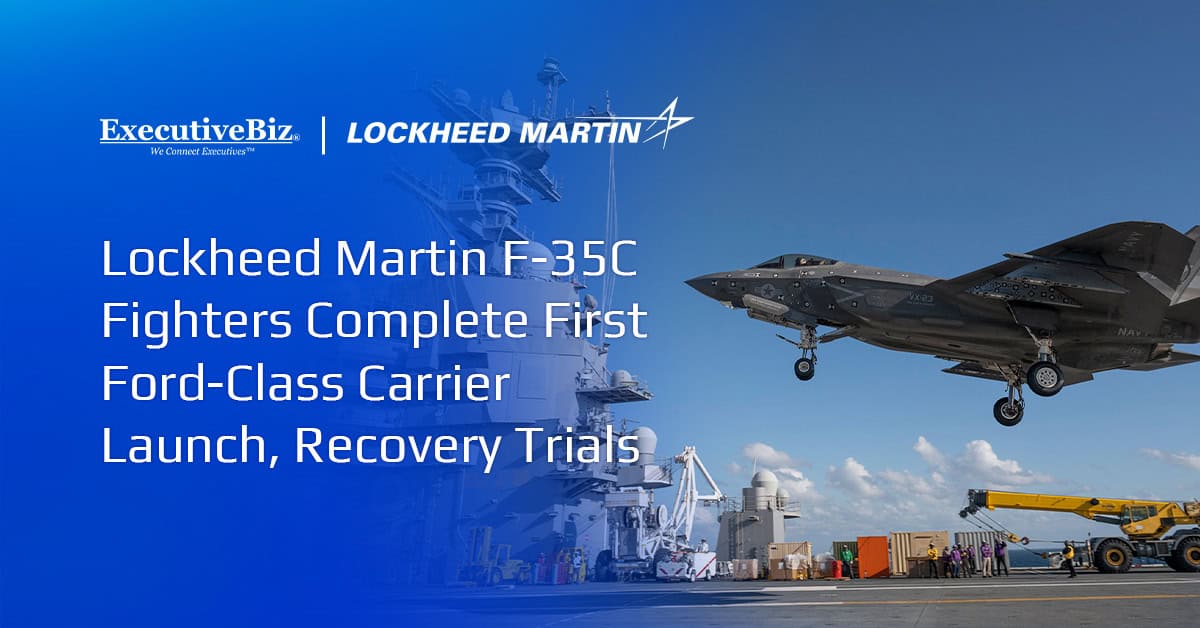
- Two test jets flew 34 flights, with 122 catapult launches and 122 arrested landings, over 11 days at sea
- The trials were the first time early Block 4 mission systems software ran in a carrier setting
- Lockheed says the Navy has now cleared the F-35C to operate from every carrier in its fleet
Two F-35C Lightning II fighters have flown their first launch and recovery operations from a Ford-class aircraft carrier. Lockheed Martin said Thursday the effort completes a test phase that clears the fighter aircraft’s carrier variant for duty across the service’s entire carrier fleet.
The jets flew from the future USS John F. Kennedy, the Navy’s newest Gerald R. Ford-class aircraft carrier. The aircraft’s first recovery aboard the ship came on Oct. 13, the Navy’s 251st foundation anniversary.
Sean Jackson, vice president of Lockheed Martin’s F-35 Development Program, called the trials “a critical event for the F-35C, Kennedy, and the United States Navy.” He said the testing was the jet’s first demonstration on a Ford-class deck, linking the stealth fighter’s fifth-generation capabilities to the Navy’s most modern carrier systems.
What Did F-35C Testing Aboard the Kennedy Involve?
During 11 days at sea, two test aircraft based at Naval Air Station Patuxent River made 34 flights. The Electromagnetic Aircraft Launch System, or EMALS, catapulted the jets 122 times. The Advanced Arresting Gear, or AAG, caught them in the same number of arrested landings.
According to Lockheed, Ford-class ships present a markedly different operating environment. EMALS offers finer control over launch forces, and AAG handles a wider range of recovery conditions. A reworked flight deck and island also change airflow, exhaust patterns and deck routines.
What Data Did the Ford-Class Carrier Trials Generate?
The integrated test team used the time at sea to verify the EMALS and AAG software and the shipboard installations of both systems. Engineers also checked the F-35C’s loads and structural models against actual launch and recovery conditions. They gathered inputs for launch and recovery bulletins written for Ford-class carriers.
The trials were the first time early Block 4 mission-systems software ran in a carrier setting, which let the team check how stable it is. Testers also assessed how easily the aircraft can be maintained and supported aboard the new ship class. Lockheed said the results move the program closer to fully integrating the F-35C aboard the Navy’s latest carriers.
How Does the Milestone Fit With Lockheed’s Recent Navy F-35 Contracts?
The carrier trials follow a string of Navy sustainment and production awards for the program. Earlier in November, Lockheed received a $93.2 million Naval Air Systems Command order for F-35 depot test equipment, software refreshes and added repair capacity. Most of that work will take place in Malabar, Florida, with completion expected by January 2030.
In November 2025, the company secured a $178.4 million contract modification for economic order quantity materials and components for Lots 20 through 22. Cooperative program partners and foreign military sales customers are funding it. That award followed a $578.7 million delivery order in July 2025 for initial F-35 spare parts, including afloat and deployable spares pools.
What Is the F-35 Program’s Economic Footprint?
According to Lockheed, the F-35 program generates more than $79 billion in U.S. economic activity each year and supports about 317,000 direct and indirect jobs. Its supply chain spans more than 2,100 suppliers in over a dozen countries. For production Lots 15-17, the company puts the F-35C’s average flyaway cost at $102.1 million, compared with $82.5 million for the F-35A and $109 million for the F-35B.