
 Charles Lyons-Burt
FutureG conversations extend beyond faster cellular networks. For government organizations, the priority is dependable, adaptable and secure connectivity across remote installations, proving grounds, flight lines and other operational environments where traditional infrastructure may be limited.
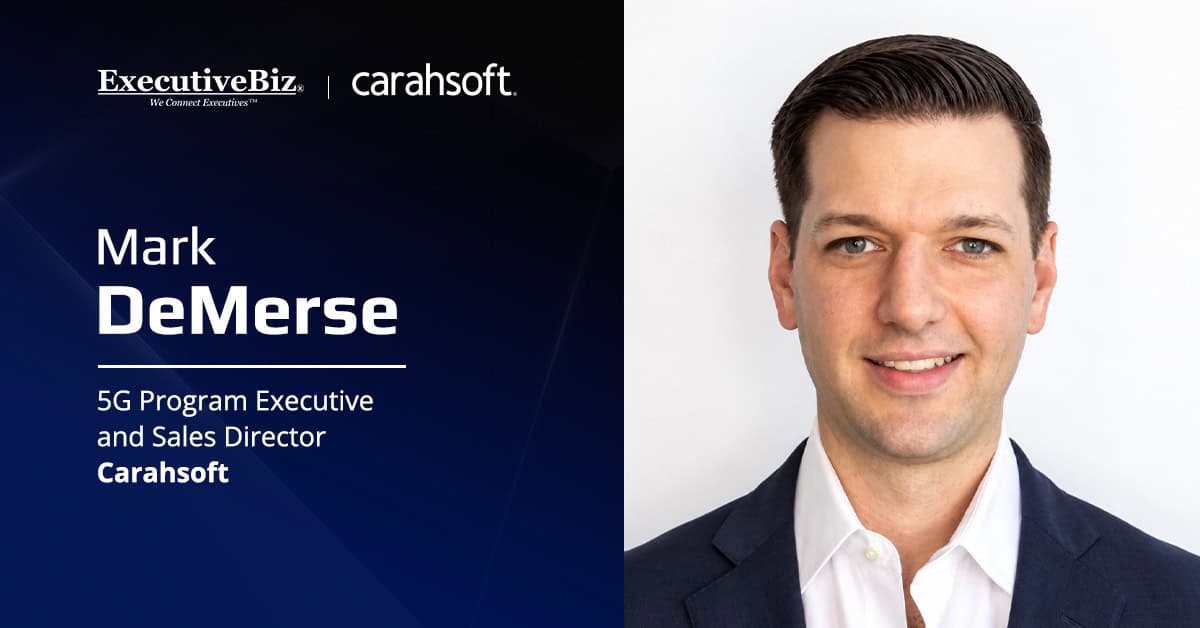
Mark DeMerse, 5G program executive and sales director at Carahsoft, works with telecommunications and software providers serving government customers. In our latest Executive Spotlight, he discussed how 5G can address current mission needs, why agencies should begin planning for FutureG now and the technologies driving the transition to 6G.
Be sure to check out our prior conversations with DeMerse:
- Carahsoft’s 5G Exec Mark DeMerse Talks Open RAN, IoT, AI, & Barriers to 5G Adoption (July 2025)
- Carahsoft’s Mark DeMerse on 5G Innovations for the Public Sector (Aug. 2024)
- Mark DeMerse, 5G Vertical Executive at Carahsoft, in Dialogue on the Challenges and Opportunities for 5G in Government (Sept. 2023)
ExecutiveBiz: Why should agencies be thinking about FutureG and 6G now?
Mark DeMerse: Although FutureG, or 6G, is not expected to arrive until around 2030, one of its defining technologies is already transforming the industry: artificial intelligence.
6G will integrate AI into the core network, helping operators optimize performance, manage connectivity, and use resources more efficiently as operating demands change. For government users, this means more consistent, responsive service across complex and high-demand environments, from automated manufacturing facilities to military bases and combat operations, where low latency, high bandwidth, and consistent coverage are mission-critical.
ExecutiveBiz: How have recent conflicts changed what government customers need from connectivity and acquisition?
DeMerse: Recent conflicts have shown how quickly the operating environment is changing. Unmanned systems now play a larger role in warfare, increasing demand for drone detection and counter-unmanned aircraft systems capabilities. The cost imbalance between relatively inexpensive drones and traditional interceptor systems is also driving the need for more scalable and sustainable countermeasures.
FutureG supports this shift by serving as both a connectivity and sensing layer, helping detect unmanned systems while enabling the technologies involved in counter-UAS operations to communicate reliably.
The other issue is speed. Technology and threats are evolving too quickly for the Department of War to wait years for a large program of record to deliver a fully mature product. A 100-percent solution delivered two years from now may arrive after the need has changed. An 80-percent capability available today gives agencies something they can put to work now and refine with industry over time.
The government’s approach to cellular technology shows how this can work. Since 2019, it has used other transaction agreements, or OTAs, to fund prototypes for specific applications instead of procuring a complete 5G system. These rapid acquisition vehicles give government and manufacturers greater flexibility to refine the prototypes as requirements evolved.
EBiz: How do OCUDU and ISAC fit into the FutureG and defense connectivity story?
DeMerse: Open Centralized Unit / Distributed Unit, or OCUDU, and integrated sensing and communication, or ISAC, reflect two important shifts in cellular technology. Networks are becoming more open and adaptable, while also taking on functions beyond communications.
OCUDU builds on O-RAN, a.k.a. Open Radio Access Network, which introduces greater interoperability. That flexibility becomes valuable when a critical part is unavailable or has a long lead time. Its open-source model also allows developer communities to adapt and optimize the software for specific applications.
That same move toward more open, software-defined networks is reflected in Carahsoft partner Nokia’s AI-RAN work. Nokia’s AI-RAN is O-RAN compliant and designed with an upgrade path to 6G.
ISAC combines communications and sensing within the same cellular network. Another Carahsoft partner, Tiami Networks, is applying this model to C-UAS operations, using 4G and 5G radio signals to support drone detection and tracking alongside connectivity.
EBiz: How does FutureG translate into modernization needs at stateside installations?
DeMerse: Many military installations are deliberately located in remote areas where fiber access is limited. Even so, they still depend on reliable connectivity to support mission systems, physical security, logistics, and personnel.
Proving grounds are a good example. During exercises and live-fire activities, teams need to control site access while maintaining dependable communications across a large area. Security cameras along the perimeter also need reliable networks to send video to monitoring teams.
Connectivity also affects quality of life. Personnel stationed at remote bases may struggle to video-call family members or access streaming services during their time off.
Satellite communications, cellular networks, and private 5G can address different parts of this challenge, giving agencies several ways to extend coverage where fixed infrastructure is unavailable.
EBiz: Where does cyber resilience and quantum-resistant connectivity fit as agencies connect more systems?
DeMerse: As adversaries become more sophisticated, encryption becomes central to connectivity. Post-quantum security is especially urgent because adversaries can collect encrypted data now and decrypt it later as quantum computing advances. Agencies must protect today’s information against tomorrow’s capabilities.
The challenge extends beyond encryption. Initiatives such as Golden Dome will require technologies, domains, and agencies to exchange information without creating a fragmented environment where systems cannot communicate effectively.
Carahsoft’s work with ZeroTier illustrates this convergence. ZeroTier provides secure software-defined networking that connects people, devices and clouds across distributed environments. Its ZeroTier Quantum platform extends that approach with end-to-end quantum-secure networking for organizations transitioning to post-quantum cryptography.
EBiz: What other emerging use cases and barriers should federal agencies watch as they move toward 6G?
DeMerse: One emerging use case is cellular connectivity in space, including satellite-to-satellite communication. As more satellites enter orbit, secure communications become increasingly important because adversaries may target or compromise those systems. This is another area where connectivity and cyber resilience converge.
Spectrum availability is a longstanding challenge that will continue into 6G. Many defense communications and weapons systems rely on specific spectrum bands, while commercial carriers want more capacity. Dynamic spectrum sharing offers a potential middle ground, letting commercial users access those bands when the government isn’t using them while preserving priority access for defense when needed.
You can learn more about the 5G solution providers that partner with Carahsoft here.