

 Elodie Collins
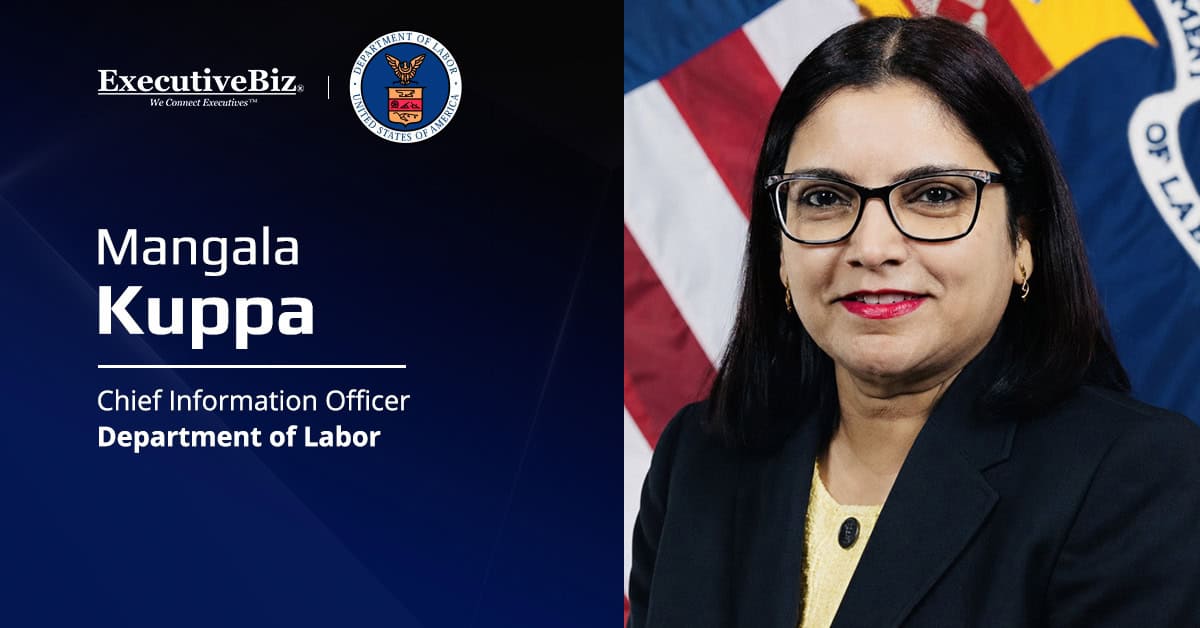
- Kuppa says intentional pilots and a solid data foundation are key to scaling AI
- DOL has already deployed AI across multiple operational use cases
- The Labor Department CIO will deliver a keynote at the 2026 FedCiv Summit on Oct. 29
The Department of Labor is moving artificial intelligence initiatives from experiment into operational use, and the secret to agency-wide deployment, according to the department’s Chief Information Officer Mangala Kuppa, is being intentional about pilot programs.
In an interview with FedScoop’s AITalks, Kuppa, who also serves as DOL’s chief AI officer, talked about how the agency is approaching the technology’s implementation, and why data is critical to ensuring effective and reliable deployment.

The Labor CIO will provide more insights into how the Labor Department is utilizing AI and future plans to implement the technology and other advanced tools at the Potomac Officers Club’s 2026 FedCiv Summit on Oct. 29. Kuppa joins a speaker lineup that includes leaders from the Customs and Border Protection, the Small Business Administration and the General Services Administration. Register today to gain insights from the top decision-makers of federal civilian agencies!
How Does DOL Transition AI Pilots to Operational Use?
Kuppa is also attributing the progress of the agency’s AI programs to active engagement with stakeholders and sharing results.
“So early on with the pilots we want to identify what’s the perceived value that you can derive from it. Then once the pilot is done, we also have a very great engagement across the spectrum within the Labor Department,” she explained. “So, sharing the results, having your early adopters use it and then they come and talk about how that particular implementation is helping them. That kind of co-sharing [and] being intentional with the pilots [are] what I think has helped us tremendously and I continue to keep doing that.”
According to the DOL website, the agency has deployed AI for a variety of use cases, including audio transcription, document processing and review, summarization, note-taking, price tolerance prediction, and personally identifiable information detection and redaction.
Kuppa cautioned against quick pilots and pursuing projects to showcase new technologies. AI, she said, needs to be integrated into the ecosystem and routine activities to achieve success in the long run. She added that embedding the technology into workflows will enable organizations to fully realize the value of AI.
What Is the Role of Data in AI Implementation?
Kuppa noted that establishing a solid data foundation is a critical precursor to effective AI deployment.
She shared that her office has collaborated with chief data officers early on, even before the government started rapidly adopting AI, to improve decision-making.
Kuppa, who was appointed as DOL’s permanent CIO in March, pointed to an effort at DOL to consolidate all IT operations under the Office of the CIO, which gave her visibility on all the systems that collect and process data.
“So we exactly know what our data is and then some of the pre-processing that we can do not just for AI reasons [but] for the reasons of maybe publishing some insights from that data [to] help this endeavor of getting the AI-ready data there,” the official noted.
However, the work does not end when the organization has AI-ready data. Kuppa said organizations are still required to review and make sure that the data is appropriate for each use case to get the best value for AI.
Why the 2026 FedCiv Summit Is the Prime Destination for Federal AI?
AI is taking center stage at the 2026 FedCiv Summit on Oct. 29. Of the event’s seven panels, five are dedicated to the exploration of all aspects of federal AI, including its potential to accelerate modernization, its impact on the government workforce and efforts to scale deployment of the technology.
The AI panels at the event are:
- Digital Labor in the Workforce of Tomorrow
- The OneGov Effect: Leveraging AI to Accelerate Agency Modernization and Migration
- The OneGov Effect: Competing When AI Becomes a Commodity
- From Strategy to Delivery: Modernizing Federal Civilian IT Through AI for Mission Impact
- Connecting the Mission: AI, Interoperability and Trusted Information Sharing
Aside from Kuppa, numerous technology leaders from government will also deliver keynotes and join panels at the event, including:
- Sonny Bhagowalia, CIO and assistant commissioner of the Office of Information and Technology at the U.S. Customs and Border Protection
- Sunil Madhugiri, CTO at CBP
- Andrea Brandon, associate director of the Office of Enterprise Management at the Department of the Interior
- David Hong, acting CIO and CAIO at the Department of Health and Human Services
- Matheus Passos, acting CTO and deputy CIO at the Department of Commerce
- Amy Ritualo, chief data and AI officer at the Department of State
- Ankur Saini, CTO at the Department of Transportation
- Basia Sall, director of the Data, AI, Technology and Applications Division at the Nuclear Regulatory Commission
- Tiffany Swygert, acting deputy director in the Office of Information Technology at the Centers for Medicare & Medicaid Services
- Wade Zarriello, director of the infrastructure and User Services Group at CMS
With multiple FedCiv technology leaders under one roof, attendees will get a comprehensive view of how agencies are experimenting with and integrating AI into their systems and workflows to support their mission. Click here to sign up!