
 Gabriella DeCesare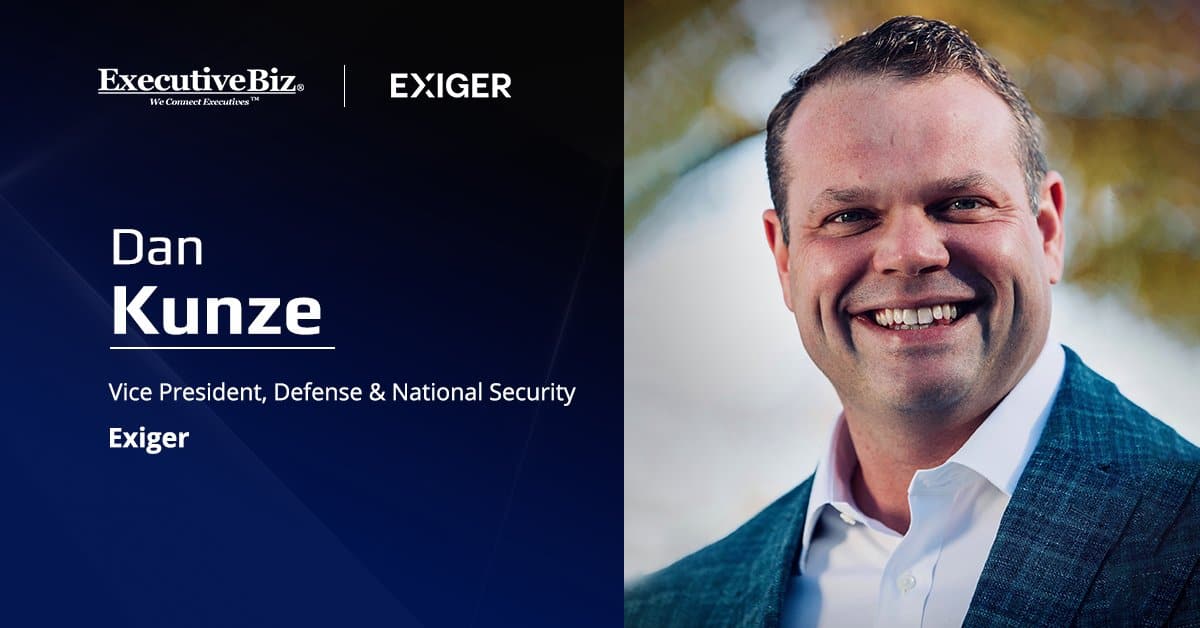
Dan Kunze, vice president of defense at Exiger, is a business leader focused on advancing U.S. government missions between technology and public private partnership. He began his career as an entrepreneur before attending Temple University and Widener University Delaware Law School, where he joined the U.S. Army through the Pennsylvania Army National Guard.
Kunze spent eight years at Gartner advising Fortune 500 and defense clients, followed by roles at Pivotal Software and ServiceNow, where he supported modern software adoption and expanded Army programs. He later joined LeoLabs, helping secure its first major space traffic management contract, before moving to Exiger, where he leads efforts to strengthen defense supply chain visibility.
Across his career, Kunze has gravitated toward mission driven organizations and complex problem sets, combining a systems-oriented approach with a deep appreciation for understanding challenges at their core.
Kunze sat down for a Spotlight interview with ExecutiveBiz to discuss the interconnection of AI, national security, energy and outer space.
ExecutiveBiz: Tell us about the current state of the artificial intelligence market. Where are you seeing new opportunities in AI, and where do you think the market is heading?
Dan Kunze: The AI market is being misunderstood right now and at the same time it is being underestimated. We are still underestimating how much artificial intelligence will shape every part of our lives. Most people are looking at it through two lenses: what it destroys and what it creates.
Model capability will continue to improve, that is not the constraint. The constraints are energy, compute and the systems required to deploy AI at scale. That includes data quality, secure environments and the ability to keep pace with technical change.
Within the Department of War, most operating models were built between the 1960s and 1990s. We are still working within legacy systems. The question now is what it looks like to replace, complement or work around those systems with AI enabled operating models. That is where real change is starting to happen.
Most of the conversation today is focused on models, tools and interfaces. That is the surface layer. The real story is underneath it. AI is no longer just software. It is infrastructure. It is a production system that runs on energy, semiconductors, data centers, cooling and specialized labor. None of those scales quickly, and that is where the real constraints and opportunities exist.
The market is splitting between experimentation and constraint. Constraint wins. Power, compute and supply chains will determine who can deploy at scale. The durable opportunities are not in building another interface. They are in making the system work: securing supply chains, optimizing compute, integrating AI into real workflow and ensuring it performs in constrained environments.
Over the next three to five years, the market will consolidate around operators who can work across that entire system.
ExecutiveBiz: Where are you seeing the most exciting opportunities to deliver better capabilities to our warfighters today, and how are you harnessing these opportunities?
Kunze: The most important capabilities for the warfighter are not years away, they already exist. The gap is deployment. We can already map and analyze complex supply chains in real time, identify risk across vendors, materials and logistics networks, and apply AI to decision-making in ways that were not possible a few years ago.
I think about the E4 infantryman: someone operating in an antiquated system trying to do their job better. They are asking simple questions—What am I about to do? Who am I doing it with? Can I trust the equipment and the people around me?
The Department of War must make that person as effective as possible in the last hundred meters between them and the objective. That is the point of decisiveness. Our job is to create an overwhelming advantage at that point, to make the fight unfair or ideally unnecessary.
America at its best is overwhelmingly capable. But that requires a shift in operating model. The technology exists today to give operators at the edge a decisive advantage. We just need to deploy it correctly.
If we can reshore production, secure supply chains, lead in AI, and win in energy, we unlock everything else. Quantum. Space. Cyber. At that point the warfighter becomes uncompetitively advantaged.
The gap today is between the edge operator and the enterprise system that supports them. Closing that gap requires control over supply chains, policy, logistics and execution. That is where we are focused. Taking capability that already exists and making it deployable, reliable, and usable at the edge, because if it does not show up when it is needed, it does not matter.
What works is focused use cases tied to mission outcomes, integrated into real workflows, and built for constrained environments. What does not work is anything that requires perfect data, ignores procurement realities or assumes uncontested conditions.
ExecutiveBiz: Which emerging technologies do you anticipate will have the greatest impact on the federal landscape in the next few years?
Kunze: The mistake is treating these as separate trends. They are not. AI, energy, compute, semiconductors, space and cyber are part of a single system.
AI depends on compute. Compute depends on semiconductors. Semiconductors depend on global supply chains. All of it depends on energy. Increasingly, it depends on space-based infrastructure and resilient cyber systems. You cannot separate these things—it does not work.
One area we should not underestimate is space. Sovereign launch capability and the ability to operate in orbit are foundational. When you unlock space, you enable everything else. The same is true for energy. If we can expand energy capacity and improve transmission, we change what is possible across the system, including quantum compute.
The real inflection points are happening at the intersections: energy is constraining AI deployment, supply chains are shaping semiconductor access, space is becoming a contested domain and cyber is becoming a constant operating condition.
The organizations that lead will be the ones that understand the system, not just the components, and can align infrastructure, policy and mission around it.
Join leaders uncovering the connections increasingly critical to cybersecurity—AI, semiconductors, supply chain and energy—at the 2026 Cyber Summit on May 22.
ExecutiveBiz: What do you think are the most pressing national security threats we’re facing today? How is your organization addressing these threats?
Kunze: The most pressing risks today are not just adversaries, they are dependencies. Over the past several decades, we optimized for efficiency, globalized supply chains, just-in-time logistics, stable energy assumptions, uninterrupted access to technology. That system worked until it did not.
Now those same systems are where risk accumulates. The key pressure points are concentration in critical supply chains, energy constraints as demand accelerates, and the convergence of cyber and physical infrastructure risk. Adversaries do not need to outmatch us everywhere. They need to apply pressure at the right nodes.
Our approach at Exiger is to understand those dependencies, where they exist, where risk is building and how to act before disruption occurs. National security today is about operating inside complex systems before they break, not reacting after they fail.
Separately, one of the biggest challenges we face is internal misalignment. Political turnover disrupts long term progress. Programs that should persist across administrations get reset, and momentum slows. We need continuity in infrastructure development, especially in AI and energy, because these are long cycle investments.
At the end of the day, every problem is a people problem. Alignment is the core challenge. If we are not willing to sit in the same room, work through disagreement and stay focused on the problem, progress slows.
You can see this clearly in energy. National priorities require expanded capacity and improved grid transmission while local realities involve zoning, land use and community concerns. Both sides are acting rationally, but without alignment, progress stalls. Closing that gap is a leadership challenge as much as a technical one.