
 jack@executivemosaic.com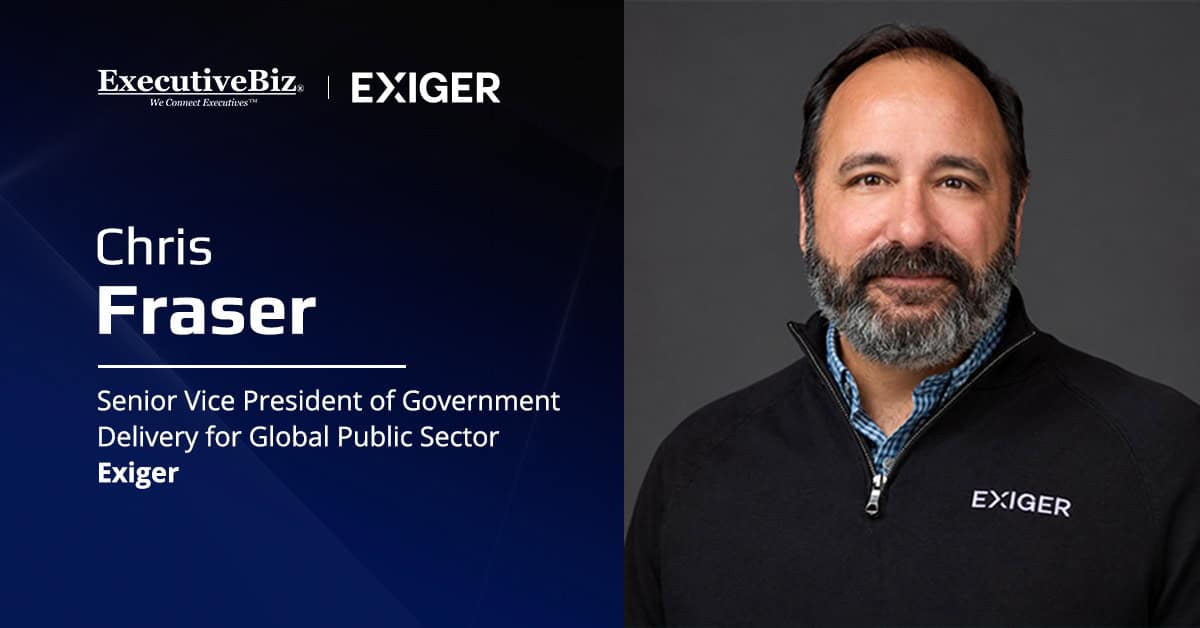
- Chris Fraser spent nearly 24 years in counterintelligence support to research and technology protection
- He now helps Exiger customers use supply chain intelligence across the full technology lifecycle
- Fraser sat down with ExecutiveBiz to talk trust in AI, agentic AI and supply chain risk
Chris Fraser revels in technological intelligence. Fraser, Exiger’s senior vice president of government delivery for global public sector, spent much of his nearly 24 year federal career in counterintelligence support to research and technology protection, culminating in a position as the Pentagon’s senior counterintelligence professional on a Secretary of War task force for critical technological protection.
He also served for a small agency that grew into the well-known Defense Counterintelligence and Security Agency, which conducts background investigations for the federal and contractor workforce and performs industrial security. Fraser’s final position before leaving the Pentagon was as the counterintelligence representative to the Protecting Critical Technology Task Force. He connected the direction set by the service secretaries and the chairman of the Joint Chiefs of Staff to the technologies the warfighter depended on, focusing protection efforts on the capabilities most critical to executing those strategies.
When evaluating post-federal career employment opportunities, Fraser wanted to move to a leading company in AI development and application that was moving fast in bringing capabilities to the government to enhance technology protection. He now leads government delivery at Exiger, helping customers use supply chain intelligence across the full technology lifecycle: from research and development through technology maturation, acquisition, fielding and sustainment. His focus is on giving customers the intelligence they need to identify risks, protect critical capabilities and make informed mission decisions.
Fraser sat down with ExecutiveBiz for his first Spotlight interview to discuss trust in AI for operational decision-making, creating unified views of supply chain risk, how federal agencies can better transition innovation pilots into sustained, enterprise-wide operations and which agentic AI applications still require human judgement and accountability.
Dive into real-time supply chain visibility at scale by attending the Potomac Officers Club’s 2026 Intel Summit on Sept. 24! Our Navigating the Foreign Entities of Concern Frontier panel discussion will provide unparalleled insight into tracing beneficial ownership through multi-tiered networks and the expanding FEOC regulatory perimeter. Network with top federal officials like:
- Rebecca McWhite, National Institute of Standards and Technology technical lead for cybersecurity supply chain risk management
- Rebecca Keiser, National Science Foundation chief of research security strategy and policy following the panel.
ExecutiveBiz: What separates an AI capability that performs well in a demonstration from one that government customers can trust, adopt and use in operational decision-making?
Chris Fraser: The biggest question is how fast can we deploy or implement an AI capability to enhance your day to day workflow and support supply chain resilience. We don’t demonstrate anything unless it’s specific to that customer: their mission, their challenges, and the problems they need us to solve. Even in a demonstration, we want to show customers how something we’ve built can be adapted to their needs and ultimately deployed in an operational environment.
Our platform gives customers an agentic workforce to help address their mission needs. A critical differentiator, especially in government, is that customers can trace the intelligence we deliver back to its sources and review the evidence supporting the findings.
We need to be clear about where every piece of information comes from—whether it’s a news article, a government source, or Exiger’s proprietary data. Customers should be able to trace what the agentic workforce tells them to the source. Government employees are understandably risk-averse, especially when investing in new technology, so we provide an auditable trail of information from source to insight.
That applies whether it’s an out-of-the-box demonstration or something we’ve curated specifically for a customer. We want to be able to say that on day one, a customer can get into the system and begin generating useful outputs, whether that’s risk insight on an entity or an assessment that informs an action package going to a secretary or other executive for an operational decision.
That’s what gives customers confidence in a capability: knowing it supports their mission and provides intelligence they can rely on to make decisions.
At the end of the day, we bring AI, software and expertise to our customers. There is nothing our customers have proposed to us that isn’t achievable. It’s the difference between a concept car at an auto show and a vehicle you can depend on every day. With our AI, we give our customers confidence that the capability will perform when real operational decisions depend on it.
EBiz: How can federal agencies combine government data, commercial risk intelligence and existing mission platforms to create a unified view of supply chain risk without replacing their entire technology ecosystem?
Fraser: A lot of this comes down to integration. We can integrate our services, data, and intelligence into a customer’s existing systems through application programming interfaces, even while they’re still defining the specific use cases. That enriches the information they already have, helping them strengthen their analysis and identify new ways to support their mission.
It starts with the data. Government agencies rely on their own data as an authoritative source, but that data can still be incomplete, inconsistent, or spread across systems.
Getting value from AI starts with understanding that data, addressing quality issues and adding the context needed to make it useful. If the underlying information is unreliable, those problems can carry into the analysis. We have to get the data foundation right if we expect AI to support operational decisions.
When we combine good government data with our commercial risk intelligence, it moves us beyond a traditional demo or a simple response to a customer’s stated pain points. It expands our understanding, as well as the customer’s, of what’s possible when you combine Exiger’s AI and insight with government data.
The speed at which we can do this today is phenomenal. Part of our value proposition is also helping customers improve data that isn’t particularly clean. Overlaying good commercial data on top of bad government data doesn’t solve the underlying problem.
But when you combine good government data with good commercial intelligence, and maintain clear source provenance, you can produce much stronger decision outputs.
This doesn’t require agencies to rip and replace their existing technology ecosystems. From a cost and capability perspective, we would prefer to have users in our platform, but there are cases where customers already have enterprise systems and data platforms Army Vantage and Space Force’s Warp Core.
In those cases, it may not make sense to invest in another enterprise front end. We can provide the services, capabilities and insights through API and data integration with forward deployed engineers and supply chain risk management expertise.
If a customer says, “I’m not buying your platform for the front end. I’m buying it for the services, capabilities and insight I can gain from it,” that’s fine—as long as they’re getting what they need from the technology.
You don’t have to rip and replace as long as you have a strong technology stack and a clear approach to integrating and deploying capabilities.
Turbocharge your IC business development at the Potomac Officers Club’s 2026 Intel Summit on Sept. 24! Find teaming opportunities with larger contractors seeking specialized capabilities for upcoming competitions. Skip the layers of gatekeepers and get in front of IC decision-makers like CIA Executive Director Dustin Gard-Weiss directly. Dozens of targeted conversations can generate more qualified leads than months of cold outreach. Secure your seat today for this essential GovCon event!
EBiz: Why do so many federal innovation pilots struggle to scale and what must government and industry leaders do differently to move successful capabilities into sustained, enterprise-wide operations?
Fraser: I’ve always been a strong proponent of other transaction authorities because I’ve always believed that speed is essential to how the government operates in the 21st century and it is how we outpace our adversaries.
OTAs provide a way to move outside the traditional acquisition lifecycle and get capability to the warfighter faster. Even if a technology takes a year or two to mature, we’re still moving faster because of what the U.S. innovation and industrial base can do from an idea-to-applied-capability perspective.
Where I’ve started to see challenges is that OTAs are now widely available and smaller organizations can make investments through them without necessarily having a pathway to turn those investments into programs of record. That’s the critical issue.
When an organization says, “I’m going to use an OTA to invest in this capability,” the next question should be, “How do I turn this into a program of record?”
You know it’s going to take more than a year or two to fully deploy or integrate a capability, train models, develop knowledge and maturity, and deliver the full value. You need to move it into a program of record so that there is funding in the out-years to sustain and expand it.
That’s where I think the OTA investment needs to be part of a larger, sustained approach.
I think back to my own experience as a government program manager and the use of end-of-year funding. If you received funding for a project, you knew the performance metrics you needed to achieve the following year. You knew when you needed to pursue additional funding to sustain the effort.
But you also knew you had to begin making the case to turn that effort into a program of record.
That’s about understanding all the gates that have to occur from both the government program manager’s perspective and the contractor’s perspective. Industry needs to help guide customers from an OTA to a sustainable program of record.
That’s where many pilots struggle. Unless there’s an extraordinary level of institutional support and funding behind a capability, organizations need to think from the beginning about how a pilot becomes a long-term program.
EBiz: Where is agentic AI delivering measurable value in defense and national security supply chains today, and which decisions still require human judgment and accountability?
Fraser: I’m a strong advocate for AI, but human judgment and accountability are nonnegotiable. AI can inform decisions and help us move faster. People still have to own those decisions and answer for the outcomes.
We want AI to help us analyze more information, faster. Customers need to be able to trace the findings back to the evidence and review the analysis, so they can make informed decisions and stand behind them.
If it previously took a week to develop an assessment, and AI can help produce it in hours, spending additional time confirming the sources is still time well invested. You’re accelerating the process while maintaining accountability.
Human judgment and accountability should always be somewhere in the loop. Where that loop exists will ultimately depend on the customer and mission, although we can provide recommendations on where human oversight should occur.
We’re seeing measurable value across current acquisition and research and development efforts. As AI becomes integrated into existing defense capabilities, it has the potential to drive significant value across all operation missions.
We’re at something of a transformative moment, similar to how the space program produced technologies that eventually benefited the broader commercial sector.
For Exiger, one area where we’ve seen significant measurable value is through what we call an AI prompt development lifecycle. We’re moving beyond the traditional software development lifecycle toward prompt versioning and evolution that can provide more immediate value to customers.
The models change and the application of models can change throughout different phases of a workflow. We might use a small language model, a large language model, reasoning capabilities or different combinations of those approaches.
That flexibility allows us to develop software at scale and address customer requirements in areas such as supply chain risk management and third-party risk management.
Another area where we’re seeing significant impact on the defense side is in providing customers with greater visibility into their sustainment supply chains.
The government invests enormous resources in sustaining multiyear and multidecade programs. Through supply chain intelligence, we’re able to give customers visibility into those supply chains and provide knowledge about risks they may not have previously had.
That’s where Exiger’s AI and expertise can deliver meaningful value: helping organizations move faster, see more and make better-informed decisions while ensuring that human judgment and accountability remain part of the process.