

 Pat Host
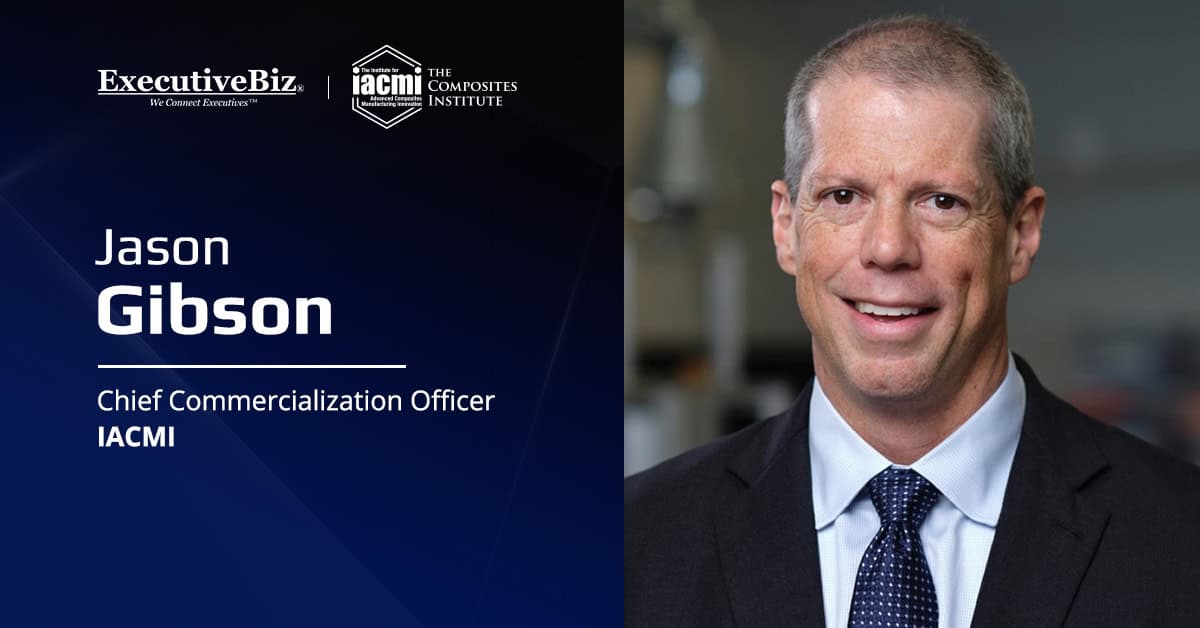
- Jason Gibson, IACMI CCO, wants to create a U.S. supply chain for silicon carbide
- It has greater structural rigidity, but is very expensive with little U.S. production capacity
- Gibson sat down with ExecutiveBiz to talk defense R&D and his silicon carbide effort
Many promising emerging technologies struggle to progress from research projects to production. Jason Gibson helps companies successfully cross that “valley of death.”
Gibson is chief commercialization officer at the Institute for Advanced Composites Manufacturing Innovation, or IACMI, a membership-based consortium funded by the departments of War and Energy. IACMI is tasked with driving advanced composite technologies from research toward real manufacturing applications.
Gibson is leading an effort to create a fully domestic supply chain for silicon carbide fiber, a critical component that is in high demand by the Pentagon for applications like hypersonic weapons as it can withstand extreme temperatures like 2,700 degrees Fahrenheit. The problem is that silicon carbide is expensive and there’s little capacity in the U.S., especially on the fiber aspect.
He has three pillars for this effort: create a domestic supply chain to reduce reliance on foreign precursors, lower its cost by roughly 80 to 90 percent and boost domestic production capacity tenfold. The goal is to open up the market for silicon fiber.
Gibson sat down with ExecutiveBiz for his first Spotlight interview to talk what the U.S. needs to do differently to get promising emerging technologies across the valley of death, the transferability of certifications for aerospace-certified thermoplastic composites to defense applications and why he’s excited about silicon carbide.
Discover the latest Pentagon initiatives to help breakthrough emerging technologies reach production by attending the Potomac Officers Club’s 2027 Defense R&D Summit on Feb. 4. The Department of War received $149 billion for R&D funding last year. Get actionable intelligence on how it plans to spend it at intriguing panel discussions on topics including Supply Chain Visibility, Critical Materials and Research Security and Engineering Assured Connectivity for the Contested Fight. Secure your seat today!
ExecutiveBiz: What exactly is silicon carbide technology?
Jason Gibson: Silicon carbide technology involves taking a pre-ceramic material and pyrolyzing it. In some applications, you also have to re-densify it.
One unique aspect of silicon carbide is that you can use silicon carbide fiber to reinforce it, which gives it much greater structural rigidity. However, it’s very expensive, and there’s not much production capacity in the U.S. today, especially when it comes to the fiber.
Because of our Carbon Fiber Technology Facility at Oak Ridge National Laboratory in Tennessee, we have the ability to produce silicon carbide fiber on a line like that with only minor modifications. It’s unique that we have the capacity to do that today.
We’re looking to launch a project to develop a precursor, optimize it for scalability, cost reduction and performance, and then prove it out at scale. That would help open up the market for these high-temperature applications.
There are nuclear applications, compressor blades for aircraft engines and energy generators, including turbines, as well as hypersonic applications.
EBiz: How does IACMI bring together government, industry, universities, and national labs to strengthen U.S. manufacturing and the defense industrial base?
Gibson: IACMI’s strength is its ability to connect the entire innovation ecosystem. We bring government priorities together with industry needs, university research, national lab capabilities and manufacturing infrastructure. That allows us to take promising technologies out of the lab, demonstrate them at meaningful scale and ultimately transition them into U.S. manufacturing.
For the defense industrial base, that means stronger domestic supply chains, faster technology adoption and more manufacturing capacity here at home.
EBiz: I heard you mention bridging technology readiness levels. Does that mean you’re the bridge across both sides of the valley of death, helping promising technologies get through it?
Gibson: Yes, we exist in that space in between. We look for new, innovative technologies and work collaboratively with our member organizations to understand where industry needs to pull those technologies through. Then we determine what testing and validation needs to be done for large manufacturers to gain confidence in them so they can implement them in their production environments.
Calling all GovCon technology leaders! The Potomac Officers Club’s 2027 Defense R&D Summit on Feb. 4 is the essential GovCon forum for professionals looking to boost their GovCon business in FY 2027. Engage with the decision-makers driving promising defense technologies, including elite federal officials, program leaders and industry executives who direct R&D investment and strategy. Spark collaborations with primes, integrators and nontraditional vendors to score that big contract. Build the partnerships that will fuel contracting success in the upcoming year. Sign up now!
EBiz: What does the U.S. need to do differently to get emerging technologies past the dreaded valley of death?
Gibson: We’re very good at funding early-stage research, but we need to put more emphasis on the middle: scaling up, demonstration, qualification and first adoption.
A technology isn’t successful just because it works in a laboratory. It’s successful when someone can manufacture it reliably, affordably, and at scale.
We need funding mechanisms and public-private partnerships that stay engaged long enough to get technologies through that transition and create a real commercial or defense market. Large manufacturers, whether in defense or traditional industry, don’t buy ideas. But they will invest in a new technology that has been validated at scale so that they’re comfortable using it in their own production environments.
EBiz: You’ve worked on aerospace-certified thermoplastic composites. How transferable is that certification pathway to defense platforms, and where does it get harder?
Gibson: That’s a good question. I think many of the fundamentals transfer very well, including material characterization, process control, repeatability, testing and establishing confidence in the manufacturing process.
Where defense becomes more challenging is that performance requirements can be very different and production volumes may be much lower. You can have exceptional material, but if qualification costs more than the potential program opportunity, adoption becomes difficult.
The challenge is creating qualification pathways that maintain the required rigor while making adoption faster and economically practical.
EBiz: Which emerging composite technology are you most excited about right now, and how close is it to real government deployment?
Gibson: One area I’m particularly excited about is advanced high-temperature materials, including the silicon carbide fiber project I mentioned, as well as carbon-carbon composites.
These materials are increasingly important for hypersonics, propulsion and other extreme-temperature defense applications, and the applications are real today. The bigger challenge is establishing the domestic supply chains, manufacturing capacity, and cost structure necessary to deploy them at a meaningful scale. That’s exactly the kind of problem where organizations like IACMI can help bridge the gap.