
 Jane Edwards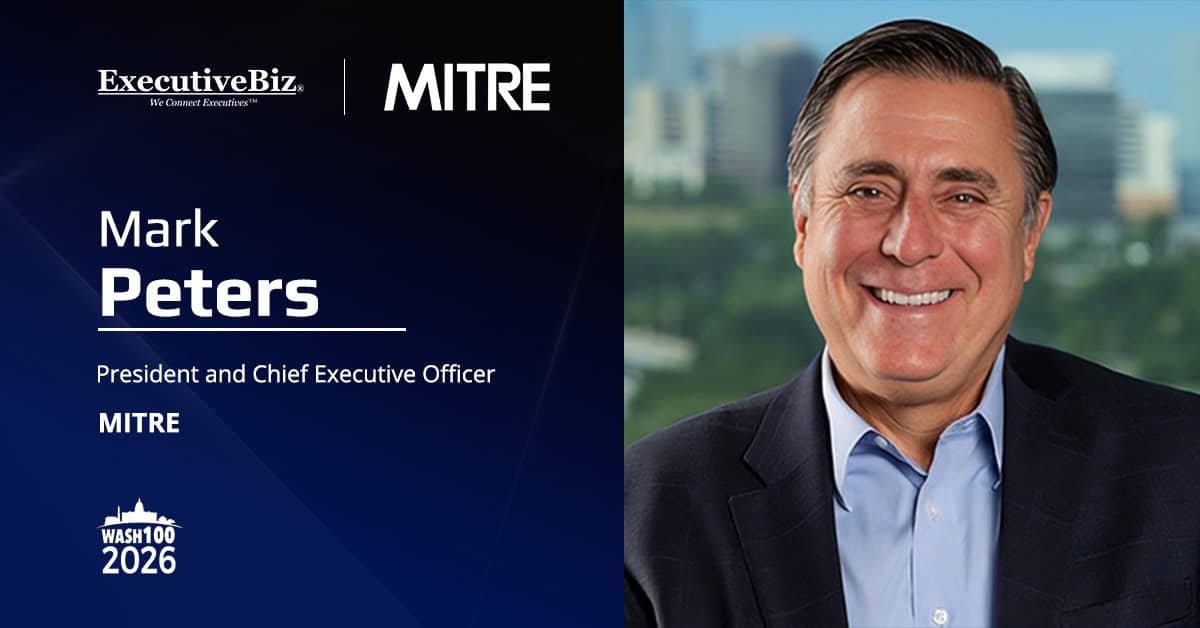
- MITRE CEO Mark Peters has said research institutions should be realigned around defined national problems
- Peters said FFRDCs and FROs should be connected to speed the shift from discovery to deployment
- The 2026 FedCiv Summit will explore AI, cloud and more
MITRE CEO Mark Peters said the U.S. should restructure how it approaches science and technology work, arguing that shared testbeds, interoperable platforms and other mechanisms should be organized around specific national problems rather than existing institutional boundaries.

The Potomac Officers Club’s 2026 FedCiv Summit will bring together government and industry leaders for discussions on AI adoption, data, cloud and compute infrastructure, cybersecurity and compliance-driven initiatives, and enterprisewide programs. Save a seat at the Oct. 29 event to hear more on the priorities shaping federal technology strategy.
In a LinkedIn post published Thursday, Peters made the case in response to the White House’s report, “Science: A New Golden Age,” which pushes for a faster, less bureaucratic approach to turning research into results.
How Can the US Get Discoveries Into the Field Faster?
Peters, a 2026 Wash100 Award winner, recommended that the government expand interoperable platforms, shared testbeds, trusted data environments and access to specialized research infrastructure. He also called for common technical standards and clearer pathways to carry discoveries through testing, demonstration and full-scale adoption.
He stated that each national mission should draw in whichever organizations are best equipped to handle the work, then assign measurable goals and clear ownership for turning results into deployed capabilities. The MITRE chief executive argued this mission-first structure would reduce the friction that currently causes promising technologies to stall between the lab and the field.
What Are Focused Research Organizations?
Peters explained that focused research organizations, or FROs, are temporary teams assembled to solve a single technical problem within a set timeframe. According to the official, FROs suit challenges that are too large or engineering-heavy for a university lab but not commercially attractive enough for private industry to fund on its own.
“They bring together professional scientists and engineers to produce broadly useful tools, platforms, datasets, or other research infrastructure,” he said of FROs.
Peters added that FROs typically form around one specific technical goal and operate for a fixed period, winding down once that goal is met. He said this sets them apart from institutions built to run on an ongoing basis.
What Role Should FFRDCs Play in This Shift?
The MITRE chief executive said federally funded research and development centers, or FFRDCs, are positioned to be the connective layer that links short-term technical fixes to long-term federal missions. He noted that because FFRDCs operate on a continuing basis, they can look ahead to future mission needs and build reusable capabilities before they are urgently required.
Peters added that FFRDCs are equipped to bring stakeholders together, manage the risks of adopting new technologies and bridge the gap between research, policy, procurement and operations.
How Should the US Put This Recommendation Into Action?
According to Peters, MITRE and other FFRDCs are already positioned to help carry out this shift by linking mission requirements to technical choices, testing new capabilities under realistic conditions, and supplying independent evidence to support adoption decisions. The official stressed that responsibility for this work does not rest with FFRDCs alone but extends to the broader American science and technology community.
Peters concluded that strengthening U.S. leadership in science and technology will depend on FFRDCs, universities, government and industry working toward the same goals rather than operating in separate lanes. He said the objective is not to build new institutions from scratch, but to link and adapt the ones already in place to meet the demands of a more competitive and technologically converged era.
In a recent Executive Spotlight interview, Peters said FFRDCs act as a national risk-reduction mechanism, absorbing uncertainty so that government and industry partners can make smarter, more confident investment decisions.