
 Pat Host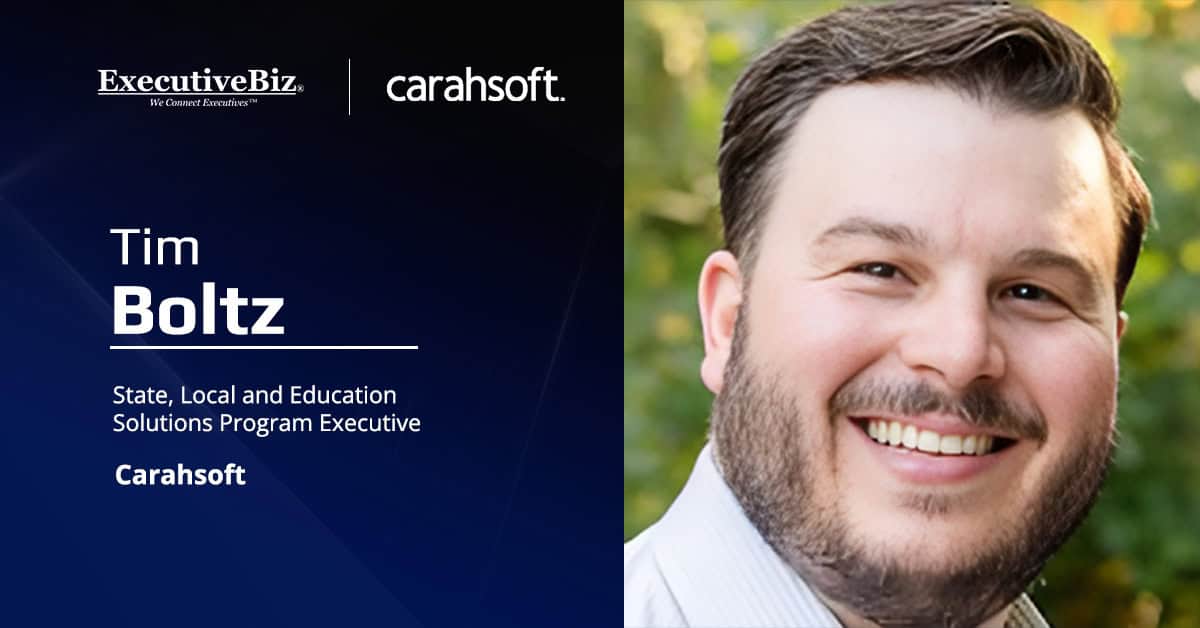
- Carahsoft’s Tim Boltz knows state and local governments are facing a perfect storm
- Federal funding is shifting and citizens are expecting better AI-powered responsiveness
- He sat down with EBiz to discuss how private cloud has become essential to AI readiness
State and local governments are facing a perfect storm. Budget pressures are mounting, federal funding is shifting and citizens are increasingly expecting the same AI-powered responsiveness from government that they get from their everyday apps. How agencies navigate that gap, and whether their infrastructure can support what’s coming, is the question Tim Boltz thinks about every day.
Boltz is the state, local and education solutions program executive for Carahsoft’s state and local distribution channel and one of the people helping agencies work through that challenge.
In this Spotlight interview, Boltz discusses where state and local IT stands today, how private cloud has become central to AI readiness and what it will take to modernize before the window closes.
Dig into the most essential AI topics in federal civilian contracting at the Potomac Officers Club’s 2026 FedCiv Summit on Oct. 29! Get actionable business intelligence on powering and scaling AI across the government; data, cloud and compute infrastructure and cybersecurity and compliance-driven initiatives. Hear exclusive investment insights from top federal officials and industry experts. Secure your seat today!
ExecutiveBiz: What are the biggest technology trends shaping state and local government IT decisions right now?
Tim Boltz: Simplification is the word I keep hearing. Agencies want to reduce complexity, standardize on platforms and get more value out of the infrastructure they already have, rather than continually adding new tools. The days of solving every problem by buying something new are over, budgets and workforces won’t support it.
EBiz: How does private cloud fit into that picture?
Boltz: The history here is instructive. Twenty years ago, agencies were drowning in physical servers: high costs, poor utilization and constant maintenance. VMware solved that through virtualization. Customers could consolidate what might have been 100 physical servers into 10, dramatically improving uptime for mission-critical applications and reducing costs. That value proposition helped VMware become the foundation for roughly 90 percent of private data centers.
Since acquiring VMware, Broadcom has invested heavily in extending that value proposition through VMware Cloud Foundation, or VCF, a fully-integrated private cloud platform. Before that acquisition, customers were dealing with numerous stock keeping units, complex licensing and technologies that were never fully integrated. Broadcom has now streamlined all of that into a true platform, one that securely delivers hyperscaler-like capabilities inside a private cloud environment.
Organizations who fully deploy VCF are simplifying their architecture, hardening their environments against AI-backed cyber threats using micro-segmentation and lowering their total cost of ownership.
EBiz: What kind of cost savings can agencies expect with private cloud?
Boltz: One of the biggest misconceptions is that private cloud costs more. However, we’re observing the opposite when customers fully deploy and optimize VCF.
In fact, we’ve seen IT operating costs reduced by as much as 40 percent compared to running comparable workloads in hyperscaler environments. A big part of that comes from simplifying infrastructure and making better use of existing resources.
As AI workloads continue to grow, infrastructure efficiency becomes even more important. Broadcom works closely with the major AI chip ecosystem, including NVIDIA, AMD, Intel and others, to help customers make better use of available compute resources. This matters because memory, particularly dynamic random access memory, a.k.a. DRAM, has become one of the biggest constraints on scaling AI Infrastructure.
VCF also helps customers optimize AI workloads by reducing token consumption through better graphics processing unit utilization. It also re-architects traditional three-tier storage with VMware’s vSAN hyperconverged storage software to make new storage investments more cost-effective.
Ultimately, it’s about getting more performance and value from the infrastructure they’ve already invested in.
Win more, and larger, federal civilian technology contracts in FY 2027 by attending the Potomac Officers Club’s 2026 FedCiv Summit on Oct. 29! Explore how federal civilian agencies like the Department of Transportation, the Department of Justice and others are executing workforce enablement and professional services, and cross-agency and enterprise-wide programs. Sign up now for this highly-anticipated GovCon event!
EBiz: Why is infrastructure readiness becoming such an important part of the AI conversation?
Boltz: Constituents are already using AI tools in their daily lives and will expect the same level of responsiveness from government services. But if state and local governments don’t get their infrastructure house in order, while maintaining compliance, governance and security in this new AI world, they won’t be able to deliver on service level agreements and application experiences that constituents expect.
EBiz: Why are private AI strategies gaining traction among state and local governments?
Boltz: Private AI matters because agencies want to use AI, but need to maintain control over their data, security and governance. Instead of relying on publicly available models, states, counties and cities can deploy large language models internally using only their own data, which is critical when you’re dealing with sensitive citizen information and complying with GovRAMP standards.
Governance is a major factor here. Congress has been slow to establish federal AI regulations, so states will, and must, move faster to protect their constituents. You’re going to see different AI laws in California, New York, and Texas; and IT teams need to be ready for that. Private AI gives agencies the ability to innovate within their own governance frameworks, rather than waiting on a federal standard that may not come.
EBiz: Where are you seeing the most promising opportunities for AI adoption in state and local government?
Boltz: Health care and human services are probably some of the most compelling right now. Federal funding shifts are placing greater financial responsibility on states for programs like Medicaid and Supplemental Nutrition Assistance Program, or SNAP, and AI is one of the most powerful tools agencies have to manage that pressure.
The Centers for Medicare and Medicaid Services are already asking states to demonstrate how they’re addressing socioeconomic determinants of health. AI can help prove it by analyzing large datasets to identify trends, improve outcomes and reduce waste, fraud, and abuse.
EBiz: How is Carahsoft helping agencies navigate this transition?
Boltz: Success in the state and local market requires more than technology. Agencies need procurement flexibility, training, technical expertise and ongoing support to fully adopt and operationalize new platforms.
We offer more than 300 contract vehicles and cooperative purchasing agreements that ensure agencies acquire technology quickly while following state purchasing guidelines. We’re also providing complimentary VMware training to help upskill existing staff on the VCF platform, which matters a lot right now given workforce shortages across the sector.
Part of that training covers how to fully deploy the platform and extend the life of existing hardware, which is important when hardware costs have risen 300 to 400 percent in some areas compared to 18 months ago and with chip and random-access memory, or RAM, shortages showing no immediate signs of easing.
We also spend a lot of time in the field helping agencies understand what’s happening across VMware, infrastructure modernization, AI and the broader technology landscape so they can make informed decisions about where they’re headed next.