
 Charles Lyons-Burt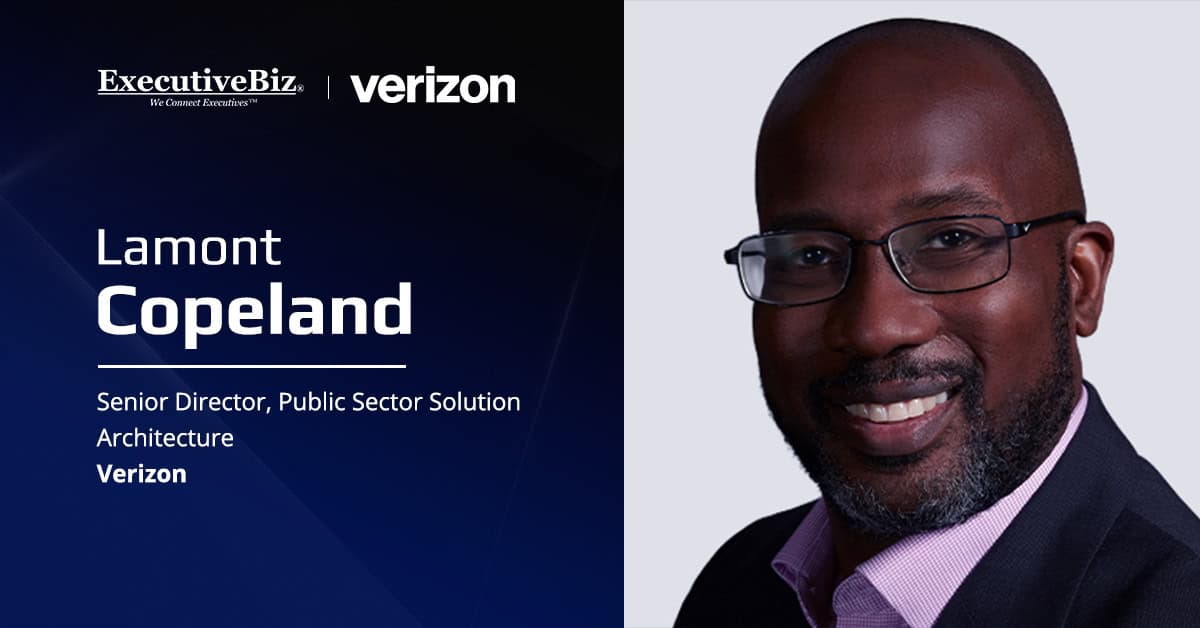
As senior director of public sector solution architecture at Verizon, Lamont Copeland leads teams supporting federal, state and local government customers with advanced networking, communications and technology solutions. During his 15-year tenure at Verizon and more than two decades serving the government market, he has helped advance the adoption of 5G-enabled capabilities across the federal government as well as other parts of the public sector, supporting efforts to integrate private networks, fixed wireless access and real-time connectivity into mission-critical government operations.
Recently, Copeland has been focused on developing network-driven solutions for drone detection, supply chain visibility and other emerging use cases while exploring how artificial intelligence, zero trust architectures and quantum-resistant security technologies can strengthen federal missions.
In this Executive Spotlight interview, Copeland discusses his perspectives on the networking, security and edge computing challenges associated with the Golden Dome initiative and explains how industry can help deliver the connectivity foundation needed for its success.

For an exclusive discussion on Golden Dome amongst air and space domain industry leaders, attend Potomac Officers Club’s 2026 Air and Space Summit on July 30. The all-day event will feature a dedicated panel on Golden Dome, as well as additional panels on AI/ML security, interoperable optical networks and commercial space relay, and keynotes from top USAF, USSF and NASA leadership. Register now!
ExecutiveBiz: We’ve heard a lot in the news about the military’s Golden Dome initiative. What are some of the challenges the military will be facing with respect to networking and communications support of the Golden Dome?
Lamont Copeland: As I see it, the Golden Dome will most likely rely on integrating a wide range of technologies, applications and hardware, but none of it works without a resilient network. As more data is processed at the edge to support split-second decisions, sensors, drones and detection systems will require secure, reliable connectivity at a high performance level.
Edge environments must also connect seamlessly to cloud infrastructure, where AI large language models can process large volumes of data before sending actionable intelligence back to the edge. Without that connectivity, the data can become disparate islands and could lose operational value.
One of the biggest challenges for the vision of the Golden Dome will be integrating these technologies into a unified architecture. It’s important to pair advanced engineering and mission systems with network services that provide secure, end-to-end communications and enable real-time decision-making across the entire ecosystem and help ensure we provide the government with the latest and greatest and the best and brightest of solutions from an engineering and technology standpoint.
EBiz: What is edge computing and how could it contribute to Golden Dome?
Copeland: Edge computing moves computing resources closer to where missions take place instead of relying solely on centralized cloud data centers. Whether supporting operations at a military installation, in an urban environment or in the field, edge infrastructure allows applications to process data where it is generated.
That capability is critical for drones, sensors, robotics and autonomous systems because information can be transmitted, analyzed and acted on in near-real time without returning to a central location. Smaller edge computing platforms can receive data from these assets, process it locally and quickly distribute actionable information to operators or other systems.
When greater computing power is required, edge environments connect back to cloud instances to help leverage additional compute resources while maintaining continuous operations. By bringing computing closer to the mission, organizations can reduce latency, improve responsiveness and enable faster operational decisions.
EBiz: Tell us ways that data transport is vital to Dome success
Copeland: Data transport begins with understanding each application’s requirements and how it uses network and cloud resources. Just as important is knowing whether the information supports human decision-makers or automated systems because both depend on reliable, high-performance communications. It’s critical that we have the interconnectivity and the understanding of expectations for an application and the end outcomes that we’re looking for.
That data communication pathway is there from a performance standpoint. If you want to get the best efficiency from your wireless solution, you have to tie that application to the available network resources. Capabilities such as network slicing, APIs and on-demand network and cloud resources allow organizations to dynamically scale performance based on mission requirements.
EBiz: How would you suggest securing the austere edges of Golden Dome from a connectivity standpoint?
Copeland: Securing austere edge environments requires a layered defense strategy. Organizations must first understand the assets, applications and users operating at the edge because you can’t protect what you don’t know.
Overall security is equally important. Network slicing, VPNs, encryption and emerging technologies such as post-quantum cryptography work together to protect data as it moves across the network. When these capabilities are integrated, they can create a secure, resilient ecosystem that supports both mission performance and rapid decision-making. These features, layered together, provide one harmonious ecosystem of outcomes that we’re looking for.
Technologies such as VPNs, encryption and identity-based access controls help secure communications across devices, applications and facilities. Encryption can be applied at both the network and application levels to provide end-to-end protection as data moves across the infrastructure.
Success also depends on close collaboration across the technology ecosystem. Application, hardware, network and cloud providers must work together to deliver integrated solutions that meet the government’s security, performance and operational requirements. The government is looking at how all vendors together bring the best of their individual capabilities integrated together to meet expectations.
That level of integration is essential to achieving the objectives of the Golden Dome initiative.
The Golden Dome Part Two: From Prototype to Production – Scaling Integrated Defense at Speed panel at the 2026 Air and Space Summit will build upon a discussion started at last year’s event, with representatives from Exiger, OMNI, Vantor and more sharing their strategies for winning business in this highly competitive project.
EBiz: How important is wireless connectivity and edge compute to Golden Dome?
Copeland: Wireless connectivity will be fundamental to Golden Dome because many mission assets will operate beyond the reach of traditional fiber infrastructure. While fiber remains essential for transporting large volumes of data and supporting AI processing in centralized cloud environments, wireless and satellite networks will also be critical for connecting edge sensors, drones and other mission systems operating in distributed environments.
Those systems continuously generate data, from drone telemetry and GPS coordinates to sensor readings and situational awareness information, that must be transmitted securely and with low latency so operators or automated systems can make immediate decisions. High-performance wireless networks provide that connectivity while linking edge assets to cloud environments where AI can process larger datasets and deliver actionable intelligence back to the field.
This capability also supports emerging mission applications beyond Golden Dome, including drone detection and remote operations where wired infrastructure is impractical (to name a few). Securing those communications requires layered protections, including network segmentation, encryption and zero trust principles, to ensure information moves safely between the edge, the network and the cloud while maintaining real-time mission performance.
EBiz: What are ways that Verizon, and industry, can best assist in making the Golden Dome initiative a success?
Copeland: Industry’s greatest contribution is helping the government integrate the best and breadth of what we all have into a unified ecosystem. Every company brings unique capabilities, whether equipment, networking, cloud, security or applications, but success depends on making those technologies work together.
That collaboration extends beyond technology. Industry partners should help the government understand the infrastructure, operational processes and integration requirements needed to support mission outcomes. Individual solutions may solve a specific problem, but they must also fit into the broader architecture.
Success will require collaboration among application developers, hardware providers, network operators and cloud vendors, as well as acquisition strategies that enable those technologies to be deployed effectively.
By working together early, industry can help deliver secure, interoperable capabilities that support the long-term success of the Golden Dome initiative.