
 Pat Host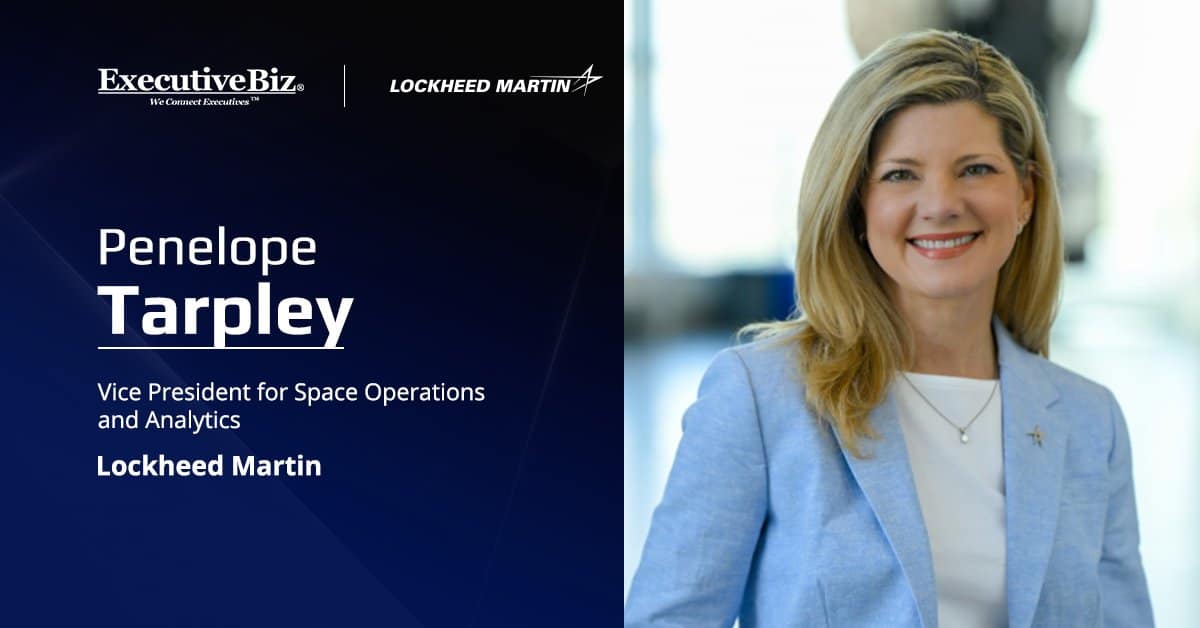
- Penelope Tarpley, VP for space operations and analytics at Lockheed Martin, has spent 30 years at the firm because it allowed her to grow as both a leader and parent.
- Tarpley is leading a major initiative to retool how LM applies AI and automation to deliver greater mission impact for its customers.
- She sat down with ExecutiveBiz to talk agentic AI, talent development and retention, and emerging cyber technologies.
It’s no accident Penelope Tarpley has spent most of her 30 year career at Lockheed Martin. The company vice president for space operations and analytics attributed her stellar career at the world’s largest contractor by defense revenue to it allowing her to grow both as a leader and parent.
Tarpley has had the opportunity to support missions that protect lives, strengthen national security and give its customers confidence in some of the most challenging environments. These include working on high-profile programs like the Terminal High Altitude Area Defense, or THAAD, missile defense system. Lockheed Martin has also given her the chance to deliver for the mission, grow as a leader and show her two children what it means to serve something bigger than yourself.
Tarpley is leading a major initiative in how Lockheed Martin applies AI and automation to increase speed, improve decision-making and deliver greater mission impact for its customers. Over the past year, Lockheed Martin operations teams have driven a significant increase in AI and machine learning projects across areas such as integration AI solutions, code enhancement, documentation and training, and process automation.
Critical to Tarpley is that Lockheed Martin approaches AI responsibly. The goal, she said, is not to replace people, but empower them, as AI and automation should enhance their expertise and help them focus on higher value work.
Tarpley sat down for her first Spotlight interview to discuss how agentic AI is enhancing mission outcomes, how Lockheed Martin identifies, evaluates and integrates non-traditional companies into its space, cyber and launch services portfolio; which cyber technologies are delivering the most value for customers and how the company attracts, retains and develops talent to ensure customers receive actionable mission-critical capabilities.
The Potomac Officers Club’s Summer Service Series of military-focused GovCon events is in full swing! Dive into advanced Army technology business opportunities at the 2026 Army Summit this Thursday, June 18; discover the latest investment priorities in space systems at the 2026 Air and Space Summit on July 30 and wrap up your summer with Acting Navy Secretary Hung Cao’s keynote at the 2026 Navy Summit on Aug. 27. Boost your GovCon success with the Potomac Officers Club this summer. Buy your tickets today!
ExecutiveBiz: How is AI—particularly agentic AI, machine learning and automation—enhancing mission outcomes and operational efficiency for your warfighter and intelligence customers?
Penelope Tarpley: AI, machine learning and automation are helping us change the pace and scale of complex mission work, but I also think it is important to be precise about how we talk about it.
I once heard someone say they don’t like the term “AI” because too often it can sound like we are just sprinkling AI dust on a problem. I think that is exactly the right caution. The goal is not to label everything AI. The goal is to understand the mission workflow, identify where data, automation or advanced analytics can create real value, and then apply the right tool with discipline.
For our warfighter and intelligence customers, the challenge is not just having more data. It is being able to process, prioritize and act on that information quickly enough to stay ahead. AI, machine learning and automation can help reduce decision timelines, identify anomalies earlier, streamline workflows and create more consistent execution across dynamic mission environments.
A good example is predictive insight. In one of our mission operations use cases, AI/ML was applied to historical system data to identify early warning signs that a critical mission planning and scheduling application could be at risk of crashing. That kind of insight is difficult to detect manually, but by using machine learning to recognize patterns and trigger automated alerts, crews can take action earlier and help prevent mission impact.
That is where these tools become meaningful. They are not replacing the operator or the mission expert. They are helping surface the right information sooner, reduce manual burden and give our teams more time to focus on the decisions that require human judgment, technical expertise and customer understanding.
The key is starting with the mission need, not the buzzword.
EBiz: How does your organization identify, evaluate and integrate non‑traditional companies into your space operations, cyber and launch services portfolio?
Tarpley: Bringing startups and non-traditional partners into the defense industrial base is critical. Our customers’ challenges are moving too quickly and the threat environment is changing too rapidly for any one company to solve alone. We need a big-tent approach that brings together traditional defense, commercial innovation, small business and specialized mission partners.
For us, it starts with the mission need. We look at where our customers are facing complexity across space operations, cyber, intelligence, data integration, launch services and mission support. Then we identify partners or technologies that can help close a gap, accelerate an outcome or bring new capability forward faster.
But identifying partners is only the first step. The real work is building relationships early, before a request for proposal is released or a program is already defined. That gives us time to understand each other’s capabilities, align around common objectives and determine how we can bring the best of each organization together in a way that serves the customer.
We do that through several pathways. Lockheed Martin Ventures is one example. Since2007, Ventures has invested in startups aligned to critical technology areas and now has more than 70 active portfolio companies. About one-third have become Lockheed Martin suppliers, which shows we are not just watching innovation from the outside, we are finding ways to integrate it into the mission.
We also work directly with small businesses, commercial companies and specialized mission partners through subcontracting, joint demonstrations, internal research and development investments and supplier engagement. For example, we recently brought more than 120 suppliers together at our own investment because we believe speed to mission is built through trust, shared understanding and relationships that exist before the customer asks for a formal response.
Zeta Associates is another strong example of specialized expertise strengthening the broader Lockheed Martin portfolio. As a wholly-owned subsidiary, Zeta brings deep mission knowledge in signals intelligence and special communications, helping us deliver more integrated and customer-relevant solutions across complex mission environments.
Ultimately, the goal is not always for Lockheed Martin to lead every piece. It is to bring the right team together, partner where others have the best capability and help turn promising ideas into secure, mission-ready solutions our customers can use.
Are you a GovCon technology executive? You cannot miss the Potomac Officers Club’s 2026 Air and Space Summit on July 30. Explore partnership opportunities during an illuminating keynote by Air Force Vice Chief of Staff Gen. John Lamontagne. Dig into how optical space communications will transform space systems at the Commercial Space Relay panel discussion, featuring Greg Heckler, NASA program executive for commercialization at the Space Communication and Navigation Program, or SCaN. Sign up now!
EBiz: In the rapidly evolving cybersecurity landscape, which technologies are delivering the most value for your customers and where are the gaps you must still close?
Tarpley: In our environment, cyber is much broader than compliance or protecting enterprise networks. We support customers across offensive cyber, defensive cyber and network operations, so the focus is on capabilities that help them understand the environment, act faster and stay ahead of evolving threats.
The technologies delivering the most value are the ones that improve speed, visibility and decision advantage. That includes autonomous threat hunting, machine learning-enabled anomaly detection, zero trust automation, and cyber analytics and tools that help teams identify patterns or vulnerabilities before they become operational risks.
What is important is that these technologies are connected to the mission. Defensive cyber is about actively detecting and stopping attacks. Network operations focus on protecting and accrediting the systems our customers depend on. Offensive cyber can include both delivering effects against adversary systems and using cyber techniques to gather intelligence. Our programs are involved in, or affected by, all of these areas.
The gaps are less about whether technology exists and more about integration, scale and trust. Customers need tools that can work across complex legacy and modern systems, reduce false positives and give operators enough context to act with confidence.
For me, the focus is on making cyber more proactive and mission connected. It is not just about defending networks; it is about protecting the mission those networks enable.
EBiz: Talent is the engine that drives successful mission outcomes for your customers. How does your organization attract, retain and develop the people—engineers, analysts, program managers and specialists—you need to ensure customers receive timely, actionable mission‑critical capabilities?
Tarpley: People want to know their work matters, and our mission gives them that. Our teams often work side by side with customers, on their sites, solving real mission challenges in real time. That proximity gives our engineers, analysts, program managers and specialists a deep understanding of the mission and how their work directly supports the customer.
Attracting and retaining talent starts with that sense of purpose, but we also have to be intentional about building the pipeline. We are strengthening relationships with universities and academic partners to help develop the next generation of engineers, analysts, cyber professionals and mission specialists.
Once people join our teams, we focus on giving them the tools, mentorship and opportunities to grow. That includes creating space for technical development, leadership growth and cross-functional experience across engineering, analytics, cyber, operations and program execution.
We are also changing how we do operations by moving “brains in seats” toward the harder problems. By using automation, analytics and smarter workflows to reduce manual burden, our people can focus more of their time on the work that requires judgment, creativity and mission understanding.
That shift helps our customers and our people. When employees are close to the mission and empowered to solve complex problems, they grow faster, contribute at a higher level and see the impact of their work more clearly.
For me, talent development is personal. I feel a responsibility to help shepherd the next generation of leaders and technical experts so they are ready to carry these missions forward.