
 Gabriella DeCesare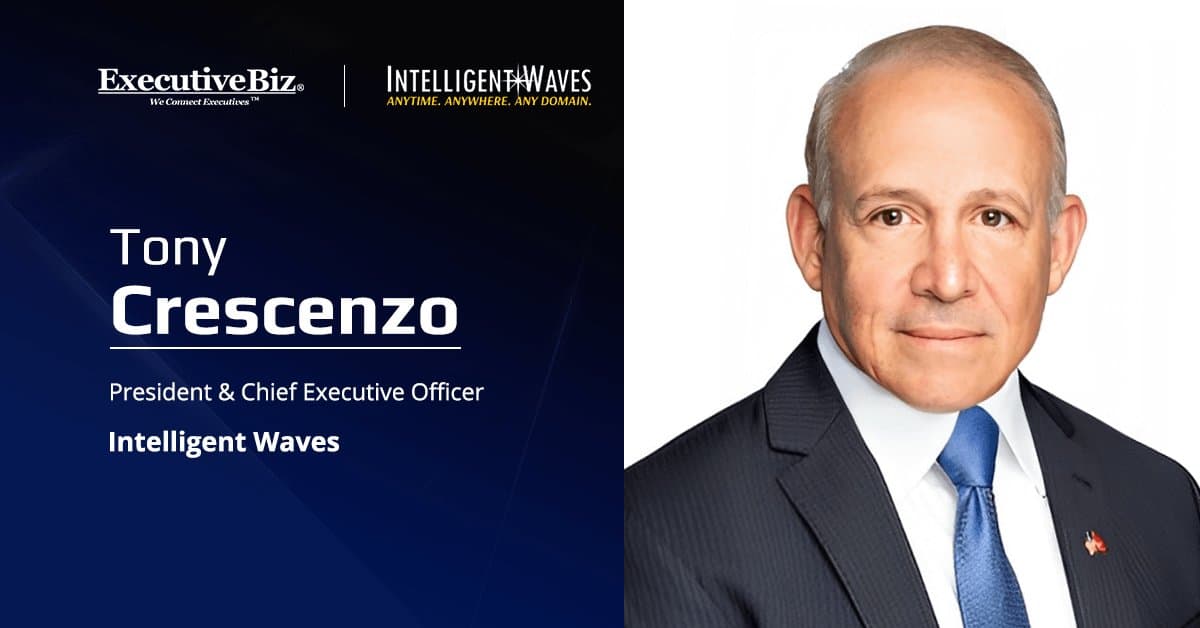
In contested environments where communications can be intercepted, spoofed or cut off entirely, maintaining decision advantage is a survival imperative. Intelligent Waves CEO Tony Crescenzo says the future fight will hinge on an operator’s ability to preserve trusted information flows and act with clarity under pressure, even as adversaries target the very networks and data streams that enable modern warfare.
Crescenzo sat down for an interview with ExecutiveBiz ahead of Intelligent Wave’s 2026 SOF Week Exhibit in May to outline how the company is rethinking secure communications, data integrity and cognitive resilience as a unified mission set. From secure and obfuscating communications platforms like GRAYPATH, Phantom, DeNet and EPCE, to AI-driven tools that protect both data and decision-making, like Peak Neuro and STRIKE, Intelligent Waves is developing technologies designed to help operators maintain coordination, trust and tempo in degraded or denied environments, where seconds matter, and uncertainty can be exploited.
ExecutiveBiz: Intelligent Waves emphasized ‘decision advantage’ as the central goal of your SOF Week 2026 exhibit. In a contested edge environment where communications are constantly being degraded, how does Intelligent Waves define that advantage for a special operator who might be isolated or under heavy electronic interference?
Tony Crescenzo: We define that as the ability for an operator and commanders to maintain clarity, coordination, and confident action in a contested or degraded environment. When you think about China’s doctrine of intelligentized warfare, their goal is to attack from an OODA loop standpoint—Observe, Orient, Decide, Act—their first attack surface is the perceptual plane. That includes radio frequency, spectrum, electromagnetics, satcom and networks, so they are essentially isolating the electronic interference.
For us, it means preserving the trusted information flows to avoid hesitation, ambiguity or a loss of tempo, essentially. Adversaries win by eroding trust in the data by creating ambiguity in the decision maker’s mind. Time is everything in a contested environment. So what we really look at there is the ability to maintain the clarity, coordination and communication in those degraded, denied and contested environments.
ExecutiveBiz: You’ve mentioned that Intelligent Waves is moving away from treating communications, data trust, and coordination as separate problems. Can you walk us through how your products like GRAYPATH and Phantom converge at the tactical edge to provide a single, unified solution rather than a suite of individual tools?
Crescenzo: In terms of communication, resilience, data protection and coordination into unified capabilities, one of the challenges that we have is that typically we don’t fight alone; we’re almost always in a coalition. That coalition requires multiple levels of, not just security, but of communication masking for different levels of access for our coalition partners.
The way we integrate that is through GRAYPATH, which provides robust, quantum-resistant, non-attributable, survivable, expeditionary communications in degraded environments and DDIL, Denied, Disrupted, Intermittent and Low-bandwidth, conditions, with a low probability of intercept and detection.
Phantom provides secure, obfuscated access via a cloud, virtual desktop or virtual mobile device to protect the identity and methods we use without exposing the operator’s identity or location.
For example, during the COVID pandemic, we had OSINT and HUMINT operators using social media to identify, manipulate and obtain sources. When you’re using social media, you can’t access it overseas, and if you haven’t used a platform for a while, it will prompt you to verify with a phone number. When you verify with a phone number, of course, the cell tower doesn’t ping the country that you claim to be in. GRAYPATH and Phantom allow us to locate a cell phone anywhere in the world, including the ability to ping a cell tower in that country. If you’re an operator sitting in your home in Reston, Virginia doing OSINT unit communications and you need to appear as if you’re in Poland, we can literally do the two-factor authentication and ping a cell tower that fits in Poland.
Another example—right now, Ukrainians are learning how to fight on a shoestring budget. There are times when we, as a coalition partner, need to provide actionable intelligence to a Ukrainian commander in the field, and oftentimes, we do that with a cell phone call because there is no other way to achieve that communication. The Russians have been able to geolocate the cell phone of the receiver, then that Ukrainian commander goes to the very top of the kill chain and the Ukrainians have experienced some losses in senior leadership because of that.
Using technologies like GRAYPATH and Phantom allows us to not only obfuscate the location of that cell phone, but to make that cell phone appear as if it’s in Moscow. That type of communication, along with masking technology, where we can actually mask the operator’s voice so the adversary can’t identify who is on that call, makes it a very low probability of interception detection and protects the identity of the receiver so they can survive to fight another day.
ExecutiveBiz: One of the more unique highlights in your press release is Peak Neuro. While much of the industry focuses on hardening hardware, it sounds like you’re focusing on hardening the operator’s cognitive resilience. How does AI-powered neuroscience fit into the traditional tactical communications landscape?
Crescenzo: When we think about the intelligentized warfare that our adversaries are espousing, degrading the commander’s ability to understand what’s happening is step one in China’s approach to this fight. Step two is, using their words, “to create multiple simultaneous cognitive challenges in the minds of decision-makers.” In other words, flooding their ability to proceed and understand what’s happening, slowing their ability to make decisions.
What happens when you get narrative flooding, the technical term for it, is that it overwhelms the brain’s prefrontal cortex—the part of your brain that is involved in cognition, decision making and logic evaluation. When you’re in a fight, if you’re down ranger or you’re sitting in headquarters and you have a hundred different things going on, when the emotional flooding happens, your amygdala—that’s your fight or flight response—when that lights up, it shuts down your ability to make decisions. It literally prevents the brain from even being able to engage in cognition.
Peak Neuro is a neuromodulation technology that builds resilience before the fight into the neurophysiological baseline for operators and decision makers, which allows you to keep your cognition online despite high emotional flooding, high strain, high stress and high physiological stress as well.
Peak Neuro can train that over the course of about 30 days, with about an hour a day’s worth of the entrainment technology. We’re working with a retired Navy SEAL and retired Delta Force Sergeant Major, who have been through the program and will be at SOF Week 2026, May 18-21, to discuss their results, along with the former Deputy Commander of Marine Special Operations, or MARSOC, Col. Scott Conway, who has also been exposed to the technology.
What Peak Neuro really allows you to do is train your cognition to stay online when the adversary degrades perception, creates ambiguity and floods you with multiple simultaneous cognitive challenges.
ExecutiveBiz: The release notes that adversaries don’t need to take down a network to win; they just need to undermine trust in the data. How do the DeNet, EPCE and STRIKE capabilities specifically ensure that a commander knows the data they are seeing on their screen hasn’t been spoofed or manipulated by an adversary?
Crescenzo: Think of DeNet as a static, permanent solution to multi-layer communication among a coalition. DeNet allows you to mix different classifications, communications and networks into a single integrated network. For example, when the United States shares information internally with our intra-service communications, that is, we want to make intelligence available to the Army, Navy, Air Force, Marines and Guardians, that’s one level of communication inside the wire; the next level would be to our five edge partners, then to our NATO partners, for example, and each one of those classification levels gets masked.
When we’re sharing information that is not foreign—foreigners can’t see it—DeNet allows that information to move across different classifications throughout the entire network permanently. It’s a permanent information-sharing environment where multiple classifications and masking enable us to communicate and make decisions quickly and accurately among coalition partners.
EPCE is an ephemeral version of DeNet. It allows you to quickly, in a matter of hours, bring up an ephemeral, mission-based coalition network. For example, if I decide on this mission, I need the Italians, the Australians, the Canadians and the United States, then the Japanese get added later, you can add them with the stroke of a key. If the Italians drop off that mission, we can take them out again with the stroke of a key. There are two reasons to do that: security and economics.
For example, when we want to put a mission together—think of a multinational coalition—we historically do not have a permanent network in place for that. What we’ve been doing for the last 20 years is obtaining a bunch of gear, wiring it all together, putting a network together and placing it all in a warehouse until we have a mission to assign to it; at that point, it takes three months to get all of the upgrades into the gear. It’s also very expensive to buy, store and maintain that gear.
EPCE is an ephemeral network that can rise and fall, adapting to mission-tactical operations. This is valuable from an operator’s standpoint because operators, especially in the operations community, don’t like to spend more than a couple of hours on target. So the vast majority of time spent in the operations community is on practicing for the actual event; the actual event often takes less than a day. To get that practice in place, to do all of the pre-exercise and pre-operational planning, exercises and practice, you need to have that network up and running well in advance of the actual operational execution.
STRIKE stands for sensor, telemetry, re-analysis, integration and kinetic enhancement. The F-35 is our fifth-generation stealth fighter, which is an absolute vacuum cleaner for geospatial and electronic signal information. While some of that information can be identified in the aircraft, much of it has to be understood and identified outside of it, and for the F-35, that used to require a $20 million device, an entire weapons bay and would take upwards of two months. Once that aircraft landed, we would get the data, analyze it, identify what the anomalous signatures are, then repurpose that, package it up and put it on every aircraft that has to fly over that area.
Intelligent Waves literally took that capability and reduced that $20 million-a-throw device to a $160,000 lunchbox that sits inside the landing gear bay of an F-35. We can now turn around the information the aircraft picks up in a combat environment in hours, rather than weeks or months. This allows us to reprogram every platform, whether that’s an F35, a truck, an LAR or an infantry vehicle with updated information, so when they get to a particular location they know that everything we’ve identified has been processed through an AI backend, validated and repurposed into software that’s available for the operator on the ground, contemporaneous with the need to actually know what’s happening.
What you see there is the sort of re-analysis, rapid verification and data integrity at the tactical edge. When you combine that with GRAYPATH’s resilient transport and obfuscation, the capabilities provide a layered assurance so commanders can trust the data displayed, that it hasn’t been spoofed or manipulated, and turns what could be an ambiguous or doubtful common operating picture into actionable insight. We do this at mission tempo, not at technical or acquisition tempo.
ExecutiveBiz: Looking at the lineup of technologies you’re bringing to the special operations community, from LiFi to Cognitive Human Performance, what is the one bottom-line message you want the Special Operations Command, or USSOCOM, leadership to take away.
Crescenzo: I think the real answer for that is—and I have to say it’s actually in an article I read not too long ago called, Why Data Superiority is the Cornerstone of DOW’s Digital Transformation Strategy—the whole issue isn’t just validating data, identifying data or being able to trust data. It all has to happen at mission tempo in a tactical environment. That is a flash-to-bang innovation requirement. The bad news is we’re always sort of preparing to fight the last war, but the next war is never like the last war. The victory in the special operations community goes to the most adaptable—the ability to adapt in real time is what these technologies essentially allow us to do. What matters is what the future battle looks like, and how quickly we can adapt our communications infrastructure, our data transport infrastructure and our security infrastructure to provide that data to operators in real time. That’s where Intelligent Waves sits in the ecosystem.