
 Gabriella DeCesare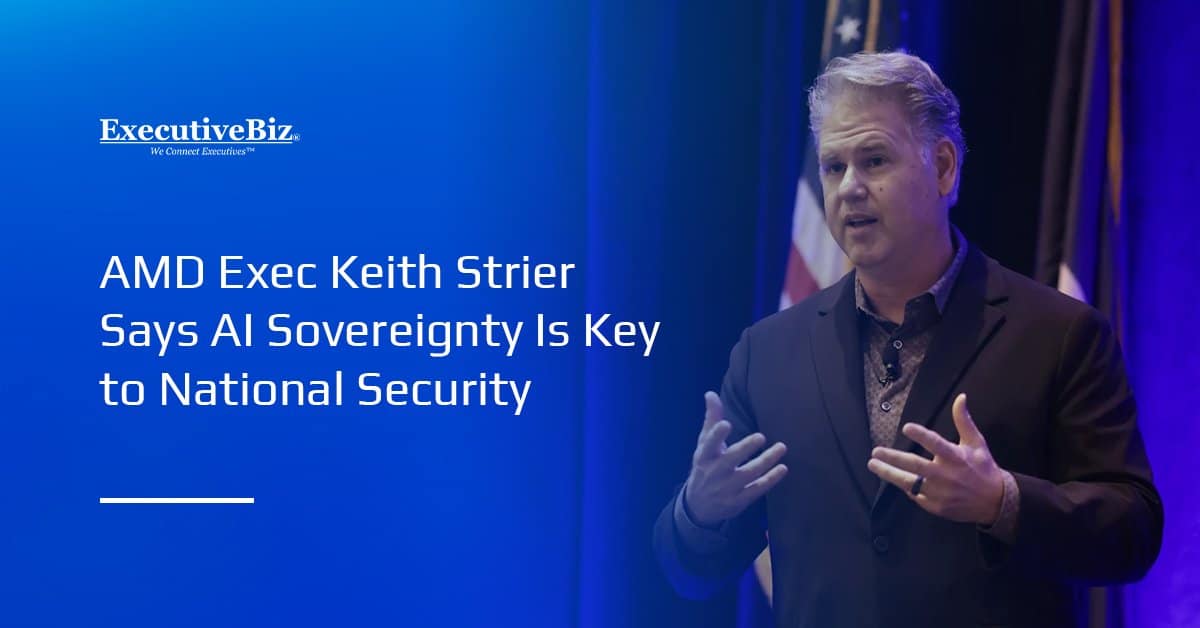
As artificial intelligence becomes central to national priorities, countries must invest in AI and data infrastructure built on open architectures and diverse semiconductor ecosystems, AMD Global AI Public Sector Leader Keith Strier said at the GovCon Executive Leadership Summit. A global adviser to governments on sovereign artificial intelligence strategy, Strier emphasized that nations must rapidly build resilient AI infrastructure to remain competitive in national security, science and economic development.
 For GovCon leaders looking to dive deeper into the issues Strier raised, the 2026 Digital Transformation Summit on April 22 will further explore the policy, infrastructure and technology considerations shaping the future of AI in government. The event will bring together federal CIOs, industry executives and technology experts to discuss scaling AI capabilities and strengthening data and AI infrastructure to support mission outcomes. Register here!
How Does AI Shape the Future of National Security?
Strier, who has spent years advising governments on the intersection of AI policy and infrastructure, said the global conversation around artificial intelligence has evolved dramatically over the past decade. What began primarily as a policy discussion has increasingly become an issue of national sovereignty, he explained.
According to Strier, all of the world’s supercomputing capability is concentrated in just 34 countries — a reality that has significant implications for global power dynamics.
“That’s when AI went from a matter of policy to a matter of sovereignty,” Strier said. He told GovCon leaders that computing capacity will play a central role in the future of national security, defense and intelligence operations.
The accelerating pace of scientific discovery enabled by AI-driven computing is already reshaping research timelines across sectors, he said.
“The ability to compress the discovery cycle — from 20 years to two years, from 18 months to 18 days — is profound.” He described AI for science as one of the most transformative applications of advanced computing because it dramatically compresses discovery cycles.
Because of this acceleration, governments and industry alike must commit to building the computational infrastructure needed to support AI-driven innovation.
How Can Silicon Diversity and Open Architecture Ensure Resilience?
A central theme of Strier’s keynote was the importance of “silicon diversity” — ensuring that AI ecosystems are not dependent on a single technology provider or architecture.
“You do not want to lock in your future to one platform,” he said. “That is not a resilient thing to do.”
As governments and enterprises deploy large-scale AI systems, Strier said a diverse ecosystem of suppliers, chip architectures and computing platforms will be essential for resilience and long-term scalability.
He also highlighted the role of open architecture approaches, including open AI factory models that allow organizations to integrate multiple technologies and avoid rigid platform dependencies.
“Diversity of ecosystem matters — in suppliers, in systems and in the broader technology stack,” Strier said.
He added that the rapid growth of AI workloads means simply building more data centers will not be enough to meet future demand. Instead, organizations must rethink how computing infrastructure is designed, integrated and scaled.
Nation-Scale Infrastructure Ahead
Looking ahead, Strier predicted an unprecedented expansion of computing capacity as governments and industry race to deploy advanced AI systems.
“We’re looking at 10,000 times more compute capacity than we have today,” he said.
Meeting that demand will require nation-scale infrastructure investments that go beyond computing hardware to include energy systems capable of supporting large AI facilities, he added.
Strier ended by urging government and industry leaders to recognize the strategic stakes of AI infrastructure and act quickly to build resilient, scalable ecosystems.
His remarks concluded the summit on a forward-looking note, highlighting both the opportunities and risks associated with the rapid evolution of AI-driven computing.
Readers interested in exploring these themes further can learn more at the Potomac Officers Club’s upcoming 2026 Digital Transformation Summit on April 22. The event will convene government and industry leaders to discuss integrating AI, policy developments and strategies for building the infrastructure needed to support next-generation digital capabilities across the federal landscape. Reserve your seat today!