
 Pat Host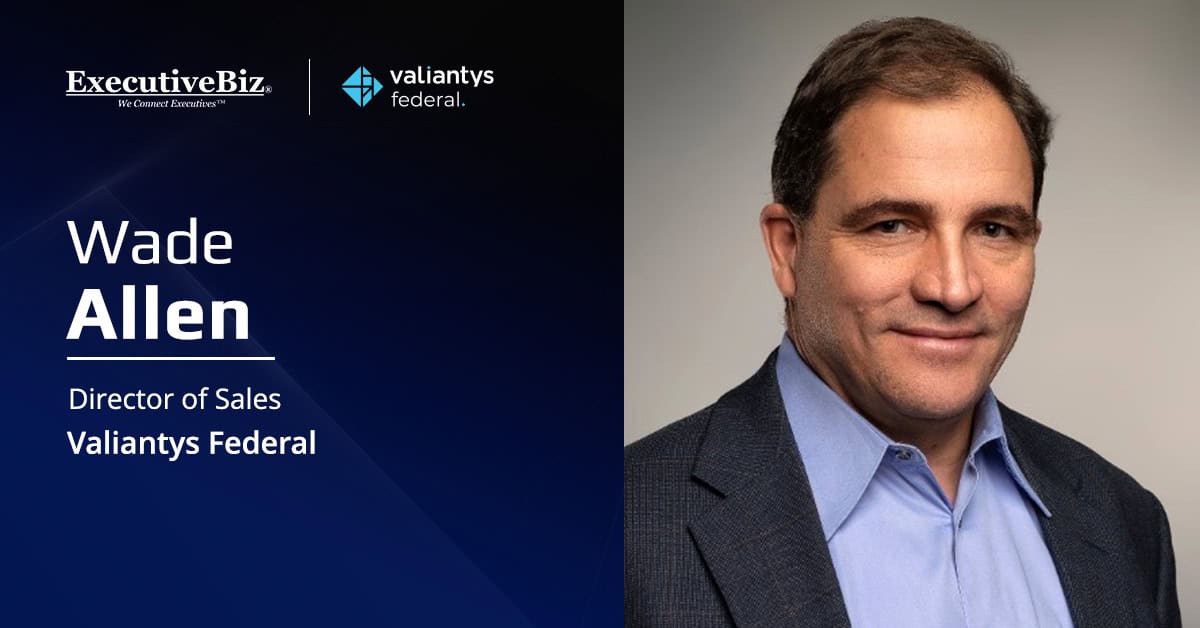
- Wade Allen, Valiantys Federal director of sales, is guiding the firm into becoming a next-generation systems integrator
- Many Valiantys Federal customers are smaller firms that need secure environments for DevSecOps work and meeting CMMC 2.0 requirements
- He sat down with ExecutiveBiz to talk evolving AI concepts beyond pilots, challenges in developing generative AI for defense and accelerated Pentagon contracting
Most executives choose government contracting as a career path. But Wade Allen believes GovCon chose him.
The Valiantys Federal director of sales was a contracting officer in his final role in the Air Force before leaving in 2001. He started his career in air-launched and nuclear missile maintenance before retraining into contracting.
He flipped that experience to the private side after leaving the Air Force by working for both small and medium-sized GovCon firms, including AIS. A highlight from his career was spending four years working for the White House Communications Agency, where he was one of three staffers responsible for acquisitions including travel, computers and operational equipment. Being part of the WHCA and supporting those operations was a unique and rewarding experience for Allen.
Allen sat down with ExecutiveBiz for his latest Spotlight interview to discuss evolving artificial intelligence concepts beyond pilots, the biggest challenges in developing generative AI applications for defense customers and what outcomes-based contracting means in today’s modern business environment.
Be the first to learn of new AI business opportunities at the Potomac Officers Club’s 2026 Artificial Intelligence Summit next Wednesday—March 18! Hear directly from Cameron Stanley, Department of War chief digital and AI officer, during his illuminating keynote address. Network with other ambitious GovCon executives in an environment designed for clarity and connection. Secure your seat today!
ExecutiveBiz: The government often adopts AI slowly and tends to run short proof-of-concept pilots. How are you helping mature AI solutions so they move beyond that stage?
Wade Allen: What we’re hearing across conferences and industry discussions is that the government is moving away from prototypes. They want scalable solutions that can be operationalized.
Internally, we’ve been developing AI capabilities focused on productivity and scalability within secure, air-gapped environments. The key is ensuring the technology can integrate into larger systems and operate securely.
The government no longer wants demonstrations that look impressive, but can’t scale. They want solutions that deliver measurable mission impact.
EBiz: What are the biggest challenges in deploying generative AI tools for defense customers?
Allen: The Department of War has already addressed some challenges by deploying genAI capabilities such as Google’s Gemini within secure networks and planning additional deployments in the future.
The real challenge is integrating AI within air-gapped systems, which are networks isolated from the public internet, designed for security and often used for sensitive, or classified, operations.. Even networks like the Pentagon’s Non-classified Internet Protocol Router Network, or NIPRNet, operate in controlled environments, so any AI tools deployed there must be able to connect securely with local infrastructure.
As organizations deploy DevSecOps environments and software factories, their AI tools must integrate with these localized systems. That’s the path forward: leveraging AI within the secure ecosystem, rather than relying on open internet services.
EBiz: In today’s GovCon market, how do you decide when growth is strategic versus simply additive?
Allen: The shift toward outcome-based contracting is driving that decision.
Strategic growth focuses on mission outcomes, understanding major government priorities and positioning the company to support them. It also requires focusing on your core expertise rather than claiming to do everything.
For us, that core expertise is DevSecOps. While many companies offer DevSecOps services, we concentrate on specific areas where we can genuinely move the needle for mission success.
Additive growth, on the other hand, is more about incremental expansion: adding tools or capabilities without necessarily changing the mission impact. The government is increasingly focused on outcomes rather than tools.
EBiz: The teaming landscape is changing, especially as large integrators no longer dominate every aspect of programs. What are your thoughts on teaming in today’s environment?
Allen: The government recognizes that no single integrator can do everything. They want the best combination of capabilities to solve mission problems.
That means teaming relationships are more important than ever. Companies need to be honest about what they do well and collaborate with others who bring complementary strengths.
At a recent Army IT event, one speaker summed it up very directly: companies need to team more effectively. The government wants teams that deliver the best outcomes, not companies trying to do everything themselves.
Are you a GovCon technology executive? Then you can’t afford to miss the Potomac Officers Club’s 2026 Artificial Intelligence Summit this coming Wednesday—March 18. It’s curated just for you! Check out the DOW’s leading AI officers including National Guard Bureau Chief Data and AI Officer Dr. Delester Brown, Space Force Chief Data and AI Officer and Director of Data, AI and Software Chandra Donelson, and many more in fascinating panel discussions. Sign up today!
EBiz: You mentioned outcome-based contracting earlier. What does that mean in practice today compared to the past?
Allen: Historically, government acquisition followed a rigid requirements process. A warfighter might request one capability, but by the time requirements moved through program offices and procurement processes, the end product could be very different and delivered years later.
Today, the goal is to move at the speed of relevance. That means adopting agile methods, accepting that iteration and occasional failure are part of innovation, and delivering capabilities more quickly.
Instead of long and rigid procurement cycles, we’re seeing more use of requests for information, down-selects and faster contracting pathways such as other transaction authorities. The emphasis is on getting usable capabilities into the government’s hands quickly and improving them over time.
EBiz: You retrained into contracting during your Air Force career. What do you enjoy most about this field?
Allen: What I value most is solving mission problems.
Throughout my career, I’ve stayed close to the warfighter and the mission. I’m not someone who simply wants to sell products. What matters to me is working with people who are supporting national security and helping them succeed.
When you work in environments like the White House Communications Agency, you realize you’re serving the institution and the mission—not any particular administration. That mindset has stayed with me throughout my career.
Who Is Wade Allen?
Wade Allen currently leads go-to-market strategy and public sector sales for Valiantys Federal, which was known as Contigex before being acquired by Valiantys. The company is expanding beyond its identity as Atlassian‘s Government Partner of the Year in both 2024 and 2025, evolving into a next-generation systems integrator. This is because many Valiantys Federal customers are smaller defense industrial base companies that need secure environments to perform DevSecOps work and meet Cybersecurity Maturity Model Certification 2.0 compliance requirements.
What Does Valiantys Federal Do?
Valiantys Federal provides technology services including DevSecOps, FedRAMP moderate platform-as-a-service and Atlassian to government customers.