
 Charles Lyons-Burt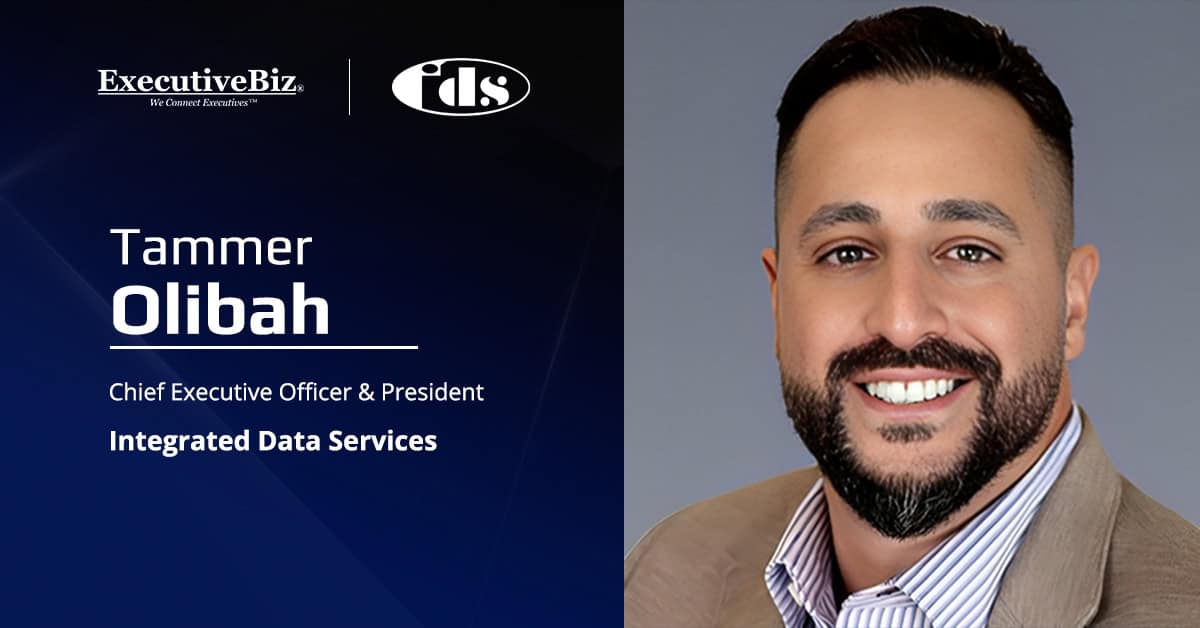
- Nearly 20 years in federal cyber and enterprise leadership
- CCaR AI is already live in U.S. Army environments
- Sees the next wave of acquisition reform as a data problem, not just a policy one
Tammer Olibah is president and CEO of Integrated Data Services, a federal software and technology firm backed by Arlington Capital Partners. He leads strategic growth initiatives and oversees delivery of business management software and custom development to defense, national security, intelligence, space and civilian government clients.
Olibah got his start at early-stage technology companies, where he learned that innovation only matters when it solves a real operational problem. That approach carried him through Pacific Northwest National Laboratory and more than a decade at Booz Allen Hamilton, then into the CEO seat at Hexagon US Federal, before he took the helm at IDS in October 2024.
Below, Olibah discusses a leadership lesson that reshaped how he manages transformation, how IDS is embedding AI into federal workflows and where he believes acquisition policy still needs to evolve.
ExecutiveBiz: What’s one significant professional challenge you faced and overcame?
Tammer Olibah: Early in my career, I moved fast, took risks and generally delivered strong results. I assumed the work would speak for itself. I learned that it doesn’t always work that way.
What I viewed as entrepreneurial and decisive could sometimes be viewed by senior leaders as overly aggressive or as moving faster than the organization was ready to move. That became a defining leadership lesson for me: being right isn’t enough. You have to bring people with you. I didn’t respond by becoming less bold or less willing to take risks. I learned to communicate the risk better, build alignment earlier and spend more time understanding how other people viewed the path forward.
That became increasingly important as I moved into CEO roles. Transformation creates uncertainty. You can have the right strategy, but if people don’t understand why you’re changing, where you’re going or how they fit into it, the strategy won’t matter very much.
I’ve also become much more comfortable acknowledging what I don’t know. I don’t believe the CEO is supposed to be the smartest person in every room. The job is to build a team of people who challenge you, complement your weaknesses and are comfortable telling you when they think you’re wrong. Over time, I’ve probably become both more decisive and more thoughtful about how I bring an organization along. I don’t think those qualities are in conflict. In fact, I think you need both if you’re going to lead real transformation.
EBiz: How is Integrated Data Services harnessing AI and data to solve federal challenges in a way that’s different from competitors?
Olibah: There is obviously an enormous amount of attention around AI right now, but our approach at IDS is pretty straightforward: we start with the mission, the workflow and the data.
We’re not interested in building flashy demonstrations or simply bolting an AI assistant onto an existing product. We want to embed intelligence directly into the trusted systems where federal employees are already doing their work and making decisions.
IDS has spent nearly three decades supporting some of the government’s most complicated acquisition, financial and program management processes. Our commercial software, CCaR, and PMRT solutions are already deeply embedded in those environments. That gives us an advantage because we don’t have to invent a hypothetical AI use case and then go looking for a customer. Our customers tell us where the friction is. We understand the workflows, we understand the data and we understand the decisions they’re trying to make.
CCaR AI can analyze requirements, budget and execution data, summarize large volumes of information, identify risks and opportunities, reduce repetitive work and increasingly surface issues before a user has to go looking for them.
The evolution we’re driving is from systems of record to systems of intelligence and ultimately to systems that create real decision advantage.
This isn’t theoretical. CCaR AI is already operating in U.S. Army environments and we’re continuing to expand AI-enabled decision support with each release.
For me, responsible federal AI isn’t really about AI itself. It’s about the outcome. If we can help a program manager identify a funding issue earlier, allow an acquisition professional to understand a complex portfolio faster, eliminate hours of repetitive work or give a senior leader visibility across information that used to live in disconnected systems, that’s meaningful.
Longer term, my ambition is for IDS to help connect the full federal resource-to-mission lifecycle, from requirements and funding through acquisition, execution and ultimately mission outcomes. When those workflows and datasets can securely work together, AI becomes exponentially more useful. That’s where I believe IDS has an opportunity to be truly transformational.
EBiz: Talk about one federal policy that’s changed for the better over the course of your career and one that you still would like to see evolve.
Olibah: I’ve become a strong advocate for federal modernization, particularly where commercial technology, smarter acquisition policy, authoritative data and responsible AI come together.
One area where I’ve seen real improvement over the course of my career is acquisition policy. When I entered the federal market, much of the acquisition system was designed around major hardware programs and long development cycles. That model doesn’t translate particularly well to software, where the technology can change multiple times during a traditional acquisition cycle.
We’ve made meaningful progress through commercial-first strategies, other transaction authorities, commercial solutions openings, the Adaptive Acquisition Framework and the Software Acquisition Pathway. Those changes matter because the government shouldn’t automatically pay industry to recreate technology that already exists and works. When a commercial solution can meet the mission, we should be able to adopt it, configure it around the mission and continuously improve it.
Where I think we still have work to do is closing the gap between policy and execution. We now have policies telling organizations to move faster and behave more like modern technology organizations, but the ecosystem surrounding those programs can still slow them down. Funding timelines can be lengthy. Data remains fragmented. Contracting can be cumbersome. Organizations often recreate the same processes and capabilities independently, and too often, we equate more reporting with better oversight.
I think the next evolution has to be about rewarding reuse, expanding outcome-based acquisition, taking greater advantage of commercial technology and giving program managers better real-time information. Better data should allow us to reduce bureaucracy, not create more of it.
That’s one of the reasons I’m so passionate about what we’re doing at IDS. Acquisition reform isn’t solely a policy challenge. It’s also a data and technology challenge.
The federal workforce is filled with incredibly talented people working on extraordinarily difficult missions. If we can give them better information, greater flexibility and more time to actually make decisions, the mission benefits and the taxpayer benefits.
Who Is Tammer Olibah?
Olibah has spent nearly two decades leading technical and business teams across government and industry. He spent more than 13 years at Booz Allen Hamilton building cybersecurity programs and businesses, supporting the stand-up of missions including U.S. Cyber Command, the FBI’s National Cyber Investigative Joint Task Force and what became the Department of Homeland Security’s Cybersecurity and Infrastructure Security Agency.
He then served as president and CEO of Hexagon US Federal, an independent subsidiary of the Swedish technology firm Hexagon AB, where he led a company-wide operational and cultural turnaround, more than doubling the business in size and expanding its geospatial and mission technology work with customers such as the National Geospatial-Intelligence Agency and the Army Geospatial Center. Olibah took over as IDS president and CEO in October 2024, succeeding co-founder James Truhe.
Olibah is a graduate of George Mason University, where he sits on the Cyber Security Engineering Industry Advisory Board, and serves as a member of the Intelligence and National Security Alliance’s Cyber Council.
What Is Integrated Data Services?
IDS is a federal software and services provider specializing in program and financial management systems, custom software development and support services for government clients nationwide. Founded in 1997 in El Segundo, California, the company has grown into a portfolio company of Arlington Capital Partners, which took a stake in IDS in 2023.
IDS’s flagship product, CCaR, functions as a core piece of the financial management infrastructure across the Department of War and is used as the standard financial system for the Air Force and other agencies, supporting the management of more than $4 trillion in government funds. Under Olibah, the company is working to evolve CCaR and its other software, including the PMRT platform, into AI-enabled tools — an effort it has branded CCaR AI — that are already deployed in U.S. Army environments and aimed at giving federal program managers, acquisition professionals and senior leaders faster, more complete visibility into their data.