
 Charles Lyons-Burt
- AI could correlate scattered data as protectee threats climb
- A 10-member in-house AI team is taking shape at USSS
- CIO Chris Kraft will sit on an AI investigative intel panel at POC’s 2026 Homeland Security Summit
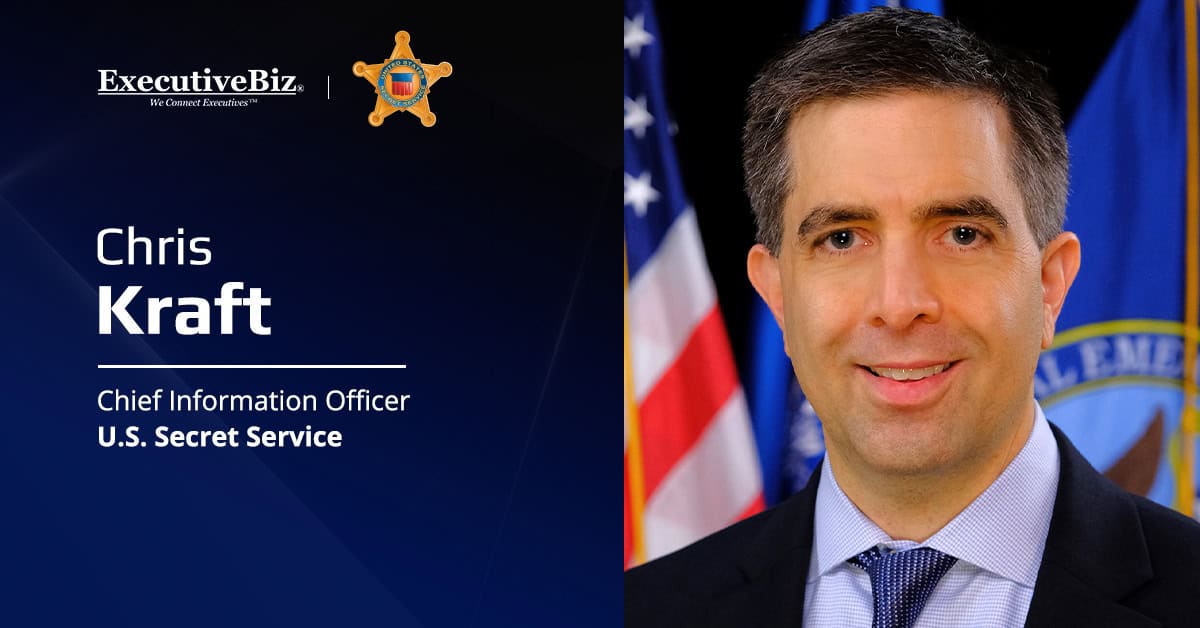
Threats against the Secret Service’s full-time protectees are up more than 40 percent since last year, with roughly 10,000 threats made since January, Director Sean Curran told CBS’ 60 Minutes. Chris Kraft, the agency’s chief information officer and chief AI officer, sees artificial intelligence as a tool for keeping pace with that volume.
Speaking at an event Thursday in a fireside chat aired by C-SPAN, Kraft pointed to the threat surge Curran described and laid out where AI fits.
“I believe that artificial intelligence can help us as we investigate those threats, monitor those threats, bring together correlations between seemingly disparate information,” he said.

That idea of finding the hidden thread is the focus of the Connecting the Dots: AI, Entity Resolution/Link Analysis and the Future of Investigative Intelligence panel at the Potomac Officers Club’s 2026 Homeland Security Summit on Nov. 10. Kraft joins the panel alongside leaders from U.S. Customs and Border Protection, ITC Federal and MongoDB. Curran himself will also take the stage at the 2026 Homeland Security Summit to deliver the afternoon keynote, giving attendees a rare chance to hear from both the Secret Service’s top leader and its AI chief in a single day. Register now!
Why Does the Secret Service Need AI to Connect the Dots?
The Secret Service runs two very different missions: protecting the nation’s leaders and investigating crimes ranging from counterfeit currency to cyber and threat cases. Kraft said both call for a wide-angle view of the technology.
“When we look at artificial intelligence, I think we have to look broadly at what’s the art of the possible,” he said. “Where is the technology today? And how could we potentially leverage that technology? And how can we lean forward?”
Some of that potential is already in the field. Two of the agency’s AI use cases are deployed: a model that supports criminal investigations through facial recognition matches and a tool that deciphers license plates from poor-quality images and video.
Kraft splits AI’s value into two buckets. The first is efficiency, where generative AI can automate labor-intensive back-office work like invoice processing and contracts. The second is operational capabilities that humans simply can’t match.
“With object detection, I could take a picture of this room and in seconds figure out how many people are actually here, at a speed that a human is not able to do,” he said.
Kraft’s panel at the 2026 Homeland Security Summit will make the same case: AI can surface links among phone numbers, social media accounts, financial transactions and travel patterns that traditional investigative methods miss. Kraft will likely discuss how the Secret Service is approaching that work at the event. Secure your seat today.
Who Is Building the Secret Service’s AI Bench?
Kraft became the agency’s permanent CIO in December after serving in an acting capacity, coming over from DHS headquarters, where he was acting chief technology officer and deputy CTO for AI and emerging technology. He described his role with a memorable contrast.
“There are a lot of real agents at the Secret Service, not AI type,” he said last week. “They have badges and they have guns. And I would say that I have AI superpowers.”
To spread those superpowers across the workforce, Kraft is standing up an internal AI Program, initially a 10-member working group of experts who rotate onto challenging problems across the agency, FedScoop reported. The model draws on the DHS AI Corps, which Kraft led at headquarters.
“We can take AI experts and have them work on a challenging need in one area, and then they can come back and other groups go work on other efforts,” he said.
Kraft added that a component-level team sits closer to protection and investigation missions than a cross-department group would. The push to embed AI specialists across the agency also reflects his view that there’s “a lot of value in having experts as federal employees, instead of just contracting for that capability,” Nextgov/FCW said.
How Does Kraft Move AI From Pilot to Production?
Kraft’s playbook starts small. When ChatGPT first arrived, his team at the Federal Emergency Management Agency loaded FEMA’s congressional budget justification, a document topping 500 pages, into an internal generative AI chatbot. The information was public and the stakes were low, but the lessons were significant.
“I encourage people to pilot, to find low-risk and meaningful use cases and to iterate on those use cases and get them in the hands of people that actually are going to use them,” he said.
The team added automated evaluations to test accuracy and groundedness repeatedly, which Kraft said helped it scale. When some stakeholders balked at moving the tool into production, live demonstrations did the persuading.
“Oftentimes, after seeing the technology in action, there were no longer any questions,” he said.
Kraft also treats early responsibility as an accelerant rather than a brake.
“By demonstrating a responsible use upfront, it’s a lot easier to expand how you’re using the technology,” he said.
Flexibility is part of the formula too. When a federal directive this year required agencies to phase out Anthropic’s Claude models, Kraft said the Secret Service’s code generation tool could easily switch to other models, FedScoop reported.
“You have to be able to test and have confidence in what the output is going to be, whether it’s a generative AI model, facial recognition model, license plate reader or whatever it happens to be,” he said.
What Guardrails Does Kraft Want Around AI Agents?
As agencies adopt AI agents and reasoning models, Kraft urges leaders to monitor and evaluate the traces those systems leave, comparing the steps an agent was expected to take with the steps it actually took. He has also emphasized building human decision points into agentic workflows so people review and approve higher-level actions, according to Federal News Network.
“There should not be ambiguity when you’re presented with a decision,” he said. “You need guardrails for the individuals that are going to be interacting with this capability.”
On data, Kraft favors steady progress over a perfect starting point. He called data the fuel that drives AI but cautioned against waiting a year or two to clean everything up before testing new tools.
He is also clear-eyed about the other side of the equation: adversaries who face no such restrictions.
“We don’t want to spend too much time thinking ideally about how we could use it … and having too many constraints on our ability to adopt the technology when the adversary does not have the same constraints,” he said.
Hear more on how DHS is balancing AI speed and safety at the 2026 Homeland Security Summit.
Where Is Secret Service AI Headed by 2030?
Kraft envisions personal AI assistants that proactively monitor information and empower agents’ work, with the internal AI team accelerating adoption across the organization where it makes sense. His legal training, a law degree from George Washington University, also helps when colleagues insist a rule blocks a new approach.
“Let’s look at the policy. Let’s look at the rule,” he said, describing how he weighs requirements against the administration’s priorities and the threat environment.
Who Else Is on the Connecting the Dots Homeland Security Summit Panel?
During his 2026 Homeland Security Summit discussion, Kraft will be joined by:
- Opeyemi Oshinnaiye, chief technologist at ITC Federal, who will moderate the discussion and guide panelists through the technical and policy questions behind AI-driven link analysis
- Baibhav “BoBo” Devkota, executive director of CBP’s Border Enforcement and Management Systems Directorate, who oversees roughly 155 customized applications supporting the border security mission and previously led CBP’s Enterprise Operational Test and Evaluation Division
- Devin Dickerson of MongoDB, who brings a commercial data platform perspective on managing the large, varied datasets that entity resolution depends on
Panelists may discuss how to harness AI for investigations while maintaining public trust and legal compliance.
Why Should GovCons Attend the Homeland Security Summit?
The 2026 Homeland Security Summit, held at the Ritz-Carlton, Tysons Corner in McLean, Virginia on Nov. 10, offers a full day of access to the officials directing DHS mission priorities and technology investments:
- Deputy Secretary Troy Edgar delivers the opening keynote
- Secret Service Director Sean Curran headlines the afternoon keynote
- Bobby Thompson, acting associate director for threat hunting at the Cybersecurity and Infrastructure Security Agency, delivers a morning keynote
- Acting CIO Kyle Schutt of DHS (pending confirmation) is slated to keynote
- Panels cover counter-unmanned aircraft systems coordination, a federated DHS data and identity fabric, edge capabilities for the border, LA28 security collaboration and more
For contractors building AI, data and investigative tools for homeland security customers, the summit is a chance to hear directly how buyers like Kraft think about piloting, evaluating and scaling new capabilities. This is an invaluable opportunity for you and your team; sign up today!