
 Charles Lyons-Burt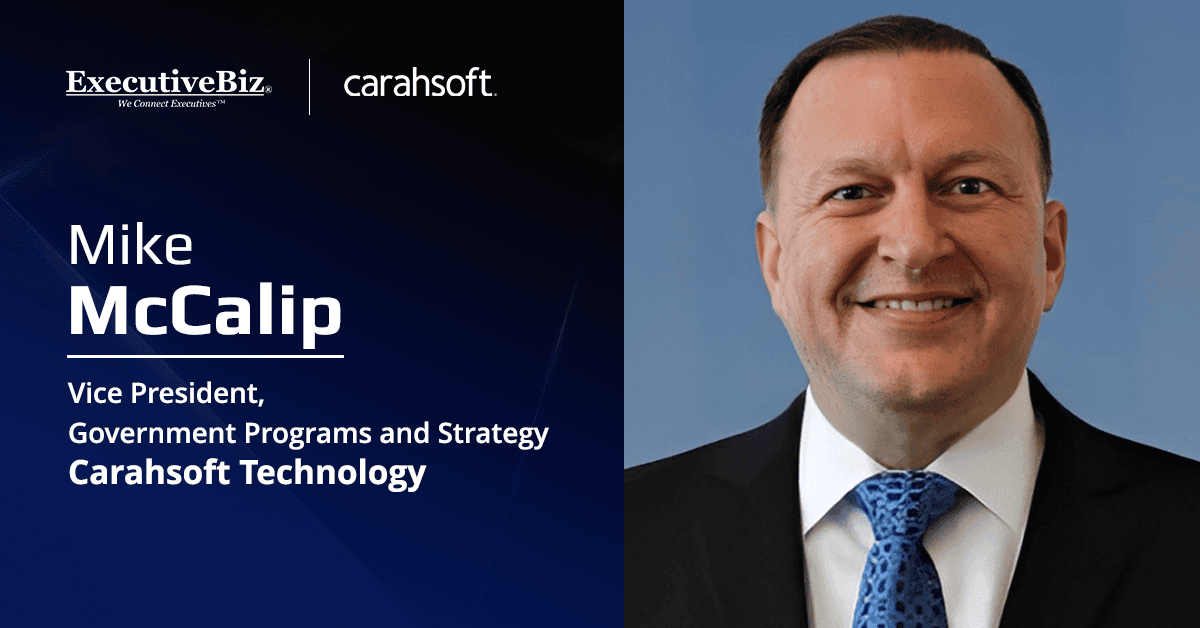
“I look at every challenge as an opportunity, “says Mike McCalip, vice president of government programs and strategy at Carahsoft. Over the past couple of years, Mike has seen his share of both.
Last year, the government focused on a renewed drive for efficiency. This year, that focus has evolved into delivering solutions faster, not just to meet the speed of today’s mission, but to build a foundation that will allow agencies to anticipate and meet future threats. Those are the challenges.
All of this has impacted the way the government purchases technology and changed the way system integrators, or SIs, managed service providers, a.k.a. MSPs, and original equipment manufacturers, or OEMs, work with their customers. McCalip and Carahsoft are helping all of them understand the new landscape, so they are better prepared to meet their customers’ mission objectives. That’s the opportunity.
McCalip spoke with ExecutiveBiz about what it will take to turn these challenges into opportunities, the importance of speed to mission and how industry can help the government move faster.
ExecutiveBiz: You oversee some important channel programs at Carahsoft. How has the government’s relationship with SIs and MSPs changed since the last time we spoke?
Mike McCalip: Speed to mission has become more important than ever, and that’s changing the way agencies work with SIs, MSPs and OEMs. For example, we’re seeing a move toward the government wanting SIs to come in, do the job and move on, rather than having them around for, say, a five-year period of performance.
Calls for solutions, or CFS, have become more commonplace, too. In the past, people may have viewed a CFS as a request for information, but these days it’s not unusual for them to transition directly into a contract award. That’s because CFSs focus on mission objectives rather than a long list of design specs and eliminates the need for a cumbersome, complex proposal.
All that said, federal programmatic business is still a long ride. At Carahsoft, we’re already working on fiscal year 2028. That tells you that while a new program may emerge today, it can still be years before the contract is awarded.
EBiz: What does “speed to mission” mean in practice for the Department of War and other government organizations?
McCalip: Speed to mission means getting the right capability into the hands of the right people. Whether we’re talking about soldiers, sailors or law enforcement personnel, the technology has to work when it is raining, muddy, snowing, 20 degrees below zero or in 120-degree heat.
It’s all about staying ahead of our adversaries and understanding where the future threats lie. Look at the landscape today. Two years ago, we would not have expected to see the way drones are being used in Ukraine, Iran, and elsewhere.
We need to anticipate and prepare for whatever comes next, which requires striving to have tomorrow’s technology today. The challenge is that the government can sometimes be using yesterday’s technology tomorrow. Carahsoft is focused on helping agencies take the emerging technology that is available now and deploy it.
EBiz: How does Carahsoft help technology OEM and integrators pursue these faster-moving opportunities?
McCalip: Small OEMs often have great technology but may not have the bandwidth to work on a program for two or three years before they receive an order. They are growing, they have unique business pressures, and they may not be able to make investments on their own.
That’s where Carahsoft steps in. We have teams that work with programs, develop strategies and help inform agencies about emerging technologies that may address their mission needs. We also help manufacturers understand where their technology can fit, help SIs understand what capabilities are available and help OEMs understand the government’s existing environment.
For larger OEMs that already have business-development teams focused on shaping opportunities, we can go to market together. Regardless of size, the key is having a strategy and the capacity to pursue the business, and, most importantly, that what we’re providing aligns to the government’s mission and readiness needs.
EBiz: Looking ahead, how might industry investment and risk-sharing help the government accelerate the delivery of new capabilities?
McCalip: We are starting to see the government ask for creative ideas about how industry can share risk to speed capability into the hands of the warfighter or the American citizen.
The government has challenges in the way it programs money considering it often works in two-year cycles. Agencies may know they need a capability, but they may not have the money available at the moment they need to make the purchase, so they’re asking the private sector for help. In return, commercial organizations are asking, “Are we willing to make an investment now for a return in the future that helps solve the problem sooner?”
At the same time, we will continue to see cyber, AI and quantum (both computing and post-quantum security) as major areas of focus. Cyber will require agencies to break down stovepipes and improve coordination, with law and policy supporting the effort. And while quantum was being talked about a few years ago, we are getting closer to a point where its capabilities will be real, which means the government needs to prepare now for the changes it will bring.
EBiz: What do you tell your customers and partners who might be struggling with how to leverage these and other technologies?
McCalip: I want them to know that my team is here to help them make sense of and take advantage of what these solutions have to offer, and they can reach out to us for help. I also want them to know that I’ll be keeping a close eye on how these tools will impact their operations both today and tomorrow.
Like I said, things are moving very quickly. It can be hard for people to keep track or piece together what it all means. But that’s what we’re here for.
For more information on joining Carahsoft’s partner ecosystem, click here.