
 Pat Host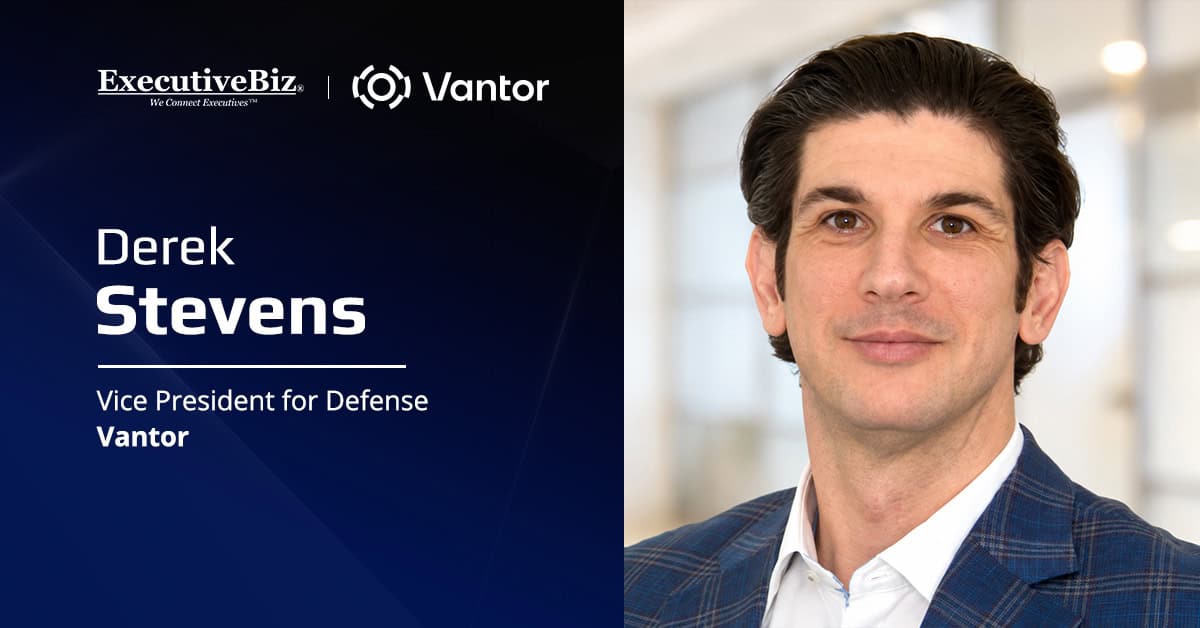
- Derek Stevens got the bug for GovCon early in an onsite and direct customer support role
- He helped stand up a new group at Maxar, now Vantor, supported by NGA and SOCOM
- Stevens sat down with ExecutiveBiz to discuss AI and resilient space-based capabilities
For Derek Stevens, GovCon is about two things: the mission and the people. Stevens, Vantor’s vice president for defense, developed a passion for the industry after leaving the Army when he served in an onsite and direct customer support role where he worked with dedicated people, solved problems and saw the results of his work.
Years later, Stevens remains driven by national security and its people. He helped stand up a new group at Maxar, now Vantor, supported by National Geospatial-Intelligence Agency and U.S. Special Operations Command, which required a combination of mission knowledge, technology, data, analytics and program management to get the team up and running, and delivering results.
At Vantor, Stevens is focused on operational terrain and giving warfighters an accurate and current 3D understanding of the environment before and during a mission. This is critical when the Global Positioning System is degraded, communications are contested and decisions have to be made quickly. Stevens and Vantor are focused on improving the operational terrain by integrating it into the command and control systems and tools warfighters already use.
Stevens sat down with ExecutiveBiz for his first Spotlight interview to discuss space and geospatial procurement hurdles, how Vantor is leveraging AI to improve its intelligence analysis, how contractors help the resilience and survivability of space-based capabilities, and new business opportunities from growing defense spending on space and intelligence capabilities.
Unpack the emerging technologies transforming the business of national security by attending the Potomac Officers Club’s 2027 Defense R&D Summit on Feb. 4. Get the latest investment insights from top federal officials on commercial space capabilities, cloud computing, secure data-sharing architectures and more. Join the conversation during question-and-answer sessions following dynamic panel discussions. Secure your seat today for this essential GovCon forum!
ExecutiveBiz: What procurement challenges do space and geospatial companies face when working with government customers?
Derek Stevens: The central challenge is speed. Technology and mission needs are evolving much faster than traditional acquisition cycles.
The government has made meaningful progress, including creating more flexible pathways for acquiring commercial technology. That is encouraging, but we are still not moving quickly enough. A capability can be ready in months and still take years to reach operators. By then, the technology, or the mission itself, may have changed.
We need to make it easier to put useful capabilities in the hands of real users, test them under operational conditions, learn from their performance and improve them over time. Too often, companies can demonstrate a strong prototype, but struggle to cross the gap into sustained operational use because of contracting, security, integration and funding requirements.
Industry has responsibilities here, too. We need to be candid about what is ready, its costs and limitations, and what can realistically be delivered.
The direction is encouraging, but speed remains critical. In this environment, speed cannot be treated as a nice-to-have. It is a mission requirement.
EBiz: How is Vantor leveraging AI to improve the speed and accuracy of intelligence analysis?
Stevens: At Vantor, we see AI as a tool that helps turn an overwhelming amount of data into something a person can actually use.
Satellites, unmanned systems, vehicles, cameras and other sensors are collecting enormous volumes of information. Without automation, more data can simply mean more screens, more alerts and more work for analysts. The goal is not to give people more to sort through, it is to help them find what matters faster.
At the most basic level, AI can identify objects and changes in imagery, including vehicles, vessels, buildings, roads, infrastructure damage or unusual activity. That allows analysts to spend less time manually reviewing large volumes of data and more time applying judgment, context and mission expertise.
But the larger opportunity goes beyond object detection. We are using AI to support more of the intelligence workflow: helping determine where to look, which sensors to task, how to combine information from different sources and how to keep maps and 3D models current as conditions change.
Imagine an area where the environment is changing quickly. AI can identify a meaningful change, prompt additional collection, align that new information with an existing map or model and surface the updated view to an analyst or operator. That creates a much faster path from collection to understanding.
AI also makes it possible to monitor far more locations than people could review continuously on their own. It can filter out routine activity, highlight anomalies and give analysts a clearer starting point.
Accuracy, however, starts with the data underneath the model. If imagery is outdated, incomplete, or poorly aligned, so will the output. That is why a trusted spatial foundation matters.
The human still has to remain in control, especially in national security. AI should support judgment, not replace it. The value is in doing more of the work up front and helping decision-makers focus on the questions that require experience and context.
Ongoing global conflicts are pushing the Pentagon to prioritize research and development to maintain a competitive edge. GovCons can help the U.S. maintain its technological advantage by attending the Potomac Officers Club’s 2027 Defense R&D Summit on Feb. 4. Engage with the government leaders, program officials and industry executives crafting R&D strategy and budgeting. Network with the entire contracting ecosystem, including prime contractors, nontraditional vendors and integrators. Come away armed with new partnership opportunities for business success in 2027. Sign up now!
EBiz: How can commercial providers contribute to the resilience and survivability of space-based capabilities?
Stevens: Commercial providers can help reduce the risk that any single satellite, system or organization becomes a single point of failure.
No one architecture can carry an entire mission on its own. Resilience comes from having multiple ways to collect information and process, move and deliver it. Commercial capabilities can add capacity, redundancy, global coverage and alternative pathways when government systems are unavailable, overtasked or focused elsewhere.
Commercial companies already operate constellations, ground networks, software platforms and analytic services at scale. During a disruption, those systems may provide another collection option, another processing environment or another way to deliver information.
But resilience does not happen automatically just because more capacity exists. Those capabilities must be integrated and tested before a crisis. Government and industry need to understand how collection, processing and delivery will shift if part of the architecture is degraded. Analysts and operators also need experience using the tools in realistic conditions.
I also think resilience is too often discussed only in terms of spacecraft. The hardware matters, but so does the software, ground systems, communications links, cybersecurity, data pipelines, and analytic tools around it. Those layers determine whether information can still move and remain useful under pressure.
The strongest model brings government, commercial and partner capabilities together by design. Commercial providers are not a substitute for government systems, they strengthen those systems, extend their reach and give mission partners more options when conditions become difficult.
EBiz: What opportunities do you see emerging from increased defense spending on space and intelligence capabilities?
Stevens: The biggest opportunity is to push trusted intelligence directly to the warfighter at the edge, where decisions often need to be made in seconds rather than hours.
We already collect enormous amounts of data. The challenge is turning that data into something useful: identifying what changed, explaining why it matters and delivering that insight to the person who needs it without requiring them to sort through multiple systems or wait for a lengthy analytical process.
That is where investments in commercial space capabilities, AI, resilient networks and edge computing can come together. AI can help prioritize the most relevant information, while more connected and interoperable systems can move that insight closer to operators in the field.
But speed alone is not enough. The information must be trusted, secure and presented in a way that supports human judgment rather than adding more noise.
The real measure of success is straightforward: can we help a warfighter understand the situation faster and make a better-informed decision? That is where increased investment can have the greatest mission impact.