
 Miles Jamison
- Veal said moving every dataset into one central location is impractical
- The Cloudera executive cited GAO’s “swivel chair” finding on manual data handoffs
- Veal outlined questions defense leaders should ask before deploying AI
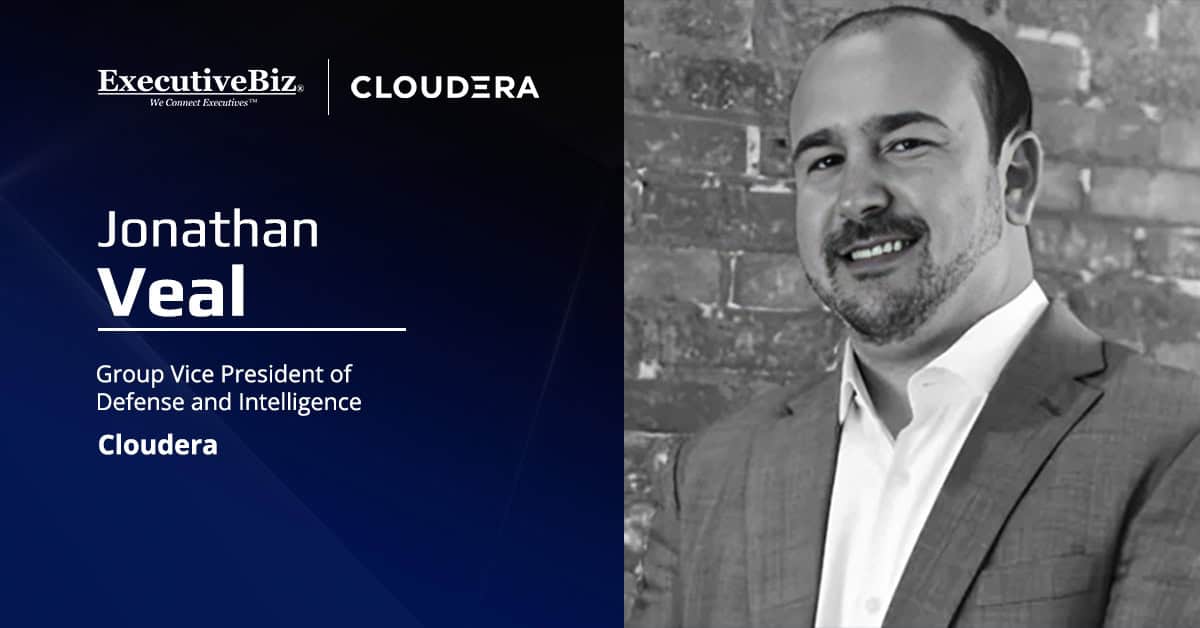
Jonathan Veal, group vice president of defense and intelligence at Cloudera, said defense organizations must establish trusted, interoperable data environments to support Joint All-Domain Command and Control, or JADC2, and artificial intelligence adoption.
Veal discussed the data-sharing, compatibility and governance challenges affecting military operations in a commentary published Oct. 26 on Federal News Network.
Why Does JADC2 Require a Connected Data Environment?
The Cloudera executive said JADC2 requires information to move between military services, operational domains and mission partners. That data sits in legacy and modern systems, cloud environments, secure networks and tactical equipment.
He said transferring all information to a central repository is impractical given the security and latency requirements of military operations. Some workloads must also remain near the sensors and units that generate or use the data.
The Department of the Air Force’s contribution to Combined JADC2, the DAF Battle Network, integrates roughly 50 programs of record to support situational awareness and operational decision-making.
Veal also highlighted the difficulty of manually moving information between systems. An April 2025 Government Accountability Office review called this a “swivel chair” approach and said such exchanges can constrain commanders’ ability to decide at the speed and scale modern operations require.
How Can Data Compatibility Support Military AI?
Veal said interoperability must extend beyond network connectivity so systems can understand and use the information they exchange. Incompatible data formats, schemas and metadata can prevent applications from interpreting information consistently, affecting AI-assisted analysis that draws on multiple sources.
He cited the Department of War’s Modular Open Systems Approach and Sensor Open Systems Architecture as interoperability efforts. He added that technical standards should account for how information is organized and understood.
CJADC2 adds complexity by extending information sharing to intelligence organizations, allies and coalition partners, which bring their own data repositories and secure networks to coalition operations, adding another layer of complexity to information exchange.
What Security Challenges Affect Coalition Data Sharing?
Veal emphasized that accessible information does not mean unrestricted access, as agencies must determine which personnel and partners are authorized to receive specific data based on applicable security and operational requirements.
He cited GAO findings on how classification restrictions interfere with coalition information exchange. In one case, a government database’s designation as critical to a trilateral security partnership prevented it from being shared more broadly. GAO also found that even when the U.S. has separate agreements with two allies, those countries cannot combine their information in a joint environment without an agreement between them.
In the same report, GAO recommended that the secretary of war establish a way to guide CJADC2 investments and measure progress. The watchdog also called for a mechanism to share lessons learned and for DOW to address challenges hindering its CJADC2 goals.
Veal pointed to Bold Quest 22, which brought together more than 1,000 participants from 19 countries to test CJADC2 capabilities and identify shortcomings in coalition information sharing.
He said defense organizations need ways to verify the origin and reliability of information used in operational decisions and AI-generated analysis.