

 Charles Lyons-Burt
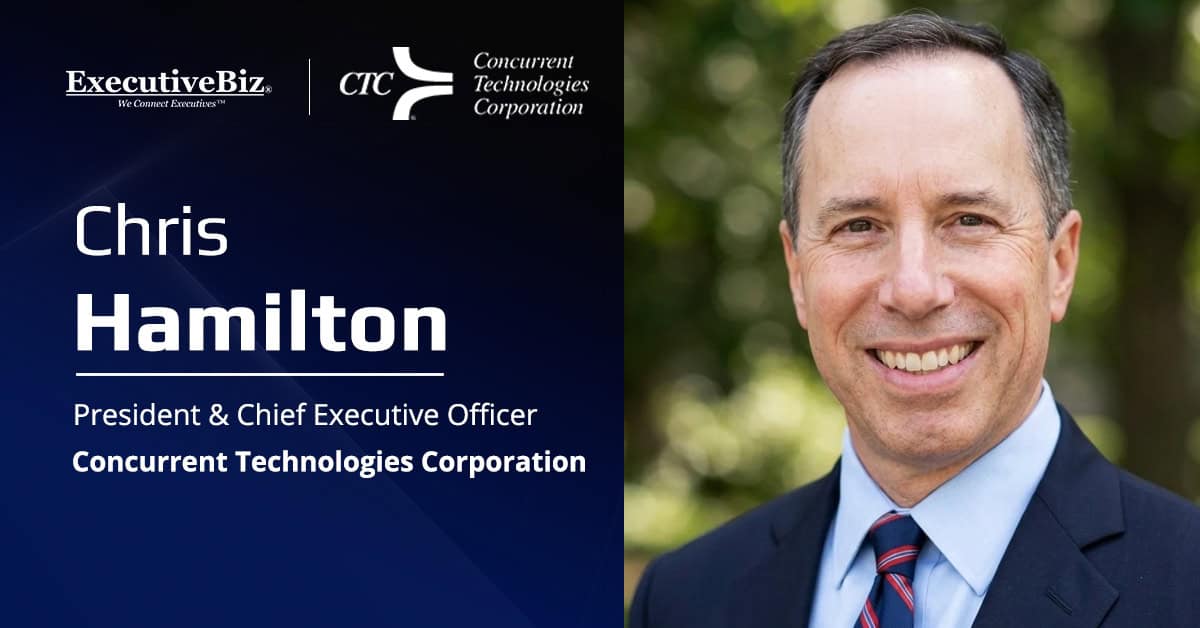
- Hamilton became CTC’s third CEO in 38 years in June
- Calls for risk-based, technology-neutral AI rules, with industry acting first
- CTC’s space work runs from 305-inch welds to cyber-hardened ground stations
When Chris Hamilton was named president and CEO of Concurrent Technologies Corp. in June, he became just the third chief executive in the nonprofit’s 38-year history, succeeding the retiring Ed Sheehan Jr., whom ExecutiveBiz last spoke with in 2025.
A former U.S. Army intelligence officer, Hamilton later led Georgetown University’s capture of a $100 million follow-on effort with the Office of the Director of National Intelligence. He then spent 15 years steering growth at CMX Technologies, Xator and Parsons, where he oversaw counter-unmanned aircraft systems and identity and biometrics work. Most recently, he was a partner for strategy and growth at AnaVation.
Since his arrival, CTC has won its first prime DARPA contract since 2012 to red-team AI-driven autonomous systems, teamed with West Point on a defense AI security tool and landed a $14.9 million Marine Corps cybersecurity contract. It has also added former National Geospatial-Intelligence Agency Deputy Director Tonya Wilkerson to its board and realigned its CFO role.
In this Executive Spotlight interview, Hamilton discusses CTC’s culture, why the right AI rules aren’t fully in place yet, AI-driven mishap analysis for the Department of War and why space has become a formidable warfighting domain.
ExecutiveBiz: You recently became CEO of CTC. What about the company’s culture drew you to the organization?
Chris Hamilton: What drew me to CTC was how deeply personal the mission is to our people. Our employees are passionate about solving challenging problems that strengthen national security, support our warfighters and help maintain America’s technological edge. Many have served — or continue to serve — in the armed forces, including the National Guard and reserves. That experience creates a firsthand connection to the people and missions we support, and it is reflected in CTC’s longstanding commitment to veterans.
I was equally impressed by the way CTC combines a strong sense of urgency with humility, respect and a genuine family atmosphere. We are committed to delivering for our customers, but we do so by working together, looking out for one another and staying focused on outcomes that matter. Our Great Place To Work certification and military-related employer recognition reflect that commitment. Ultimately, CTC’s culture is rooted in people who care about the mission, take pride in their work and understand the importance of serving something larger than themselves.
EBiz: What is the importance, in your view, of AI governance, and do you think the right rules are currently being put in place?
Hamilton: AI governance is essential to ensuring that these technologies are developed and used safely, responsibly and in ways that protect sensitive information. At CTC, that starts with aligning every use of AI with our data management and security requirements. Employees are trained in the proper handling of controlled unclassified information, or CUI, and other sensitive data, and our policy prohibits entering proprietary information or CUI into public or third-party-hosted generative AI models. AI models that process sensitive information must operate in secure, authorized environments.
I do not believe the right rules are fully in place yet. Regulation remains uneven, and important questions involving model evaluation, liability, privacy and coordination among governments still need to be addressed. Because AI is evolving so quickly, regulation should be risk-based and technology-neutral. Governments should establish enforceable safeguards for high-risk applications, encourage independent testing and require appropriate incident reporting without restricting beneficial innovation.
Industry also has a responsibility to act before legislation requires it. At CTC, we believe trustworthy AI depends on stakeholder awareness, strong privacy and security protections, and safeguards against known vulnerabilities. We are advancing these objectives through work in AI assurance, defensive AI, adversarial testing and other counter-AI capabilities. As an independent 501(c)(3) organization, CTC can help government and industry assess technologies objectively and strengthen transparency and accountability.
EBiz: What is one way CTC is using AI to achieve mission outcomes for the government or military?
Hamilton: One example is CTC’s use of AI to conduct advanced analysis of Department of War mishap data. This helps the Office of the Secretary of War better understand the causes of mishaps and improve prevention and mitigation efforts. By helping prevent future mishaps or reduce their impact, this work enhances force readiness and warfighter safety.
We are also applying our AI assurance expertise to help evaluate the security and reliability of autonomous systems. Our AI red-teaming approaches are designed to test systems under realistic operating conditions, identify vulnerabilities and help ensure that these technologies perform as intended. This work builds on CTC’s AI assurance research, which began in 2018.
EBiz: Why is space now a formidable warfighting domain, and what is CTC doing to help secure it?
Hamilton: Space has become a critical and increasingly contested domain because so many national security missions depend on space-based capabilities and the information they provide. The challenge extends well beyond putting satellites into orbit. Those assets must be manufactured, launched, protected and connected to the ground systems and networks that deliver information to decision-makers and warfighters. The pace of technological change also means that government and industry need solutions that can be developed, tested and transitioned more quickly.
CTC supports this mission across the space enterprise. In advanced engineering and manufacturing, we support the commercial space industrial base through large-scale manufacturing and specialized materials expertise. Our work includes a 305-inch friction stir weld in 3-inch-thick aluminum, as well as precision carbon-carbon machining and the joining of ceramic matrix composites to traditional metals for demanding, high-temperature applications such as hypersonics and atmospheric reentry.
On the digital side, our teams completed several projects with the Army in support of satellite research and development. Our solutions ranged from developing AI and machine learning algorithms that translate small-satellite synthetic aperture radar payload data into imagery recognizable by analysts to cyber-hardening ground stations used to download, process and analyze satellite-system data.
What makes CTC distinctive is the breadth of our contribution. We support the physical systems that enable space operations, the data and analytics that turn information into insight, and the secure networks and resilient ground infrastructure that help keep those capabilities connected to the mission. Our role is to help government and industry address complex challenges across the full space enterprise.
What Is CTC?
Headquartered in Johnstown, Pennsylvania, Concurrent Technologies Corp. is an independent, nonprofit applied scientific research and development organization that delivers full-lifecycle solutions through research, development, test and evaluation. Working alongside its technology transition affiliate, Enterprise Ventures Corp., on whose board Hamilton also serves, CTC operates across four areas: digital mission solutions; energy, resilience and sustainability; engineering and advanced manufacturing; and readiness solutions. Its work centers on safeguarding national security, preserving the U.S. technological advantage and strengthening American manufacturing.
Who Is Chris Hamilton?
Chris Hamilton is president and CEO of Concurrent Technologies Corp., a role he assumed in June 2026, and a member of its board of directors. He began his career as a U.S. Army intelligence officer, serving more than a decade in roles ranging from platoon leader and company commander to strategic intelligence officer with the Defense Intelligence Agency and electronic warfare officer with the National Reconnaissance Office.
In industry, Hamilton held executive positions at large and small companies serving the defense, intelligence and federal law enforcement communities, including The Titan Corp. He later served as deputy director of a Georgetown University research division, where he led the capture of the university’s cornerstone contract with the Office of the Director of National Intelligence and the division earned the Intelligence Community Medallion. Hamilton joined CMX Technologies as chief operating officer in 2010 and became its president in 2013, leading the company to its 2014 acquisition by Xator. He spent seven years on Xator’s executive leadership team and, following Parsons’ acquisition of Xator, led Parsons’ counter-unmanned aircraft systems program and identity and biometrics portfolio. Before joining CTC, he was a partner for strategy and growth at AnaVation.