
 Pat Host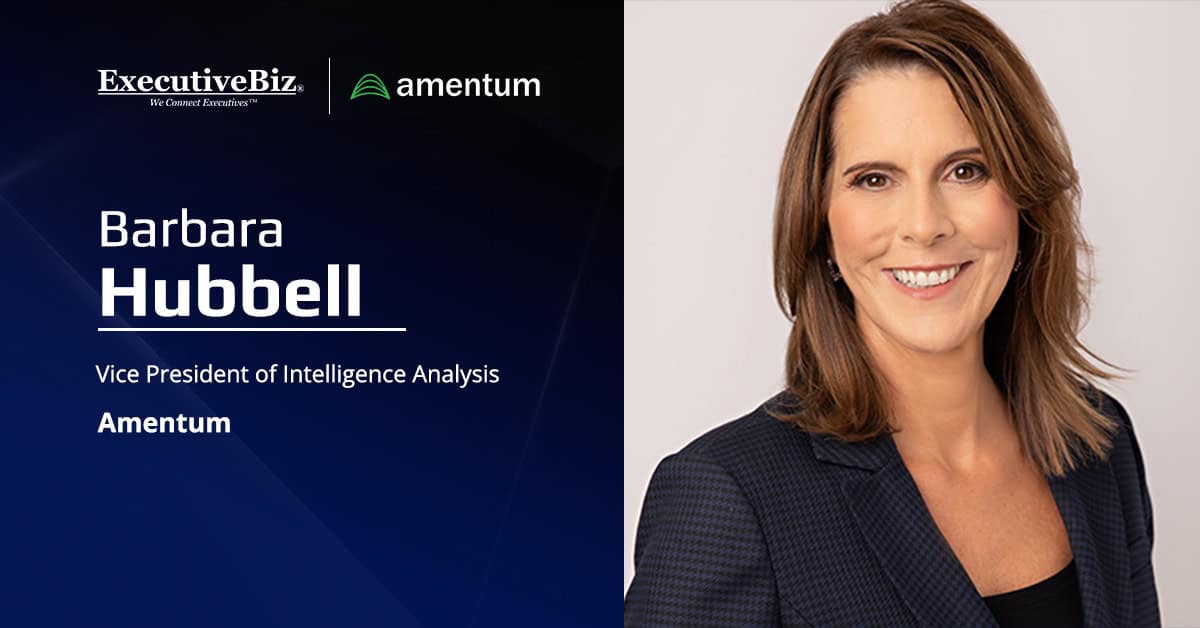
- Barbara Hubbell learned that finance numbers always point to operational problems
- The Amentum VP now leads efforts to have AI-assisted products validated against sources
- She sat down with ExecutiveBiz to talk how AI is changing intelligence
Barbara Hubbell, Amentum vice president for intelligence analysis, learned a couple of essential traits to GovCon success from her 20 years as a finance director at CSC, now part of DXC Technology.
The first is that the numbers always point to operational problems. The second is that having a finance background is an advantage as government customers are stewards of public funds and an executive who understands cost, risk and delivery together can be a stronger partner.
Eventually, Hubbell wanted to fix problems, not just report them. So she took on operational positions of growing significance, starting as vice president of operations at Sotera Defense Solutions. Now at Amentum, Hubbell is helping the firm put AI in the hands of its analysts in a way that strengthens tradecraft, rather than shortcut it, with a goal of having every AI-assisted product validated against sources before it moves.
Hubbell sat down for a Spotlight interview to discuss how AI is changing intelligence analysis, demand signals from the conflict in Iran, how to best protect against the newest threats to U.S. cyber systems and balancing compliance-driven cyber programs.
Adversaries are weaponizing agentic AI against U.S. cyber systems. Discover how to restructure defense architectures for AI-era threats by attending the Potomac Officers Club’s 2026 Intel Summit this Thursday—Sept. 24. Our four (!) agentic AI panels featuring top federal officials on topics including Cybersecurity in the Age of Agentic AI and Agentic AI and Quantum Risk will position your GovCon firm for contracting success in fiscal year 2027. Tickets are extremely limited, secure yours now!
ExecutiveBiz: How is AI changing intelligence analysis, and how is Amentum putting it in analysts’ hands?
Barbara Hubbell: The most important thing I’d say about AI in intelligence analysis is that it enhances analysts. It does not replace them. The judgment, the sourcing discipline and the accountability for what goes in front of a decision-maker stay with the human.
Where AI is making a real difference is in the hours that sit between raw information and finished analysis. Our analysts are using structured prompts to accelerate triage, summarization and first-draft production, then applying their own tradecraft to validate and refine. The time savings are measured in hours per analyst per week, and we are seeing meaningful production gains across analytic teams without sacrificing rigor.
We treat prompts as tradecraft that are structured, tested and refined just like any other analytic method. They’re shared across teams, iterated through real mission use and evaluated against standards we already hold for sourcing and analytic rigor. Every prompt includes built‑in verification steps so analysts validate AI-assisted output directly against trusted sources before anything moves forward. We also train for this the same way we train any core skill, including in the classified environments where most of our work happens.
The payoff is that decision-makers at the highest levels get better analysis faster. That is the whole point of the job.
EBiz: What business opportunities do you see arising from the conflict in Iran?
Hubbell: I don’t think about conflict as a business opportunity. I think about it as a demand signal, and that signal shows up in several parts of the mission.
When operations accelerate, the need for timely, sourced analysis rises with it. Our analysts support deployed commands across the globe, and our work has contributed to more than 70 real‑world precision activities. Customers depend on surge capacity that is already cleared and already fluent in the mission.
Conflict also moves people, money and materiel in ways that complicate identification and targeting. Identity intelligence, watchlisting and counter‑smuggling support become more critical, not less. We hold one of the Department of War’s largest identity intelligence contracts for a reason: fusing biometric, forensic, behavioral, and reputational data at scale is how you find the threat actor in the noise.
Then there is the information environment. Adversaries wage an influence campaign alongside any kinetic one and analysts who can map those activities and deliver a clear picture to decision‑makers are in high demand.
What I tell my teams is that we build durable capacity where the demand is structural and we make sure our people are ready before the phone rings. Being part of Amentum, with roughly 50,000 employees and half of our U.S. workforce cleared, gives us a level of reach‑back that a standalone intelligence firm cannot match.
Fuel your GovCon business with premium-level networking at the Potomac Officers Club’s 2026 Intel Summit this Thursday—Sept. 24! Meet program executives, chief AI and data officers, and integration leads from the CIA, FBI, Space Force, National Security Agency, National Reconnaissance Office, Department of Homeland Security and the Drug Enforcement Administration.
Discover the latest offerings from top contractors like TRSS, AT&T, SAIC, Snowflake, MANTECH, Kpler Defense and more. Connect with the entire IC industry ecosystem gathered under one roof. Secure your seat today for this critical GovCon event!
EBiz: What is the newest threat facing U.S. cyber systems today, and what can be done to protect against it?
Hubbell: The newest threat is not a new technique—it is the speed at which old techniques now run. AI has compressed the timeline between a vulnerability becoming public and an adversary exploiting it from weeks to hours, and it has made phishing, credential harvesting, and social engineering nearly indistinguishable from legitimate traffic. Nation-state actors are using it to scale operations that used to require skilled human operators.
That shift forces a different defensive posture. Identity has effectively become the perimeter, because once an adversary can convincingly appear as a trusted user, traditional network boundaries offer little protection. Strong identity controls, access separation that preserves collaboration, and continuous verification form the new baseline.
We also must assume the adversary is already inside and hunt accordingly. Our teams have deployed classification-aware, out-of-band analytics that let defenders analyze logs across domains an attacker cannot see or tamper with. When you look at the problem from a different angle, you can spot the subtle threat that’s hiding in plain sight.
Underneath both is the human factor. We train more than 2,600 personnel a year in incident response and forensics because tooling is only as good as the defender running it. And we emulate adversaries against our own environments so we find the gap before they do.
The threat is faster. The answer is to be faster at detection, more disciplined about identity, and honest that prevention alone is not a strategy.
EBiz: How do you balance compliance-driven cyber programs with the realities of adaptive, nation-state threats?
Hubbell: Compliance tells you where you were. Threat intelligence tells you where the adversary is going. A good cyber program uses the first to build a foundation and the second to decide what to build next.
In practice, that means automating compliance so it does not consume your best defenders, moving ahead of mandates when the threat warrants it, and validating controls through adversary emulation rather than self-attestation. When the same team owns both the audit and the hunt, the tension largely disappears.