
 Pat Host
- Edgewater’s Andrea Snader measures GovCon success in both mission impact and people served
- The firm recently acquired RedLine Performance Solutions for its HPC capabilities
- Snader sat down for he first Spotlight interview to discuss the RedLine acquisition
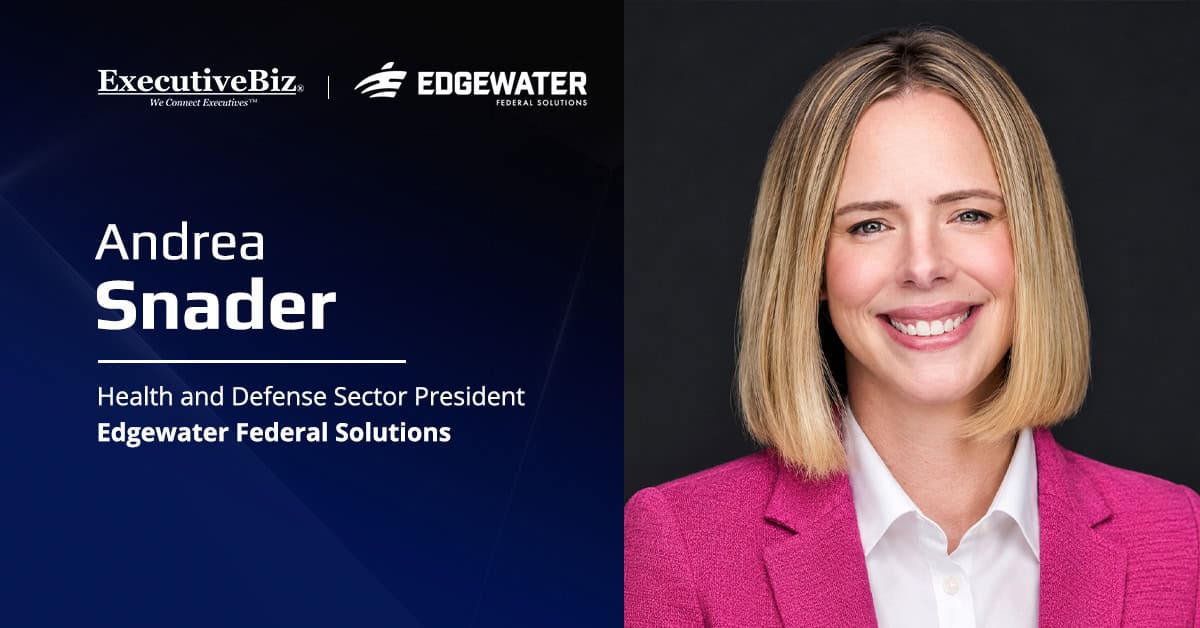
For Andrea Snader, GovCon success is measured by both mission impact and the people Edgewater serves, from military recruits to federal agencies advancing their computing capabilities.
In October, Edgewater expanded its federal technology portfolio by acquiring RedLine Performance Solutions, a recognized leader in high-performance computing and complex computing environments supporting scientific research, engineering and innovation. The combined company brings complementary strengths across enterprise modernization, cloud, cybersecurity and HPC.
In her first ExecutiveBiz Spotlight interview, Snader, Edgewater health and defense sector president, discussed why the company chose HPC acquisition over building the capability in-house, how HPC and related technology programs may fare in federal IT budgets over the next three to five years, how RedLine’s expertise strengthens Edgewater’s AI offerings and what defines success for the acquisition.
Unpack new HPC research initiatives by attending the Potomac Officers Club’s 2027 Defense R&D Summit on Feb. 4. Go beyond the headlines with exclusive investment insights from leading DOW and national security technology officials during thought-provoking keynotes. Join the conversation on the panel discussion topics transforming emerging military technologies including Securing the Innovation Base: Supply Chain Visibility, Critical Materials, and Research Security. Leave the day with actionable intelligence to grow your defense technology revenues in 2027. Secure your seat today!
ExecutiveBiz: What was missing from Edgewater’s portfolio that made HPC the right capability to add now rather than build in-house?
Andrea Snader: Edgewater already has a substantial enterprise IT portfolio and an established presence in high-performance computing. The addition of RedLine significantly strengthens that position and establishes us as a leading federally-focused HPC provider. We saw the acquisition as a meaningful differentiator, particularly as HPC becomes increasingly important to the growth of AI, advanced analytics and other compute-intensive federal missions. Strategically, it was the right capability at the right time.
From a buy-versus-build perspective, RedLine was a strong fit because it brought established HPC expertise, customer relationships, and past performance that complemented Edgewater’s broader enterprise IT capabilities. Historically, RedLine performed much of its work as a subcontractor, while Edgewater brings the scale, qualifications, and infrastructure to compete effectively as a prime.
By bringing those capabilities together, we are now positioned to pursue larger and more complex HPC opportunities as a prime contractor, including opportunities we may not have been positioned to compete for independently. That ability to accelerate our market position, rather than building those capabilities organically over time, was a significant factor in the decision to acquire.
EBiz: Enterprise IT can broadly refer to the nuts and bolts of computing. How do you define it?
Snader: I often think back to the broad-scope Information Technology Support Services contracts from about a decade ago. Those contracts were truly all-encompassing, covering network operations, infrastructure, local area network/wide area network, application development and just about every other aspect of enterprise IT.
I see HPC in a similar context. It can absolutely be part of a broader enterprise IT environment, but it is a highly specialized capability that not every IT provider can deliver effectively. As agencies increasingly connect HPC with AI, advanced data analytics and data center modernization, I expect those capabilities to become more integrated within federal IT strategies and budgets over the next three to five years.
The Pentagon is prioritizing R&D funding on projects like AI that can deliver fieldable capabilities within 12 to 36 months. Find out what it takes to keep pace by attending the Potomac Officers Club’s 2027 Defense R&D Summit on Feb. 4. At the AI-Driven Connectivity for the Expeditionary Force panel discussion, examine where industry partnerships in network automation, rapid deployment and secure mobile connectivity keeps units connected on the move. Unpack unique perspectives on how AI that configures, optimizes and defends the network frees up warfighters to focus on the mission. Sign up now for this essential GovCon conference!
ExecutiveBiz: How do you see HPC, AI and data center modernization coming together in federal IT budgets over the next three to five years?
Snader: When you look at where the federal market is heading, the conversation is increasingly about compute as a strategic capability. The Department of War is investing in advanced computing to support increasingly sophisticated weapon systems and mission requirements. At the same time, the Department of Energy, where Edgewater has a significant customer footprint, is bringing HPC and AI closer together through initiatives such as the Genesis Mission and the national laboratory ecosystem.
We believe our HPC qualifications position us well to support that evolution. Over the next several years, I think the lines between HPC, AI and data center modernization will continue to blur, with compute increasingly treated as strategic infrastructure, rather than as a stand-alone technology investment. That convergence was an important part of our thinking and one of the reasons we believed this was the right acquisition at the right time.
EBiz: How might RedLine’s HPC expertise strengthen Edgewater’s AI offerings?
Snader: I think the RedLine acquisition, combined with Edgewater’s existing HPC capabilities, gives us much stronger full-stack credibility around the infrastructure that enables AI. Our strength is helping customers assess, build, operate and optimize the HPC environments that increasingly complex AI workloads depend on.
As AI adoption accelerates, we expect significant demand not only for AI solutions, but for the infrastructure behind them. That includes AI compute and readiness assessments, as well as operating, tuning, and sustaining graphics processing unit clusters across on-premises and hybrid environments. Those are ongoing operational requirements, which creates an opportunity for us to support customers throughout the lifecycle, rather than simply at the point of deployment.
We do not necessarily need to build the AI models themselves, which we also do, to play a critical role in the AI ecosystem. We build and manage the computing infrastructure that makes AI possible. As AI capabilities become more sophisticated, the demand for compute capacity and for the expertise required to operate increasingly complex HPC and GPU environments will continue to grow. That is where we saw a very strong strategic fit with RedLine.
EBiz: One year from now, how will you determine whether the RedLine acquisition has been successful?
Snader: It’s about how this differentiates our enterprise IT business and whether we’re able to capitalize on that by winning a new prime contract in a space where we might not have been positioned to compete before.