 Charles Lyons-Burt
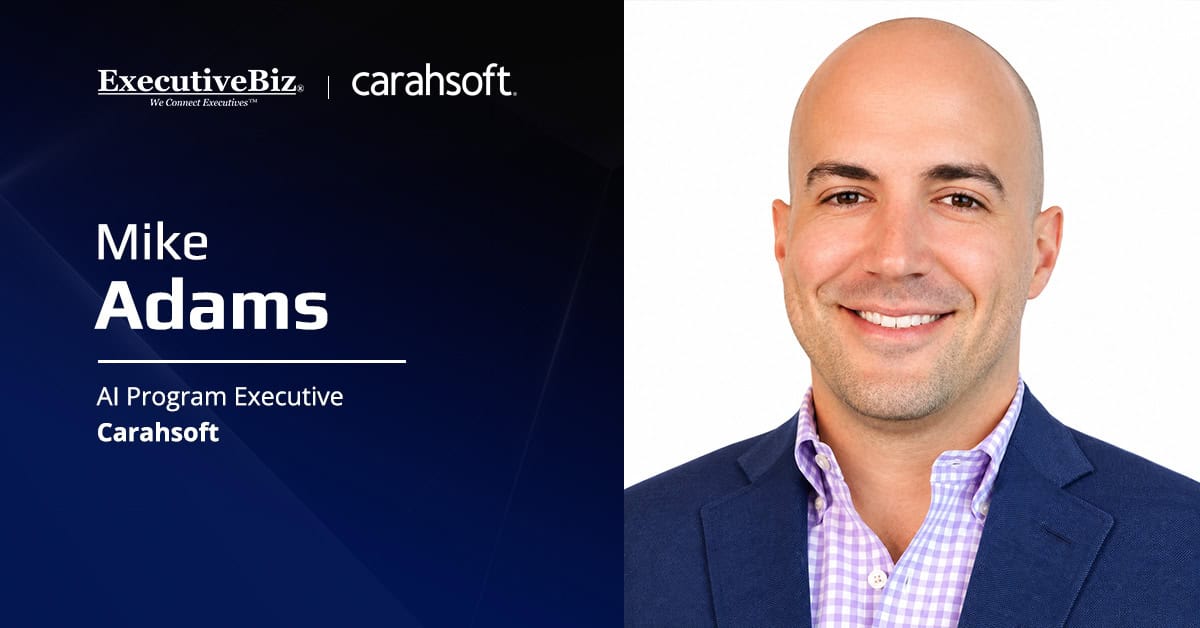
- 19-year Carahsoft veteran Adams helps AI vendors navigate government contracting
- Deployed engineers and workflow experts are key to agentic AI success
- Token limits and usage monitoring help agencies keep AI costs in check
Government agencies are moving beyond early experimentation with artificial intelligence and toward more practical, mission-focused applications. Mike Adams, program executive for Carahsoft’s AI solutions team, joined the company in September 2007, only a few years its founding, and has played a part in its record year-over-year growth ever since.
In this Executive Spotlight interview, Adams discusses how Carahsoft helps AI providers navigate the public-sector market. He also covers how the company supports agencies’ adoption efforts and encourages a focus on measurable outcomes, responsible use and cost management.
This is Adams’ fourth Executive Spotlight with ExecutiveBiz. Catch up on his previous conversations:
- Executive Spotlight: Michael Adams, Director of Sales at Carahsoft (August 2022)
- Michael Adams, AI Solutions Leader at Carahsoft, Muses on the Promise of—and Prerequisites for—AI in Government (August 2023)
- Carahsoft’s Mike Adams Discusses the Shift From AI Talk to AI Action in Government (August 2025)
ExecutiveBiz: What is Carahsoft’s role in helping AI companies and government agencies work together?
Mike Adams: I work with AI companies that want to enter the public-sector market, helping to onboard and vet new technology manufacturer partners and connect them with the right teams, contracts, resellers and integration partners.
Carahsoft helps educate government customers about the AI technologies available to them, acquire those solutions through our contracts and ecosystem, and integrate them through systems integrators and AI adoption services firms.
We work with organizations of all sizes, from established technology providers to emerging companies that are new to government. Today, agencies are evaluating agentic AI, AI governance tools and AI infrastructure, including servers and GPUs. With so many new providers entering the market, our role includes helping customers identify solutions that are positioned to meet their needs and deliver measurable mission outcomes.
Many AI companies are not government-procurement specialists, which is why we have invested in helping them navigate the contracting process. We support proposal development and other upfront work so providers can focus on their technology while gaining the resources they need to serve government customers.
EBiz: What makes an AI provider ready to serve the public sector?
Adams: There are many AI companies in the market, and an important distinction is whether a provider is truly committed to serving the public sector. A company may have compelling technology, but it also needs a meaningful U.S. presence, local personnel and a clear security and compliance strategy, including progress toward FedRAMP, when applicable.
We also look for technologies that complement the solutions already in our ecosystem. If a new offering can help agencies derive more value from their existing investments, it is more likely to address a real customer need and fit into a broader solution.
EBiz: How can agencies use agentic AI to improve manual workflows and deliver measurable outcomes?
Adams: AI can sometimes be viewed first as a productivity and efficiency tool. It can reduce repetitive work, and agentic AI can help automate manual, repeatable processes. The starting point is to identify a workflow that is currently handled manually and determine how AI can improve it.
That work requires subject-matter expertise. Agencies and providers need people who understand the workflow, the intended outcome and the limits of the technology. As a result, deployed engineers and workflow experts are becoming increasingly important to successful AI implementations.
The most effective AI providers are focused on outcomes. For example, the question is not simply whether an agency has deployed AI, but whether it can process more requests in a day, reduce wait times, accelerate a mission process or improve detection capabilities. Measurable results are what demonstrate value.
EBiz: Where are you seeing the public sector move from AI pilots to real operational use?
Adams: We are seeing AI applied across a range of public-sector missions. The Department of Veterans Affairs is using it to help veterans access benefits more quickly and to support fraud detection. Treasury and the IRS are using automation to process taxes, claims and refunds more efficiently, while also identifying cases that may require further review.
State and local governments have also been relatively early adopters. They are using AI to support citizen services, improve employee efficiency and reduce redundant work. We have seen activity across states including Pennsylvania, Texas, New York, Florida, Virginia and Maryland, just to name a few.
National security is another important application area, although many examples are understandably sensitive. We have seen bad actors use tools to exploit vulnerabilities, and AI-enabled cybersecurity technology will be a big use case. Higher education is also evolving quickly: institutions that initially focused on concerns about student misuse are increasingly looking at how AI can benefit students, faculty and administrators when it is used responsibly.

Fraud detection, faster benefits delivery and the guardrails that keep AI on mission are top priorities for federal health leaders heading into fiscal 2027. Hear from CMS Deputy Administrator and Chief Operating Officer Kimberly Brandt, who may share updates on the agency’s AI-powered fraud prevention efforts, during her keynote at the Potomac Officers Club’s 2026 Healthcare Summit on Dec. 3. The AI Governance and the Role of Policy Expertise panel will dig into what responsible AI looks like as these tools move into payment, oversight and enforcement decisions. Register today!
EBiz: Why is adoption, not simply access to AI, a big challenge for agencies?
Adams: Successful adoption depends on more than giving people access to a tool. Users need to understand which model is appropriate for a given task, how to use the technology responsibly and where its use should be limited. Agencies also need processes for safeguarding data, monitoring use and addressing behavior that does not align with the system’s intended purpose. Again, AI is critical to cybersecurity.
Putting those guardrails in place starts with education. Carahsoft helps government customers get up to speed through introductory and advanced webinars on topics such as prompting and agent development, as well as hands-on boot camps. We also work with frontier model providers to develop training, customer-success and adoption programs that help users apply the technology effectively.
That education also helps agencies align AI use with mission needs and available budgets. Consumption-based models allow agencies to pay for what they use, test use cases without long-term commitments and avoid paying for unused software. Controls such as token limits, notifications and usage monitoring can help agencies manage costs while allowing teams to pursue valuable projects.
Ultimately, the goal is to help agencies use AI in ways that improve service delivery, strengthen mission outcomes and benefit citizens. Driving that responsible adoption is one of Carahsoft’s biggest roles.
To support agencies at each stage of that journey, Carahsoft offers AI-focused events, webinars and training resources.
Learn more about the Carahsoft AI ecosystem here.
Who Is Mike Adams?
Mike Adams is AI program executive at Carahsoft, where he onboards and vets new AI technology partners and connects them with the contracts, resellers and integrators that serve government customers. He joined the company in September 2007 and built experience in both federal and state and local government sales. He has held roles including director of sales and senior sales director while leading the company’s AI and big data vertical. That portfolio has grown quickly: Carahsoft onboarded nearly 100 new AI vendors in a single year, he told ExecutiveBiz in 2025. More recently, Adams has championed Carahsoft’s work with Anthropic under the GSA OneGov agreement, which extends Claude access to government organizations at every level.
What Is Carahsoft?
Founded in 2004 by President Craig Abod (a 12-time Wash100 Award winner), Reston, Virginia-based Carahsoft Technology Corp. bills itself as The Trusted Government IT Solutions Provider. The company connects federal, state and local, education and healthcare customers with technology manufacturers through an extensive ecosystem of resellers, systems integrators and consulting partners. Carahsoft closed 2025 with $22.5 billion in bookings and $125 billion in lifetime bookings. It now counts more than 4,000 employees and more than 1,000 technology vendors, Virginia Business reported.