
 Pat Host
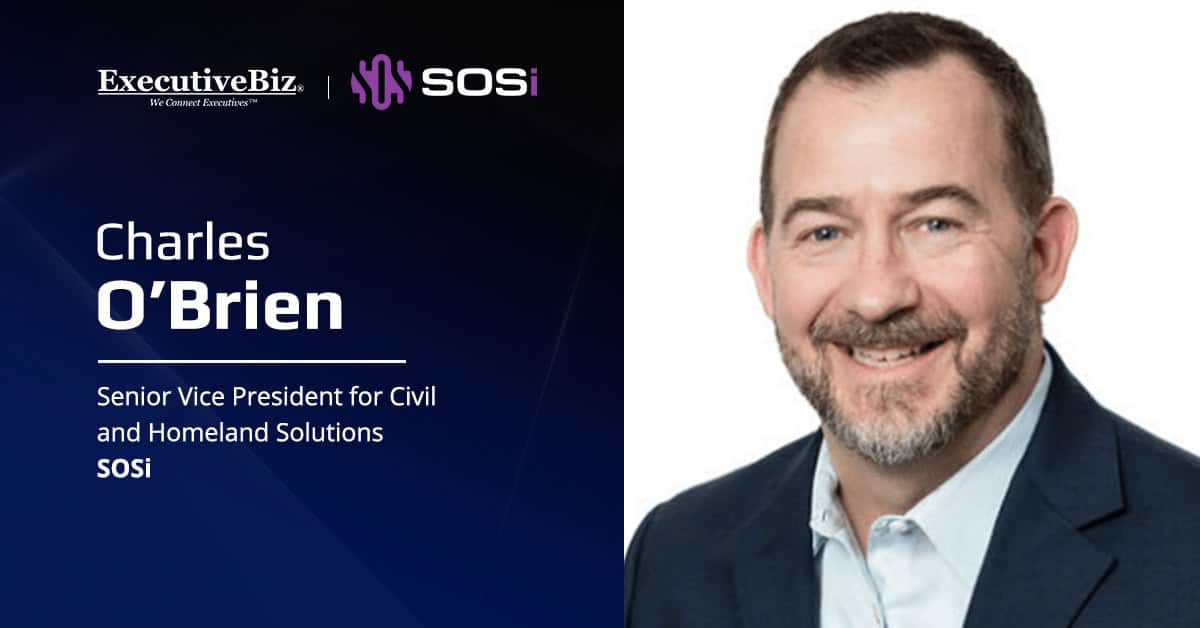
- Charles O’Brien, SOSi SVP, is helping scale its wordbridge language-access-as-a-service platform
- wordbridge combines human interpretation with automatic speech recognition
- He sat down for a Spotlight interview to discuss AI and LaaS
Charles O’Brien is senior vice president for Civil and Homeland Solutions at SOSi, a private defense and government services company that provides advanced technology, operational support and specialized services to U.S. government customers worldwide.
SOSi has a wide variety of capabilities, including data science, software development, network engineering and more. SOSi is also a provider of language services and technology solutions to federal and state agencies. It has delivered specialized foreign language support for critical healthcare, law enforcement, national security, intelligence and humanitarian operations for almost four decades.
We last sat down with O’Brien in 2024 to discuss expansion opportunities and setting priorities around limited capture dollars. ExecutiveBiz recently caught up with O’Brien for a Spotlight interview where the GovCon veteran discussed a key initiative he’s leading, growth opportunities in SOSi’s Civil and Homeland Solutions business unit and how agencies and contractors should respond to threats that cross traditional boundaries.
Federal healthcare programs are increasingly leveraging AI to detect fraud, waste and abuse. Dig into the policy, legal and technical implications by attending the Potomac Officers Club’s 2026 Healthcare Summit on Dec. 3.
The AI Governance and the Role of Policy Expertise panel discussion will examine how agencies can ensure both technically sophisticated and technically robust systems as AI moves from retrospective analysis into payment, oversight and enforcement decisions. Join the conversation with Ricky Clark, National Institutes of Health IT Acquisition and Assessment Center director and Cdmr. Darshan Thota, Department of War Joint Trauma System chief medical informatics officer. Secure your seat today!
ExecutiveBiz: What is a major initiative that you are leading?
Charles O’Brien: One of the initiatives I’m focused on is scaling wordbridge™, SOSi’s language-access-as-a-service platform that delivers comprehensive language support to government agencies and commercial customers. The goal is to help more organizations overcome language barriers to better serve the communities who rely on their services.
Specialized language services have been part of SOSi’s identity for decades. wordbridge began as a solution to simplify interpreter scheduling and has evolved into a full-service platform that brings SOSi’s entire interpreter workforce, one of the nation’s largest, into a single digital environment. It streamlines scheduling, automates administrative tasks and supports all language access needs on demand, including in-person, video remote, over-the-phone interpretation, scheduled appointments and document translation.
By combining human interpretation with automatic speech recognition, machine translation, optimized workflow automations and other AI capabilities, wordbridge delivers scalable, high-quality language support. Today, the platform facilitates more than 420,000 appointments annually across more than 405 languages through a network of 28,000-plus qualified interpreters, while maintaining a 96 percent appointment fill rate.
EBiz: How do you validate the accuracy of AI-assisted interpretation when a mistake could affect someone’s legal rights?
O’Brien: Qualified, trained interpreters remain at the center of the language support SOSi provides. Their fluency, cultural understanding, and judgment are critical in complex, high-consequence situations.
Technology’s role is to strengthen the system around that expertise. Demand for language support is growing across government, healthcare, education and the private sector, and meeting it means getting the right interpreter to the right appointment quickly. wordbridge brings qualifying, onboarding, scheduling and appointment management together in one platform, streamlining how requests are matched and tracked so we can expand capacity and keep our appointment fill rate in step with that growth.
Automatic speech recognition and machine translation enhance speed and efficiency by helping process information, reduce administrative burden and support communication workflows. Technology isn’t replacing expertise—it’s amplifying it.
Federal healthcare agencies are heavily investing in IT and electronic health record modernization, including $10 billion by the Department of Veterans Affairs. Hear from top government healthcare officials on how they plan to spend that money in fiscal year 2027 at the Potomac Officers Club’s 2026 Healthcare Summit on Dec. 3. Our all-star lineup of keynote speakers, including Kimberly Brandt, CMS deputy administrator and chief operating officer, Dr. Matthew Memoli, National Institutes of Health principal deputy director, and more to come, will provide exclusive insights on upcoming solicitations and requirements before they’re publicly announced. Sign up now for this essential GovCon conference!
EBiz: The work of SOSi’s Civil and Homeland Solutions business unit spans language services, case management, contact centers, healthcare, emergency response and data integration. Which line has the strongest growth runway over the next few years?
O’Brien: The greatest opportunity lies in delivering comprehensive, integrated solutions that combine those lines. That’s where SOSi is differentiated and where we see the strongest growth runway.
In practice, our most successful programs draw on several of these capabilities. Language services today almost always depend on remote delivery through contact centers. Matching a qualified, ready-to-work interpreter to a specific appointment is fundamentally a case management challenge, one that relies on optimized workflows and, often, customer relationship management tools. Underpinning all of it is data integration.
That integration layer is becoming increasingly critical. Much of our case management work now brings together open-source and publicly available information with personally identifiable information and protected health information, all within secure and compliant systems. This is especially important in emergency response and public safety missions, where accuracy and speed directly affect outcomes.
We are also seeing growing demand for public services delivered in stressed, time-compressed operational environments. Agencies operating in those conditions need more than a collection of vendors. They need a partner who can bring people, process and technology together as one solution and deliver from day one. That is exactly what we have built in Civil and Homeland Solutions.
EBiz: Homeland threats now blend cyber, terrorism, trafficking and transnational crime. How should agencies and contractors organize to respond to threats that cross traditional boundaries?
O’Brien: Threats that cross traditional boundaries demand a response built on deliberate operational integration, synchronization, and coordination.
The foundation is unity of effort. Agency authorities, jurisdictions and chains of command will remain distinct, so unity of command across them is rarely achievable. Unity of effort fills that gap by aligning every participant on the ‘why’ and the ‘what’ of the mission, while each organization retains responsibility for the how.
That alignment depends on shared situational understanding. A common operating picture gives every stakeholder the same view of the threat, and maximum interoperability allows them to act on it together.
In some cases, deliberate interdependency is the most effective path. The Goldwater-Nichols Act offers a useful model: by making the military services rely on one another, it made joint operations the norm. Joint and interagency task forces apply that same principle to homeland security missions.
Execution then comes down to discipline. Standardized enabling and sustainment activities give partners a common foundation. Joint planning and preparation integrate the actors and synchronize actions and resources across time and space. Coordination happens at the appropriate level, with strategic, operational, and tactical initiatives aligned among all direct stakeholders.
For contractors, the role is to strengthen that integration by delivering interoperable systems, supporting shared situational awareness, and operating as a seamless part of the mission team.