 Charles Lyons-Burt
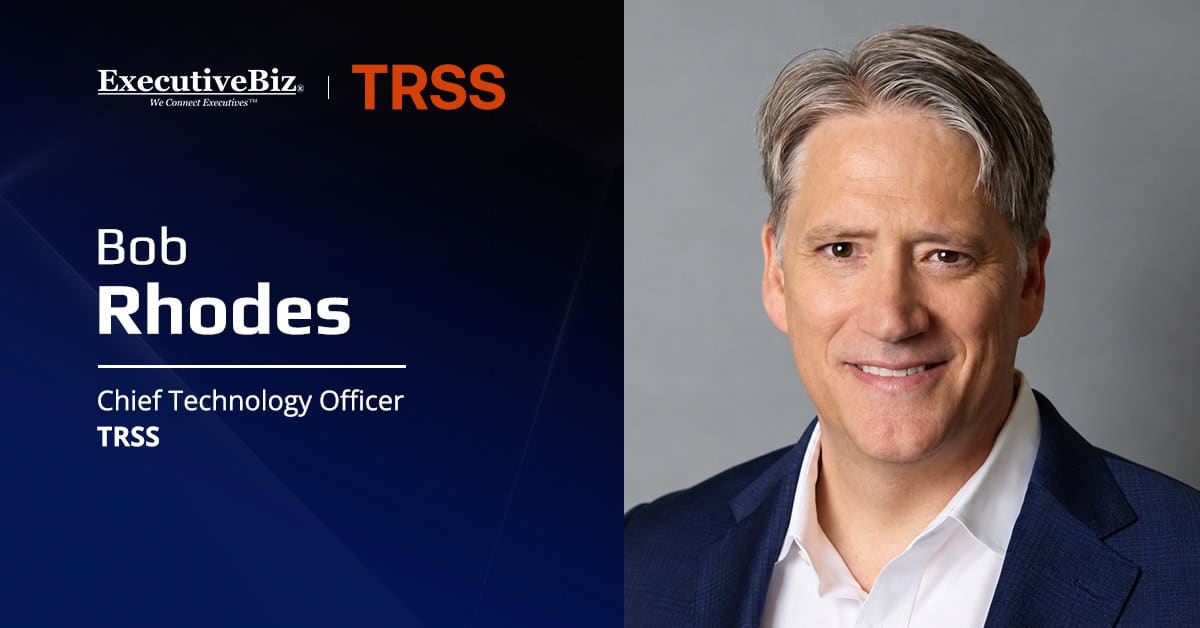
- Rhodes established the founding technology team at TRSS in 2009
- TRSS encodes analyst expertise into agentic AI
- Foreign entities of concern remain an underestimated threat
A few years after 9/11, Bob Rhodes learned something about his own company that permanently redirected his career. In the aftermath of the attacks, the business had been instrumental in identifying connections between the hijackers inside the U.S. It did this by drawing on public records and company data that had been hiding in plain sight.
“The key clues were actually in the data if we knew what we were looking for, if we could create the relationships and we could disseminate it in a way that could help an investigation,” Rhodes told ExecutiveBiz recently.
That realization sent the software engineer volunteering for projects with ChoicePoint Government Services. He has worked almost exclusively on government missions in the roughly 22 years since. Today, as chief technology officer of Thomson Reuters Special Services, or TRSS, Rhodes is applying that same conviction to agentic AI, graph analytics and global risk data built for the intelligence community, law enforcement and the Department of War.
In an Executive Spotlight interview, Rhodes explained how TRSS is encoding its analysts’ experience into AI workflows that didn’t exist half a year ago. He also covered why foreign entities of concern remain an underestimated national security threat and how the intelligence community has grown more receptive to commercially available data.

For more explorations of cutting-edge AI usage in the federal government, register for Potomac Officers Club’s 2026 FedCiv Summit on Oct. 29. CIOs and CTOs from across the federal civilian enterprise will speak, and panels will address agentic AI, OneGov and modernization.
ExecutiveBiz: AI is obviously the defining tech trend of this decade (probably this generation), and everyone is utilizing it. What’s one way TRSS is harnessing it for the government customer that differentiates you?
Bob Rhodes: AI is moving extremely quickly, as you well know. Just a little over two and a half years ago, it was just using large language models to ask questions and to try to get answers out of it. We’ve quickly moved past using LLMs just to answer questions, and we’re using AI today with agentic workflows. We’re using AI to help mine out answers to our customers’ most important questions using advanced context engineering. We know our customers extremely well. We know their missions, and our people are sitting next to our government customers in a lot of ways. So we’re taking advantage of the analysis and data science teams we have, and we’re encoding that analyst experience into our agentic workflows. We’re focused on outcomes grounded in authoritative content.
So we’re able to differentiate because we have tools that are trained with human-in-the-loop, but also with human experience. We’re building data products and tools on top of our data platform that our agents are then able to use to help quickly answer those questions.
What we’re doing today using AI assisted coding and product development wasn’t even possible six months ago. It was maybe being done in a research lab or at a frontier model company, but now the open-source tools and frameworks are maturing such that they’re enabling more and more powerful use cases and workflows every day. The question is less can we build something, but should we.
EBiz: The government is famously slow to adopt new technology, and by the time compliance approvals come through, the technology can be outdated. How is TRSS navigating that?
Rhodes: There are two things that I’d say are foundational. There’s the base level of cyber security trust that needs to be established. For our team, we have a long history of a very robust IT security infrastructure. We’ve also been very aggressive at tracking the development of policies like the 800-52, 800-171, FedRAMP and Cybersecurity Maturity Model Certification, or CMMC. We’ve been tracking CMMC since it was originally announced. Just this past June, after many, many iterations of the rules and the frameworks, we were CMMC Level 2-certified. We work very hard to keep up with government security policies and how we need to change as they evolve. Our security posture and our transparency about how we secure our systems and how we work with our government customers have been strong.
Secondly and most importantly is establishing and maintaining trust of the customers by providing them people of high character with the appropriate skills and clearances who are working within a high quality Facility Security apparatus. We work with the Defense Counterintelligence and Security Agency to make sure that our facility clearances and our personnel security program are robust and compliant. We’ve found that this helps our government customers, when possible, lean into some of the new technologies as they come out. If they trust that you’re operating your company securely and in compliance, then oftentimes government customers will be more open to looking at using new technologies where possible.
Now, we’ve seen instances where government policy doesn’t adequately keep up with the pace of large language model usage and AI usage. At the program level, oftentimes the end users of our customers really want to use some of the new technologies that we’re building but are unable to. They have to wait until we get the appropriate authorities to operate, or ATOs, or we have the conversations that we need to have with the CIOs or the CISOs of those teams. So we work really hard to be transparent about what we’re doing. Being smaller and so collaborative with our customers, I think it’s crucial that we can talk pretty transparently about where the data goes, how it’s secured, where the customer input goes and what happens after the data is processed by us and our people.
So it’s a mix. But one thing I’ve seen over the past year is that the government agencies we’re working with are looking for us to tell them about the new technologies so that they can run them up the chain and get approval. Even under an R&D approach, they’re eager to try out new technologies that are going to help their end users be more successful. So I think momentum is building, and people are more comfortable using AI in the government space than ever before. It really all comes down to trust. When you can prove that you’re grounding your answers in reliable data using AI, it helps the end user feel more comfortable using it.
EBiz: There’s more data to be understood, classified, organized and implemented now than ever before. What work is TRSS doing to help the government solve data challenges?
Rhodes: For a lot of our government customers, we’re really focused on building data products and aggregating content that is highly accurate, constantly being updated and global in scope. TRSS is building data sets that help our government customers understand who they’re doing business with and what risks are associated with the companies or people they’re doing business with. We’re also performing advanced analytics using graph technology, relationship analysis, and AI to help the government ask questions of the data in different ways and uncover the risks that may be more opaque.
We use large language models and AI techniques to translate a set of government user questions into a set of questions that our data systems can more accurately answer. That’s one of the ways we’re using LLMs to help the government customer ask better questions, and also to help our systems answer those questions more effectively.
EBiz: What’s one threat to national security that isn’t being talked about as much that you feel is critically important?
Rhodes: We talk about identifying risks, whether they’re shell companies or bad actors from foreign governments trying to do traditional espionage. People understand those risks. People understand that governments do that. I think the risk that is still underestimated has to do with the newer designation of foreign entities of concern. That means understanding who you’re doing business with further down the supply networks and how people or companies are connected back to state-owned entities. It also means spotting who is operating with purposefully opaque connections back to adversarial countries. That is one of those risks that people still underestimate.
Those types of risks enable fraud. They’re related to drug trafficking, corporate espionage and, like I mentioned, traditional espionage. They’re also related to supply chain risks. People know it’s important to understand those foreign entities of concern and who actually owns and operates the companies, to the nth degree of separation. But I think people still undervalue the risk it could pose if you don’t understand transparently who you’re working with.
That’s especially true if companies have to attest that their supply chains are clean. That’s a risk to the company, because at some point, do they really know every step? Especially on the commercial side, do they really know every step in the chain of where things are coming from? Oftentimes, I think the answer to that is no.
EBiz: TRSS was the Lead Platinum Sponsor of Potomac Officers Club’s 2026 Intel Summit in September. Why is it important for the intelligence community and industry to get together right now? And what’s one way the IC has changed over the last few years?
Rhodes: It’s important for industry and the intel community to get together because, while I think the gap is closing, what we’ve seen over the years is that the intel community is all about collecting their own intelligence. They’re producing finished intelligence, they do it the best and they produce the highest-quality packages. But why it’s important for us to get together is that the data in the open sources, we believe, changes faster and can be as relevant as data collected and produced by traditional intelligence tradecraft. If industry and the intelligence community can work together more closely, the intel community can have access to the highest-quality content in the fastest amount of time. That’s going to close the gap for critical decisions to be made.
It’s also important because the intelligence community, and that whole apparatus, is built on trust. There are many companies like ours that would love to be able to help the country and the community, so it’s important for the intelligence community to learn about companies who may be able to provide some dual use capabilities to the IC. It’s also important for companies that may not even realize they have data that could be useful to the intelligence community to be open to working with the U.S. government. That dialogue lets ideas pass back and forth, and maybe the crucial piece of evidence comes from a company connection that didn’t previously exist.
As for how the IC has changed, in my opinion, the IC is embracing technology in ways where, before, it might have relied on human-only collection and analytics. The IC is leaning into using AI and alternative ways to collect information. It’s not a perfect data-sharing environment, but I think some improvements have certainly been made over the last few years in data sharing and intelligence sharing between the IC and other agencies. That could always be improved, I’m sure. But from my perspective, I’ve seen the IC start to value commercially available data to help inform its mission. That’s gotten better, from my view.
That includes open-source intelligence, or OSINT, but also commercially available or aggregated data like ours. With data like ours, you’re finding information on companies that has been synthesized in a way that helps the IC understand the risks or advantages related to the company aggregated from many sources. Where does the company operate? Who operates the company? What does it do? Can it help, or does it pose a risk to the community? I think the IC is more open to using commercial partners for some of that data because of the scale of aggregation and the ability of the commercial world to keep the most up-to-date data possible. When you’re talking about taking large data sets and moving them into the IC, that introduces a certain amount of latency that, in some ways, reduces the value of the data. If the data’s a year old, it’s not as valuable as if it’s a month or a day old.
Who Is Bob Rhodes?
Bob Rhodes is chief technology officer of TRSS, a role he has held since August 2017. He leads the company’s technology teams, which span IT infrastructure and cybersecurity, product development, software engineering and data. His focus areas include team and leadership development, strategic vision, product innovation, insights generation, AI, and agentic workflows. He applies these technologies to the real-world problems facing the intelligence community, law enforcement, the Department of War and financial institutions.
Rhodes was one of the founding members of TRSS in 2009 and has served as its principal architect and later CTO ever since. He joined Thomson Reuters in 2008, when ChoicePoint Government Services and its CLEAR product were sold to the company after Reed Elsevier’s LexisNexis acquired ChoicePoint.
Earlier, Rhodes held software engineering and business technology relationship manager roles at ChoicePoint, which had acquired his previous employer, Database Technologies. He began his career in 1998 as a webmaster for Information America and KnowX. He is a self-taught engineer and excels at learning by doing and by absorbing knowledge and experience from those around him. He has continued to learn throughout his career by attending numerous professional development courses and training programs in business and technology from organizations like UC Berkeley, Wharton and MIT. Rhodes is a contributor to several U.S. patents and is on the board of trustees at Thomas University. Rhodes has dedicated his work to government technology and data solutions since 2003.
What Is TRSS?
Thomson Reuters Special Services is a wholly owned U.S. subsidiary of Thomson Reuters. It uses global data, technology and expertise to help government agencies, law enforcement and corporations assess risk, illuminate networks and address critical threats. The McLean, Virginia-based company was created specifically to serve U.S. government customers, since its parent company is majority Canadian-owned.
TRSS is mitigated for foreign ownership, control or influence, or FOCI, which allows it to support classified and sensitive work. The company is led by an independent board of directors that includes former senior staff from the Department of War, National Security Council, FBI and White House.