
 Pat Host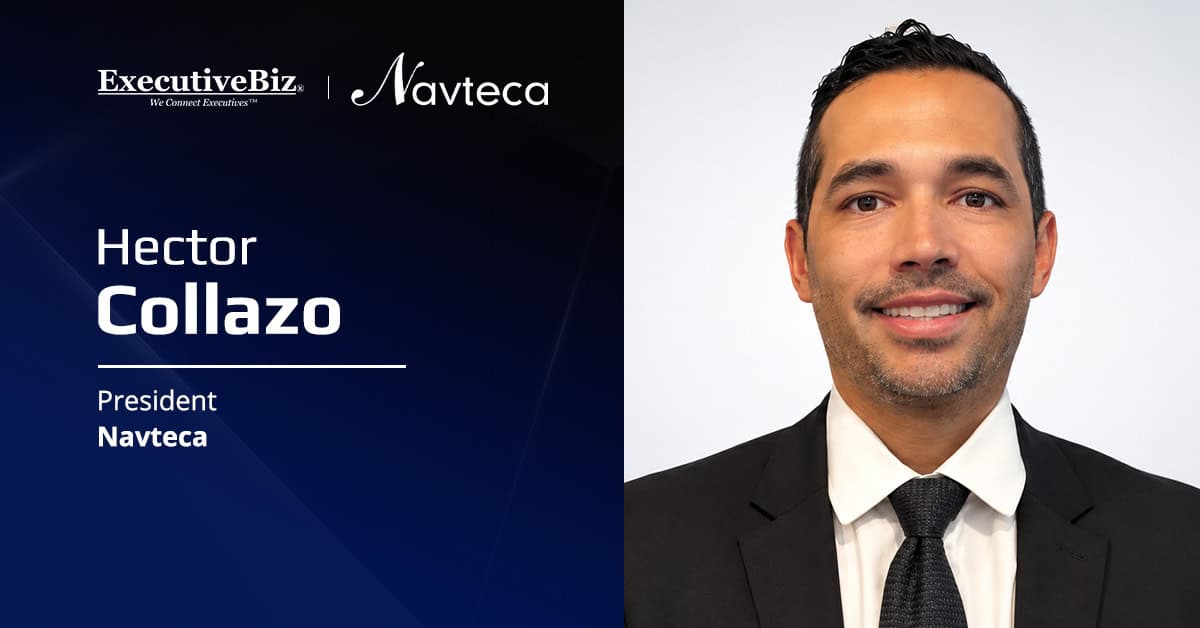
- Hector Collazo knows how emerging technologies actually move from a lab to the field
- At Navteca, he’s building a firm that can operate in highly technical and consequential realms
- Collazo sat down with ExecutiveBiz to discuss edge AI, data readiness and acquisition
Hector Collazo understands how to conquer the “valley of death.” The Navteca president has spent 20 years supporting the most consequential defense and science missions from the Department of War and the Defense Advanced Research Projects Agency to the National Aeronautics and Space Administration and the U.S. Geological Survey.
At these agencies, Collazo got a first-hand view on how emerging technologies actually move from the lab into the field and what it takes to get them there. He’s helped build Navteca into a small business that can operate in highly technical and high-consequence environments.
Collazo is leading the continued expansion of Navteca’s AI capabilities, particularly where it intersects with cloud and high-performance computing, cyber and other capabilities. A veteran of many technology cycles across defense, space and civilian missions, what makes AI different to Collazo is both the speed of advancement and the number of missions it touches.
The question is no longer whether an agency can stand up an AI prototype. Instead, to Collazo, it’s whether that capability can be trusted, secured, integrated with existing systems and operated successfully in a real-world environment.
We’ve frequently profiled Collazo, most recently in September 2025 and a few times when he was at Sev1Tech. We caught up with Collazo for his latest Spotlight interview to discuss the difference between applying AI to scientific data and fraud detection, common data readiness problems that impede federal agencies from starting AI initiatives, an underappreciated technology and which acquisition reform effort would have the most impact on technology adoption.
Trusted information-sharing is a top priority among federal civilian agencies. Examine AI and commercially derived intelligence for interagency collaboration at the Potomac Officers Club’s 2026 FedCiv Summit on Oct. 29!
Our AI, Interoperability, and Trusted Information Sharing panel discussion features a pair of top federal technology officials in Emily Burdick, Department of Energy acting director for cybersecurity, energy security and emergency response, and Tiffany Swygert, Centers for Medicare and Medicaid Services deputy director for innovation and financial management. Get your burning questions answered by Burdick and Swygert during our informative question-and-answer session. Sign up today!
ExecutiveBiz: Navteca’s work spans geographic information system data visualization and machine learning/AI for clients like NASA and NOAA. How does applying AI and machine learning to scientific and Earth-observation data differ from more typical federal AI use cases like fraud detection or predictive maintenance?
Hector Collazo: In a fraud detection or predictive maintenance use case, the model is largely judged on whether the prediction is right. Scientific AI presents a very different challenge because the objective is often not simply to predict an outcome. Scientists need to understand why a model produced a result, where the underlying data originated, what transformations were applied and whether the result can be scientifically reproduced.
Earth observation is a good example. We are dealing with enormous volumes of heterogeneous data coming from satellites, airborne sensors, ground observations, simulations and, increasingly, other commercial and government sources. Those datasets have different spatial resolutions, temporal resolutions, formats, calibration requirements and uncertainty characteristics.
That makes data and model provenance extremely important. If an AI model identifies a change in vegetation, predicts wildfire behavior or detects an anomaly in satellite imagery, the scientist needs more than an answer. They need confidence in the lineage of the data and the methodology behind the result.
There is also a significant computing challenge. Many scientific AI workloads combine cloud computing, high-performance computing, large data repositories and specialized accelerators such as graphics processing units. Navteca has worked extensively in hybrid cloud and high-performance computing environments and we see AI becoming another component of that scientific computing ecosystem.
The opportunity is enormous. AI can help scientists analyze datasets at a scale that would be impossible manually. But scientific AI has to augment scientific expertise rather than obscure it. The goal should be to accelerate discovery while maintaining transparency, reproducibility, and trust.
EBiz: Good AI/ML outcomes depend on good data foundations. What’s the most common data readiness problem you run into before an agency can even start an AI/ML initiative?
Collazo: The most common problem is usually not a lack of data. Government agencies often have tremendous amounts of data. The challenge is that the data was collected over decades by different programs, for different purposes, using different systems and standards.
Before you can build a meaningful AI capability, you have to understand what data exists, where it resides, who owns it, whether it can be accessed and whether its quality is sufficient for the intended use.
We frequently see organizations eager to start with a model or a generative AI application when the first investment should really be in the data architecture. That means building reliable data pipelines, establishing metadata and governance, addressing access controls, understanding data lineage, and creating interfaces that allow data to be discovered and used consistently.
Another major issue is organizational. Data ownership often crosses multiple programs or organizational boundaries. The technology to integrate those datasets may exist, but policy, security and authority to operate boundaries, governance, or acquisition boundaries can make integration difficult.
My view is that agencies should treat AI readiness as data and infrastructure readiness. The model is often the most visible part of an AI system, but it is only one component.
If agencies build strong data foundations, they also avoid locking themselves into a particular AI model or vendor. Models will continue to change rapidly. A well-designed data architecture gives an agency the flexibility to evaluate new models and technologies without rebuilding the entire environment every time the technology changes.
The White House has proposed a record $76 billion budget for fiscal 2027 to support IT projects at FedCiv agencies. Hear directly from the top federal officials directing that spending at the Potomac Officers Club’s 2026 FedCiv Summit on Oct. 29. Get beyond the headlines with our stellar lineup keynote speakers:
- Dawn Zimmer, Department of Energy CIO
- Bill Briggs, Small Business Administration deputy administrator
- Mangala Kuppa, Department of Labor chief information officer
- Greg Justice, General Services Administration chief acquisition officer (pending confirmation)
- Pavan Pidugu, Department of Transportation chief digital and information officer (pending confirmation)
Learn about initiatives and policy shifts to better tailor your proposals. Secure your seat now!
EBiz: What technology do you think will have the biggest impact on the warfighter in the next five years that isn’t getting enough attention today?
Collazo: Having spent much of my career supporting DOW missions, including DARPA, I believe one of the most consequential areas over the next five years will be the convergence of edge AI, autonomous systems and distributed computing.
Much of the attention today is on generative AI and very large models running in hyperscale cloud environments. Those technologies matter, but the operational environment presents a very different problem.
The warfighter cannot assume continuous access to high-bandwidth connectivity or a centralized cloud. Communications will be degraded, intermittent, contested or denied. That means more intelligence and computing capability has to move closer to the point of need.
A sensor, unmanned system, aircraft, vehicle or deployed unit should increasingly be able to process information where it is generated. Rather than moving massive volumes of raw data back to a central environment, AI at the edge can identify what matters, prioritize information, flag anomalies and deliver actionable insight locally.
What I believe is underappreciated is that this requires far more than putting a model on a device.
We need an integrated computing continuum that connects the tactical edge, autonomous platforms, enterprise cloud, data centers and HPC environments. Applications and workloads should be able to operate anywhere across that continuum based on mission requirements, connectivity, latency, security and available compute.
DARPA has long demonstrated the importance of looking past incremental improvements toward technologies that fundamentally change operational capability. I believe distributed intelligence is one of those opportunities.
The strategic advantage is not simply having more AI. It is compressing the time between sensing something, understanding what it means, making a decision, and acting on it. That is where AI can have a profound impact on the warfighter.
EBiz: What acquisition reform would have the biggest impact on how quickly agencies can adopt new technology?
Collazo: Government has become fairly good at creating on-ramps for experimentation. Between Small Business Innovation Research, Small Business Technology Transfer, other transaction authorities, commercial solutions openings, pilots, prize challenges and agency innovation organizations, there are many ways for agencies to work with emerging technology and nontraditional contractors. The larger problem is what happens when the technology works.
A company can demonstrate a capability, meet every technical objective, prove measurable mission value and have an enthusiastic government customer, and still face a long and uncertain path to production. Everyone in this industry knows it as the valley of death, and it remains one of the most important acquisition challenges in government: the gap between innovation and operational adoption.
I would like to see a more predictable transition pathway. If an agency has competitively selected a company, funded a prototype or pilot, established measurable success criteria and confirmed those criteria were met, there should be a streamlined mechanism for moving that capability into an operational environment. Authorities such as SBIR Phase III and follow-on production under OTAs exist for exactly this purpose, but they are applied unevenly and often too slowly.
That does not mean eliminating competition or acquisition oversight. Those protections matter. It means designing the acquisition system so that successful innovation has somewhere to go.
Agencies should also acquire emerging technology more incrementally. Define the mission outcome, deliver capability in smaller increments, measure the results and scale what works.
That is especially important for AI, cybersecurity, autonomous systems, and other rapidly evolving technologies. A requirement written today may be technically obsolete by the time a traditional multiyear acquisition reaches implementation.
Acquisition reform should ultimately be measured by one question: how quickly can we move a proven capability into the hands of the mission?
If we can shorten that cycle while maintaining appropriate competition and oversight, we will dramatically improve government’s ability to adopt innovation.