

 Pat Host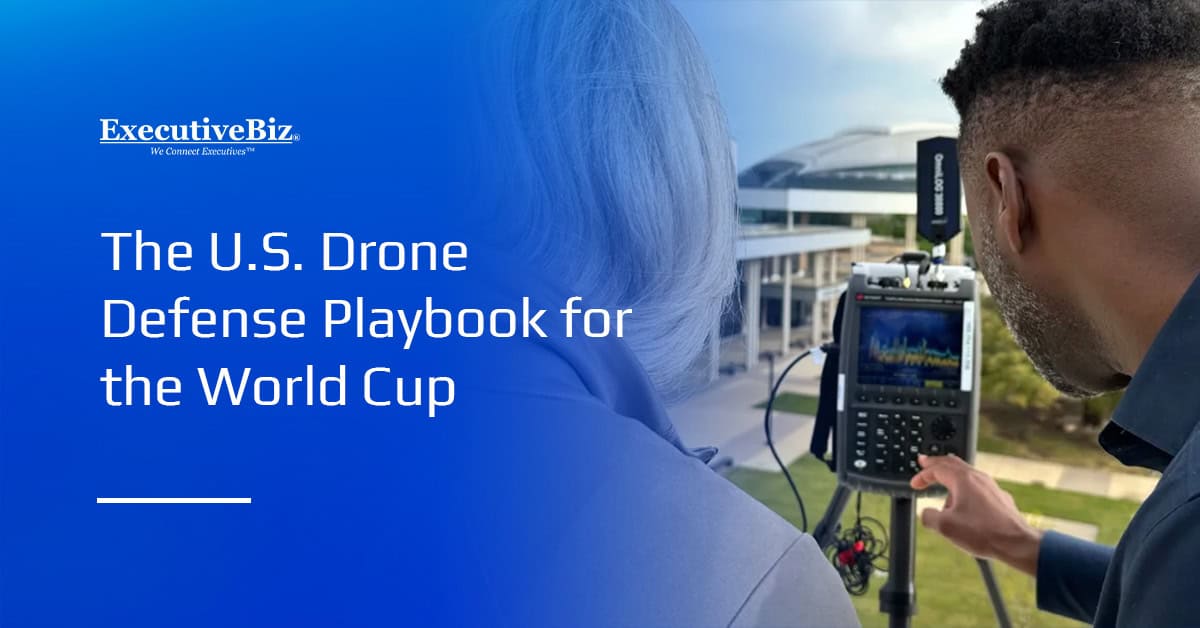
- DHS developed custom C-UAS mitigation strategies for all 11 U.S. World Cup sites
- The goal was to provide detailed guidance to federal, state and local stakeholders
- Unveil innovative C-UAS practices by attending the 2026 Homeland Security Summit!
The 2026 World Cup was more than just a soccer tournament. It was a global mega event spread over three countries, including U.S. 11 host cities, that required immense amounts of planning and logistics from a wide range of stakeholders.
The U.S. homeland security enterprise responded by deploying counter unmanned aerial system, or C-UAS, devices, technologies and strategies to keep crowds safe. Ahead of the tournament, the Department of Homeland Security’s National Urban Security Technology Laboratory, or NUSTL, and the DHS Science and Technology Directorate collaborated with stakeholders in each city, including Boston, Kansas City and Philadelphia, to develop customized technical specifications and best practices.
This included C-UAS equipment selection, siting, integration, deployment and operations to secure the national airspace throughout the tournament. The goal was to provide detailed guidance to federal, state and local stakeholders and stadium owners about where to place C-UAS equipment to maximize the total coverage realm for timely threat detection during matches and associated events.
Let’s dive into five key insights for GovCons into this massive technological undertaking and some of the C-UAS technologies used, and strategies executed, to help protect the World Cup in the U.S.
Dig into technology and authority gaps in C-UAS capabilities and policy by attending the Potomac Officers Club’s 2026 Homeland Security Summit on Nov. 10! Our Safeguarding the Homeland: Coordination for C-UAS Operations panel discussion will address the accelerating threat posed by weaponized UAS, swarms and other autonomous systems.
Examine innovative detection, tracking and defeat strategies with Tony Crane, Customs and Border Protection executive director for the C-UAS defense capability group, and Cathy Lanier, NFL senior vice president and chief security officer. Sign up now!
What C-UAS Strategies Did the U.S. Use to Protect the World Cup?
1. Custom Plan of Action for Each Venue
As each individual stadium was different, DHS developed a unique plan of action for each venue that considered a variety of factors for C-UAS sensor placement. This included a 360-degree line-of-sight analysis and radio frequency spectrum evaluation. It also examined the suitability of physical characteristics near the top of each venue for deploying the necessary equipment.
DHS improved its C-UAS capabilities at large scale events leading into the tournament , according to Drone Life. Homeland Security Secretary Markwayne Mullin said in a June House hearing that officials were able to successfully ground eight drones that had violated airspace restrictions during the Miami Grand Prix Formula 1 auto race in May. He also said DHS was able to ground 12 UAS that entered restricted airspace during the Masters golf tournament in April.
Mullin said providing C-UAS protections for “soft areas,” like fan festivals, was one of his biggest safety concerns for ensuring the safety of all World Cup sites.
2. Lots of Cooperation and Coordination with Private Infrastructure Operators
Securing a global mega event like the World Cup was far from an individual effort. DHS, for the tournament, entered into extensive levels of cooperation and coordination with public infrastructure operators outside of the host venues.
The NUSTL identified contacts for surrounding buildings that could also prove suitable for placing C-UAS equipment. The team then coordinated with the owners of 12 structures in Atlanta and 16 in Houston.
NULSTL engaged with owners of infrastructure that, upon first glance, seemed unrelated to the World Cup: parking ramps, hotel, condominiums, car dealerships, university buildings and a range of others. It then deployed C-UAS equipment on all of their rooftops.
Fast-evolving UAS capabilities are redefining homeland security. Join the conversation by attending the Potomac Officers Club’s 2026 Homeland Security Summit on Nov. 10. Get the inside scoop on the Federal Emergency Management Agency’s expected $250 million C-UAS grant program for fiscal year 2027 from our stellar slate of keynote speakers:
- Troy Edgar, DHS deputy secretary
- Sean Curran, U.S. Secret Service director
- Paul Courtney (pending approval), DHS chief procurement officer
Secure your seat today for this highly-anticipated GovCon forum!

3. Use of Highly Advanced C-UAS Technologies
DHS used some of the most advanced C-UAS technologies to help secure U.S. World Cup venues. The NUSTL team produced aerial-view line-of-sight images that used color codes to display the minimum altitude at which an unidentified UAS can be detected by a sensor.
In addition to mapping obstructions to physical visibility, NUSTL also measured invisible obstructions to sensor capabilities by examining the RF environment of each venue. Spectrum analyzers allowed the team to identify potential sources of interference, such as dense WiFi, broadcast signals and cell towers.
DHS also measured the RF environment near the stadiums using internet speed tests to assess the typical demands on local cellular infrastructure. This allowed NUSTL to also accommodate the expected influx of a stadium’s worth of fans and their smart device technologies.
Dr. Alex Sedunov, NUSTL staff member, developed a map-based engineering tool that permitted a variety of sensors to be placed on a map detecting UAS targets at different heights. It also visualized RF survey and line-of-sight results, and detailed photo documentation, for each sensor location, providing NUSTL staff members with a holistic view of coverage options for the entire system of sensors.
4. After-Action Analysis and Application to Future Events
NUSTL’s C-UAS work is still ongoing despite the World Cup concluding in July. Expecting another round of C-UAS grant funding to be released by FEMA this fall, NUSTL is collecting after-action reports from their state and local stakeholders in host cities.
These after-action reports will allow DHS to further refine its guidance and tools based on real-world operator feedback. The lab will also help additional state and local agencies with lessons learned from their World Cup experience and continue their work optimizing the collective use of federal, state and local C-UAS assets into the future.
FEMA in December 2025 awarded $250 million to the 11 states hosting the tournament and to the Washington, DC metro region to improve their ability to detect, identify, track and mitigate UAS.
“The 2026 FIFA World Cup [represented] an unparalleled scale of event security and coordination. The insights and lessons gained from this undertaking will significantly inform the planning and execution of future [large scale] events, including the multi-city Los Angeles 2028 Summer Olympics,” said Teddy Damour, NUSTL engineer. “Building on the experience gained from the World Cup, NUSTL will continue to provide state and local partners, as well as DHS components, with comprehensive C-UAS technical support.”
5. Leveraging Less High-Tech, but Still Critical, Deployment Details
DHS utilized many less advanced, but still tried and true, technologies to secure U.S. World Cup stadiums from unauthorized UAS advances. NUSTL staff examined how rooftops could be accessed and whether those access points were suitable for transporting C-UAS equipment for installation.
Government personnel also assessed and documented available rooftop power sources in addition to any existing equipment that could present challenges to optimal readings, like existing antennae and sensors.