
 Charles Lyons-Burt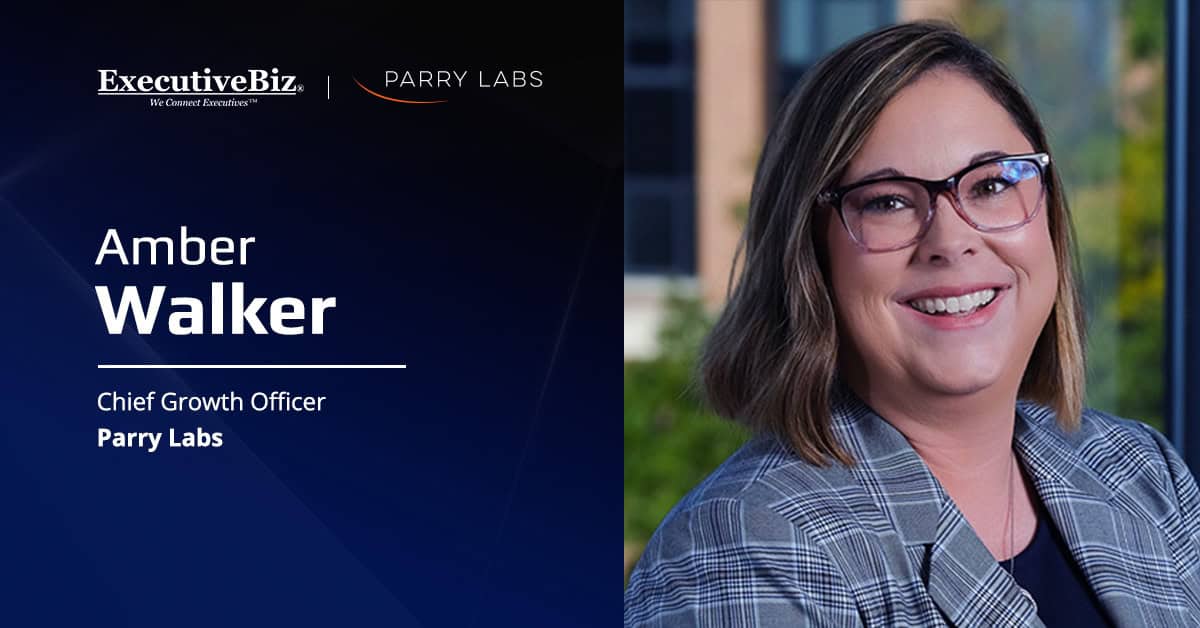
Amber Walker built her career on a single throughline: understanding the operator’s problem firsthand before trying to solve it with technology. A West Point graduate, Walker spent the better part of two decades in uniform, culminating in a role as a program manager at the Defense Advanced Research Projects Agency, where she oversaw a high-paced missile development effort spanning four prime contracts worth more than $160 million. It was there, she said, that she found what she wanted to be when she grew up.
“I really enjoyed the ideation and the applied research and development, program and product management aspect of my role there,” Walker told ExecutiveBiz. “So that’s when I decided to leave active duty service and go pursue that full time as a career in the defense industrial base.”
Walker left active duty in 2021 and moved through senior technical and business development roles at Raytheon Intelligence & Space and Anduril Industries before joining Parry Labs in the spring of 2024 as senior vice president of ground, C2 and maritime. She was named chief growth officer in July 2025.
“At my heart, I’m a technologist, but all of my operational expertise is really on the application in aerospace and defense,” Walker said. “I’ve been on both sides of the need for the equipment and understanding the national security space, and I’m happy to continue to contribute to it in a different way.”
We caught up with Walker to discuss her vision for Parry Labs, how the company is approaching AI at the tactical edge and her advice for the next generation of GovCon executives.
ExecutiveBiz: As chief growth officer, what’s your vision for Parry Labs over the next five years?
Amber Walker: My focus has largely been, and will continue to be, on manned-unmanned teaming and enabling mixed robotic and manned fleets. Since my graduate degree programs in the early 2000s, robotics, autonomy and artificial intelligence have become such battlefield multipliers, and a lot of what I’m focused on, and what Parry is focused on, is helping realize that future vision.
I think we’re unique in the industry because of where we sit in an interoperability manner. We’re very vendor agnostic. We work with hundreds of different companies and algorithms across the board, really focused on making disparate systems work better together toward a common effect. If we’re successful over the next five years, I think you’ll see Parry more and more in that robotic command and control, autonomous systems enablement space, giving commanders a better view of the battlefield and further reach through the intelligent use of robotic systems.
EBiz: Lots of companies are competing to use AI right now. What’s Parry’s differentiator?
Walker: We have our own use of AI, both for product development and direct customer-facing capabilities, but I’d say Parry’s value in the AI race is more about our ability to enable and host AI at the edge. AI for decades has really been a cloud-based, large-data-center problem and solution, and where we’re going, at least in the defense space, requires that we push AI further out to the tactical edge. A lot of the software and hardware we build is focused on getting AI further toward the edge, into more disconnected systems with lower demands for processing and networking.
We’re also focused on how you make AI work alongside deterministic systems, aircraft, main battle tanks, these complex weapon systems. A lot of what we do today in defense is built around provable outcomes on some of this equipment, and now we’re adding systems to the battlefield that don’t necessarily have provable outcomes. Parry has spent a lot of time looking at that problem and developing solutions for it.
Parry’s value in the AI race is more about our ability to enable and host AI at the edge.
EBiz: How do you go about proving those outcomes?
Walker: For us, it’s less about trying to prove the AI outcomes and more about trying to prove that non-deterministic outcomes cannot impact safety-critical, or in some cases mission-critical, components in a vehicle. It’s a lot about separation and severability between those components. You’re never going to make AI perfectly safe in every scenario, and you can see that in the autonomous vehicle industry. The best you can do is draw a box around those capabilities and prove that box cannot be breached. That’s one of the approaches Parry has taken, especially when we think about aircraft and avionics.
EBiz: Has Parry worked directly on programs like Collaborative Combat Aircraft, where AI operates alongside crewed platforms?
Walker: We haven’t directly, though we have enabling capabilities that are applicable across a lot of aircraft. What’s interesting about something like CCA is you’re in a fully unmanned vehicle, so the safety case can look different depending on who the approval authority is and how they’re taking it through safety certification.
Where it gets hairy is when you’re talking about launching, say, a Group Two-launched effect off of a crewed helicopter, where now you have them operating in close proximity, or a loyal wingman scenario where you’ve got a crewed fighter and an uncrewed fighter potentially sharing airspace. Those boundaries become so critically important because the highest safety cases tend to be driven by the presence of human beings.
EBiz: How has your military background informed your work at Parry?
Walker: A lot of what we do just requires a common understanding, a common language. My military background has really helped me speak that common language with the operators and warfighters who are depending on the technology. I think there’s real value in having firsthand experience in a problem set rather than reading off a prompter and trying to interpret it.
That said, I’ve worked with a number of people in GovCon who have no military experience, some of whom came in through the commercial side and transitioned to defense later. As long as you provide the right mixture of backgrounds in a company or a group, that collaboration can make up for a lot. There are experiences I don’t have that others on my team do, and vice versa.
EBiz: What advice would you give to up-and-coming GovCon executives?
Walker: Surround yourself with people who fill your knowledge gaps. Build a team around you that’s well-rounded. And then, like anyone will tell you, and GovCon is no different, build your network of strategic partners and folks on the customer side who can speak to the customer’s problems. Go to the conferences. That’s never my favorite part, but go to the conferences, because you’ve got to stay in touch with what the problems are and how the threat is moving.
EBiz: There’s an increased push toward bringing commercial and private-industry talent into government and Pentagon roles. Is anything lost in that shift?
Walker: For sure. I think right now, the risk is you’re losing your most seasoned people and your most junior people. What’s left is a very competent middle that can carry the water, but what we’re not doing is creating the next generation’s senior leaders. That worries me, not just in government, but with AI taking over more entry-level positions too. How are we grooming the technologists and technical expertise we need for the next 20 years?
The benefit of the commercial mindset is that these are people who have lived in tools and processes the government hasn’t touched, in maybe its entire history. I do think forcing higher velocity into government is important. I believe nature seeks an equilibrium, and over time we’ll find the right mix. Maybe there’s an overcorrection now that comes back to more of a middle longer term, but I do think it’s a necessary blend.
It’s less about trying to prove the AI outcomes and more about trying to prove that non-deterministic outcomes cannot impact safety-critical, or in some cases mission-critical, components in a vehicle.
EBiz: Why did you want to focus this conversation on commercial software?
Walker: Two reasons. One, Parry is, at heart, a software company, so if I’m here representing Parry Labs, I should talk about software. Second, early in my career, through my master’s degree, I would’ve told you I was a mechanical engineer. I built and designed systems, did materials experiments—a lot of fast-fracture and finite element analysis. When I went for my doctorate, I made a pivot into software, and I’ve kept getting drawn back to it because it’s so rapidly changing.
As somebody who enjoys ideation and applied research and development, I can build an infinite number of new things through software in a compressed timeline. Hardware takes longer, and even when you’re fast in hardware, you’re still not going to refresh it as often. It’s more costly and more difficult to maintain and capitalize. Software is eating the world because it’s soft versus hard on the hardware side, and there’s just so much you can accomplish through it without a lot of changes to the rest of the system.
EBiz: What’s your take on the shift toward commercial software and COTS, and how does that change the role of bespoke systems in military technology?
Walker: It’s important to separate commercial from COTS. Commercial off-the-shelf implies there are no changes made, you’re getting the exact version everyone else has purchased, whether that’s Microsoft Office 365 or an Apple application. Commercial software is a bit more liberal. It’s about how it was funded, primarily at private expense, with potentially non-defense or multiple user personas, without necessarily being the exact same piece of software every time it’s deployed.
COTS is very difficult in defense outside of enterprise IT, but commercial software, where that last 10 percent is configured to a specific mission set or platform, has a lot of potential. When I think commercial software, I think heavy reuse: something developed against a well-described, broadly stated need, with more than one buyer and more than one user persona, that I can reuse to attack many problems.
That said, bespoke systems still have a place. In cases where software isn’t broadly applicable, doesn’t have multiple user personas and has a single buyer, there will always be a need for it. Fire control is the easy example; nobody else is buying that, and it’s very specific to a weapon system or a vehicle. As long as we understand where one starts and the other ends, we’re doing alright.
EBiz: Anything else you’d like to add?
Walker: GovCon, aerospace and defense is an exciting place to be right now. I’ve never seen as much change in it in my 25 years working in this industry, and I’ve never seen so much passion for solving the problem and solving it quickly. That passion has introduced some chaos to the system, but chaos breeds opportunity. I’m not pretending it isn’t hard or chaotic some days, but the alternative is that things never change, and I don’t think any of us could afford that as Americans. There’s a lot of opportunity in the chaos.
Who Is Amber Walker?
Amber Walker is chief growth officer at Parry Labs, a role she has held since July 2025 after joining the company as senior vice president of ground, C2 and maritime in the spring of 2024. A West Point graduate, Walker spent more than a decade on active duty in the Army, including as an assistant professor of civil and mechanical engineering at the U.S. Military Academy and as a program manager at DARPA’s Tactical Technology Office, where she managed a missile development portfolio spanning four prime contracts worth more than $160 million.
Walker left active duty in 2021 and went on to hold senior roles at Raytheon Intelligence & Space, including autonomy lead at Raytheon BBN Technologies and deputy business unit lead for network and cyber technologies, before serving as senior technical director at Anduril Industries. She has also supported the Defense Innovation Unit’s space portfolio and served on the Army Science Board’s systems engineering subcommittee. Her focus throughout her career has centered on human-robot interaction, shared autonomy and manned-unmanned teaming.
What Is Parry Labs?
Parry Labs aims to redefine the edge for the modern battlespace by rapidly delivering digital systems infrastructure to ensure operational superiority. Through the integration of open software architecture and hardware, the company provides scalable solutions that let organizations deploy mission-critical capabilities in real time. Parry Labs is headquartered in Alexandria, Virginia.