
 Pat Host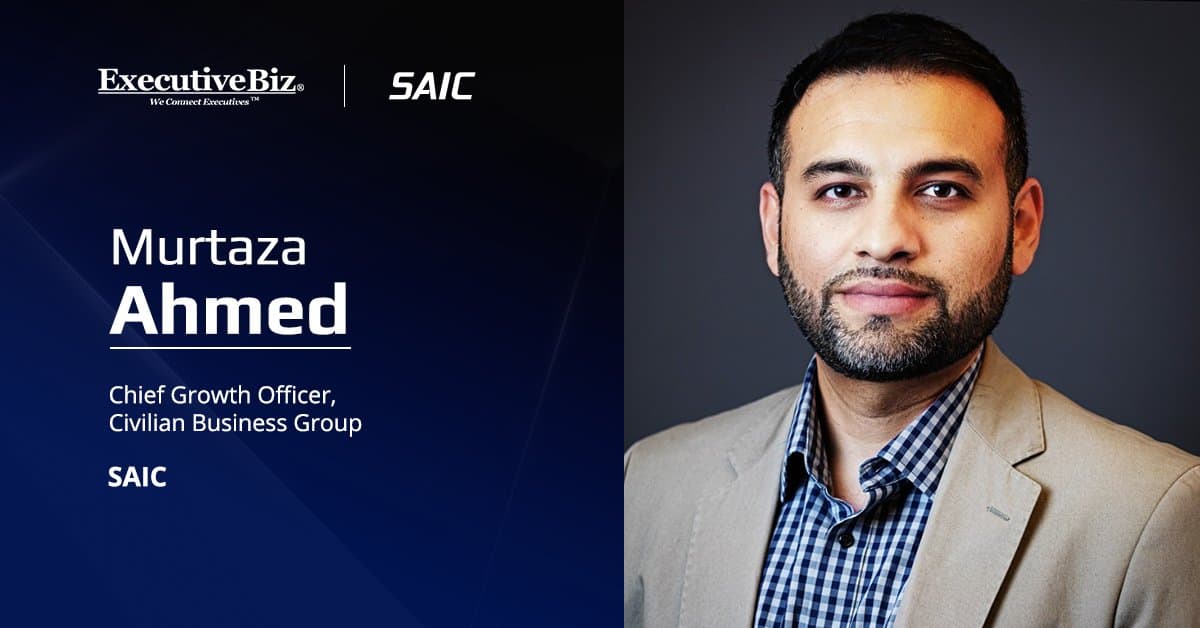
- Murtaza Ahmed, chief growth officer for civilian business at SAIC, had a revelation at the intersection of technology and service early in his GovCon career.
- By installing a document scanner at a local Social Security Administration field office to help applicants move claims along faster, he learned that tech applied properly can help governments better serve people.
- He sat down with ExecutiveBiz to talk state and local government procurement, untapped opportunities in government services or technology and qualities he seeks in new talent.
Murtaza Ahmed had a revelation at the intersection of technology and service early in his 22-year GovCon career. At the time, disability claimants in 2004 submitted medical evidence through manual processes, slowing decisions and delaying benefits.
By installing a document scanner at a local Social Security Administration field office, Ahmed, now SAIC‘s chief growth officer for civilian business, helped disability claimants submit medical evidence electronically. This helped claims move faster and gave people a better chance of receiving essential benefits sooner.
While this wasn’t the largest program Ahmed has supported and not his most complex technology project, it made an important point: technology applied the right way can directly improve how the government serves people.
Ahmed is now focused on mission modernization across the civilian government market. While technology such as cloud computing, data, cybersecurity and AI is changing quickly, the goal remains to use the right technology to help improve missions that affect citizens, veterans, families, travelers and communities every day.
Ahmed sat down with ExecutiveBiz for his latest Spotlight interview to discuss procurement dynamics between federal and state/local governments, untapped opportunities in government services or technology, the best way for the U.S. to adopt cyber solutions to defend networks at scale and the qualities he seeks in new talent.
Check out our recent Spotlights with Ahmed:
- On the importance of mission integration (October 2025)
- How company culture and market understanding are driving growth (June 2024)
Get the newest federal civilian business opportunities directly from top federal officials at the Potomac Officers Club’s 2026 FedCiv Summit on Oct. 29! Examine cybersecurity and compliance-driven initiatives, workforce enablement and professional services and cross-agency and enterprise-wide programs. Get exclusive insight on federal investment priorities and what government leaders seek from trusted industry partners. Sign up today!
ExecutiveBiz: How do procurement dynamics differ between federal and state/local government customers?
Murtaza Ahmed: The biggest difference is not just the procurement process. It is the operating environment around the buyer.
At the federal level, especially across civilian agencies, procurement is often tied to long-term mission continuity, security, compliance and scale. These agencies are managing large programs, complex legacy environments and modernization requirements that cannot introduce additional risk. They need partners who understand the mission, can operate within rigorous governance models and can bring modernization, cyber, cloud, data and emerging technology together in a way that is executable.
State and local governments are often working on a different clock. Their cycles can be shorter, budgets are usually tighter and the pressure to show visible outcomes to citizens and elected leaders is very real. They may not always have the same acquisition capacity or technical depth as a large federal agency, so industry has to make it easier to buy, implement and measure value.
This is where I think SAIC’s experience translates well. We have spent decades supporting mission-critical federal environments where security, resilience, compliance and performance matter every day. The opportunity in state and local is to bring that same discipline, but deliver it in a more modular, flexible and outcome-focused way.
The practical takeaway is simple. Federal buyers tend to reward depth, governance, proven delivery and scale. State and local buyers tend to reward speed, flexibility, affordability and clear public value. In both markets, the foundation is the same: understand the mission, solve the real problem and deliver what you promise.
EBiz: Where do you see the greatest untapped opportunities in government services or technology?
Ahmed: The greatest untapped opportunity is helping agencies move from modernization activity to mission acceleration.
For years, government modernization has been discussed in terms of cloud migration, application upgrades, infrastructure refresh and system rationalization. Those are still important, but they are not the end state. The next phase is about helping agencies build operating environments that are secure, data-driven, AI-ready and directly tied to measurable mission outcomes.
Secure multi-cloud is a major part of that. Most agencies are already operating across multiple cloud environments, but many are not managing them as one integrated mission platform. When cloud operations, security, compliance, data governance and cost management are fragmented, agencies see duplicated effort, delayed authorizations, governance bottlenecks and higher operational risk.
The opportunity is to bring those pieces together. Agencies need environments where security is designed in from the start, compliance is continuously monitored, cost is actively managed and data can be trusted for operational decisions and AI use cases.
I would also put workforce modernization in that same category. Technology alone does not transform a mission. People do. Whether we are talking about cyber analysts, air traffic controllers, benefits administrators, border personnel or healthcare teams, the government needs better ways to train, equip and support its workforce as missions become more digital and more complex.
So, to me, the opportunity is not just secure multi-cloud or AI by itself. It is mission integration. It is bringing cloud, cyber, data, AI, digital engineering and workforce enablement together in a way that helps agencies move faster without increasing risk. That is where SAIC is focused and where we believe the market is headed.
Want to boost your federal civilian business revenues in FY 2027? Then you cannot afford to miss the Potomac Officers Club’s 2026 FedCiv Summit on Oct. 29. Examine powering and scaling AI across the government. Get actionable business intelligence on data, cloud and compute infrastructure. Spark new business opportunities with other ambitious GovCon executives and score that big contract. Secure your seat today!
EBiz: What’s different about AI-powered cybersecurity solutions from cyber capabilities that don’t use AI? What is the best way for the U.S. to adopt cybersecurity solutions that leverage AI to defend federal networks and deter intrusions at scale?
Ahmed: Traditional cybersecurity capabilities are still essential, but they were not designed for the speed, scale and complexity of today’s federal environments. Many rely on known signatures, periodic assessments, manual triage and human-driven response. Those approaches still matter, but they can struggle when threats are moving faster, infrastructure is distributed across clouds and the volume of data is beyond what analysts can reasonably process on their own.
AI-powered cybersecurity changes the model by helping defenders identify patterns, detect anomalies, prioritize alerts, accelerate triage and recommend response actions much faster. It gives agencies a better chance to move from reactive defense to continuous and intelligence-driven defense.
But AI is not magic. It will not fix weak data, fragmented governance or poor operating models. If an agency does not have visibility across its environment, trusted data, clear controls and disciplined operations, AI becomes another tool layered on top of complexity. The foundation has to come first.
I think the best path to federal adoption has four parts.
- First, build the right foundation: resilient infrastructure, trusted data, identity, visibility and secure cloud operations.
- Second, integrate CloudOps, cyber and compliance so controls are not treated as separate workstreams. Security and compliance need to be part of how the environment operates every day.
- Third, keep humans in the loop. AI can accelerate detection and response, but federal agencies need explainable, governed and auditable capabilities so leaders can trust the outputs and act with confidence.
- Fourth, use contracting models that allow agencies to pilot, prove value and scale quickly without getting trapped in disconnected experiments.
Done in that order, AI-powered cyber becomes more than a tool category. It becomes a scalable defensive operating model that improves speed, resilience and mission confidence across federal networks.
EBiz: What qualities do you look for most when hiring new talent?
Ahmed: Outcomes, first. I look for people who start with the mission and work backward.
- What is the customer really trying to achieve?
- What problem are we solving?
- What result would actually matter to the agency, the mission and the people being served?
Technical skill is important, but it is most valuable when it is connected to a measurable outcome.
The second quality is curiosity with accountability. This market is changing quickly. Customer priorities are shifting, technology is moving fast and agencies are under pressure to do more with less. I want people who stay curious, ask better questions and are willing to challenge old assumptions.
But curiosity has to come with follow-through. Ideas only matter if you can execute.
The third is trust. This business is built on trust with customers, partners and teammates. The best people show up prepared, communicate clearly, tell the truth and do what they said they would do. Over time, that is what makes you the person a customer calls when they have a real problem.
I also value judgment under pressure. In our business, the facts are rarely perfect and the timelines are rarely ideal. Strong leaders know how to assess tradeoffs, make decisions, communicate clearly and keep the team focused on the mission.
At the end of the day, I want people who are mission-first, client-forward and team-aligned. If you can combine that mindset with discipline, humility and the ability to deliver, you can make a real impact in this industry.
Start with the mission, solve the real problem and deliver what you promise.