
 Jane Edwards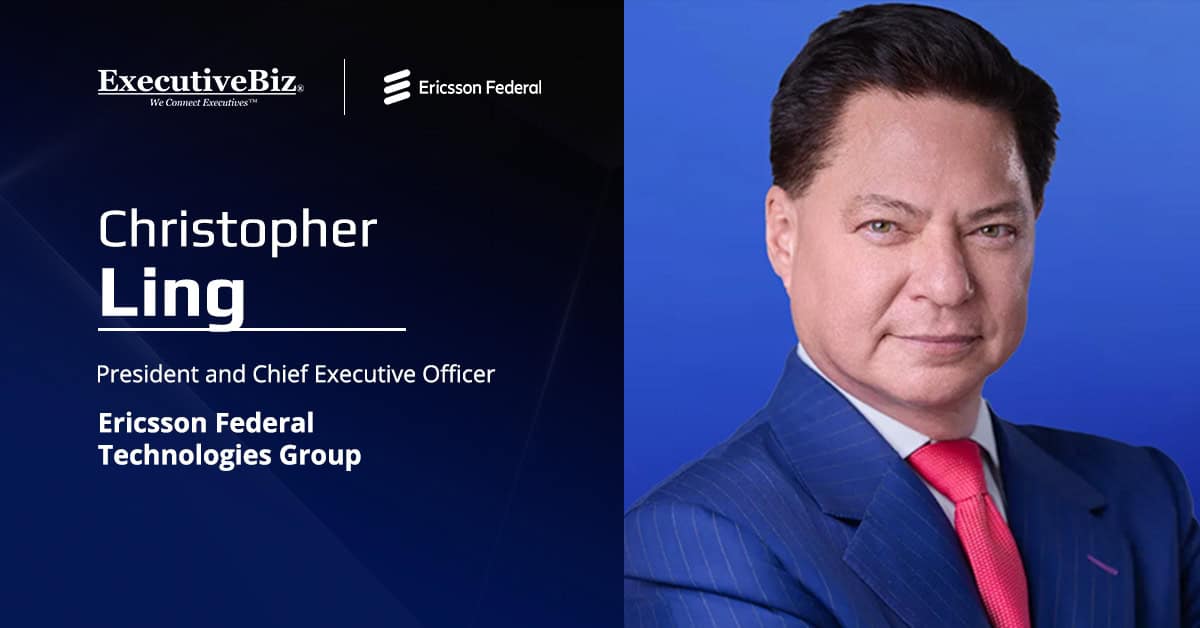
Christopher Ling, president and CEO of Ericsson Federal Technologies Group, discussed how commercial technology partnerships and global telecommunications integration could support U.S. defense operations worldwide.
How Could a Commercial Consortium Support Defense Technology Integration?
In a recent GovCon Conversation video interview with Executive Mosaic Senior Content Specialist Charles Lyons-Burt, Ling said Ericsson is working with Nokia and other partners to establish a commercial consortium designed to deliver integrated technology capabilities to government customers.
The effort includes two primary components. The first focuses on integrating technologies across the commercial technology stack, including artificial intelligence systems, datasets, hyperscalers and autonomous platforms such as drones.
According to Ling, the goal is to provide a turnkey solution that allows the industry to assume greater responsibility for integrating those technologies rather than requiring government agencies to manage the process themselves.
“So really we want to have a turnkey capability,” Ling said, noting that customers increasingly expect industry to take on integration risk and deliver complete platforms.
Why Is Global Network Collaboration Important for Defense Operations?
The consortium’s second component centers on collaboration among telecommunications operators worldwide, according to Ling.
“So, if you think about where DOD operates around the world, they touch many, many different countries, and those host nations each have their indigenous network operators,” he said.
Through cooperation among those providers, Ling said industry partners could help create a more seamless digital environment for defense missions and enable a virtualized enterprise environment where data and applications move across global networks.
What Defense Technology Trends Did Ling Highlight?
Ling said discussions with U.S. Army Lt. Gen. Joshua Rudd, deputy commander of U.S. Indo-Pacific Command, on the sidelines of the AFCEA TechNet INDOPACOM conference highlighted several trends shaping how the Department of War approaches commercial technology adoption.
He pointed to three “micro-trends” focused on the role of commercial technology in defense environments: educating defense personnel on commercial capabilities, accelerating innovation by adopting technology at the “speed of relevance,” and implementing those technologies across operational environments.
Surrounding those efforts is what Ling described as a broader “mega-trend” — networking those capabilities together to strengthen mission effectiveness.
“And so as valuable as any one asset is for the military, the ability to network those assets, you know, really is a force multiplier,” Ling said.
Ling added that integrating those technologies ultimately supports a broader objective of strengthening strategic deterrence through networked capabilities and commercial innovation.