
 Miles Jamison
- LR-1 is designed to operate on the moon for at least five years
- Reactors must meet Department of Energy nuclear safety standards
- Final solicitation reflects feedback from an August draft and September industry day
NASA is inviting industry to compete for work on a lunar nuclear power system through its Space Power and Reactor Capabilities Request for Proposals, which seeks to advance technology intended to supply electricity for future lunar operations.
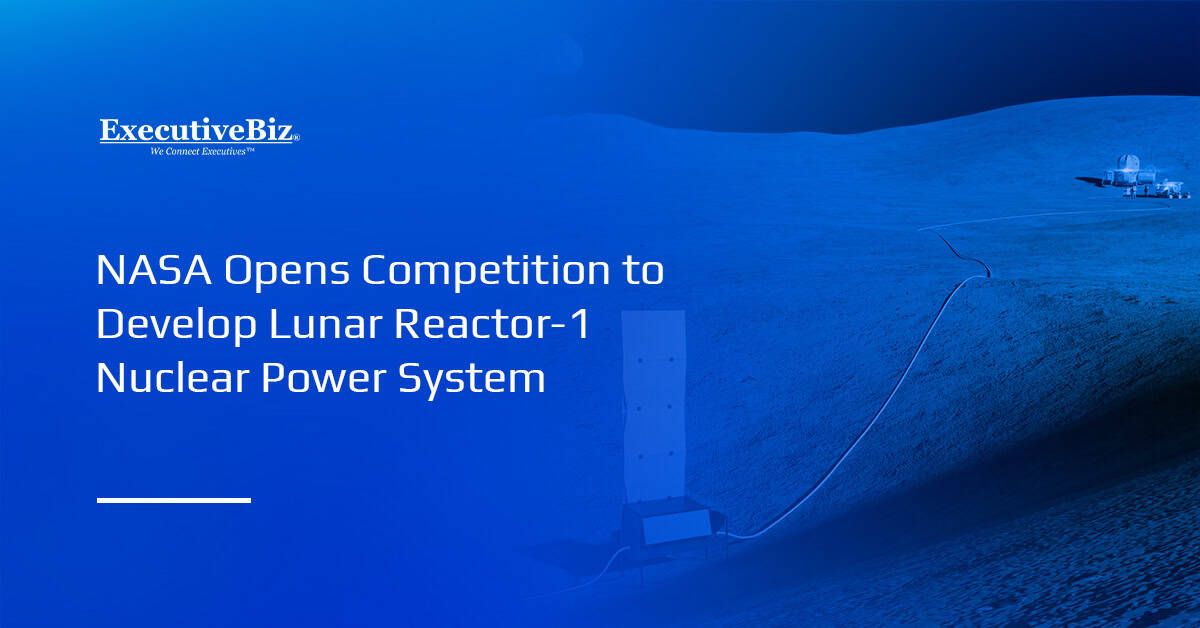
The agency said Monday the procurement covers the development, testing and flight design of Lunar Reactor-1, or LR-1, a fission-based system designed to generate 20 kilowatts of electricity. Proposals are due Dec. 21, with NASA targeting 2030 for launch readiness.
The solicitation also allows NASA to pursue other space nuclear power projects through additional task orders, although LR-1 remains its primary focus.
What Must Contractors Deliver Under NASA’s Solicitation?
NASA wants industry partners to advance LR-1 into a system that can be launched to the moon by 2030. Once deployed, the reactor is expected to operate for at least five years.
The procurement establishes a nuclear safety requirement for the work: the proposed reactors must comply with Department of Energy standards governing nuclear operations.
NASA developed the final request after gathering industry input through two earlier activities. NASA’s Glenn Research Center released a draft solicitation in August for a planned multiple-award, indefinite-delivery/indefinite-quantity contract. The agency also held an industry day in September at the Ohio Aerospace Institute in Cleveland. Feedback from those engagements was incorporated into the procurement.
The procurement builds on NASA’s Fission Surface Power Project. In June 2022, NASA and DOE awarded Phase 1 contracts to Lockheed Martin, Westinghouse and IX, a joint venture of Intuitive Machines and X-Energy, to develop concept designs for a 40-kilowatt lunar fission reactor. In 2024, NASA said it planned to extend those contracts to gather information ahead of a second phase, in which industry would design the final reactor for a lunar surface demonstration.
How Will LR-1 Support NASA’s Lunar Exploration Plans?
The reactor is intended to supply electricity to several types of equipment and facilities associated with NASA’s proposed Moon Base. Potential applications include crew habitats, communications equipment, lunar rovers and scientific instruments.
NASA estimates that the reactor’s electrical output would be comparable to the annual power needs of approximately 16 average U.S. households.
The system’s ability to generate electricity during extended periods without sunlight is particularly relevant to lunar operations. A lunar night lasts approximately 14 Earth days, creating a prolonged period when solar power cannot provide electricity through direct sunlight.
The agency also cited conditions on Mars as a reason for pursuing nuclear energy. Dust storms on the planet can obstruct sunlight for months, while the availability of solar energy declines farther from the sun.
In January, DOE and NASA signed a memorandum of understanding to jointly develop a fission surface power system that would keep producing electricity through the lunar night and run for several years without refueling. The 2030 target aligns with President Donald Trump’s Ensuring American Space Superiority executive order, which calls for a lunar surface reactor ready for launch by that year.
NASA outlined a three-phase Moon Base plan in March at its Ignition event, starting with expanded Commercial Lunar Payload Services missions and Lunar Terrain Vehicle deliveries supporting mobility, power, communications and science. Later phases introduce semi-habitable systems and recurring logistics, followed by cargo-capable human landing systems for larger infrastructure.
What Other Nuclear Technology Is NASA Developing?
LR-1 is one of two nuclear technology efforts managed by NASA’s Space Reactors Division in partnership with the Energy Department. The division also oversees Space Reactor-1, or SR-1, Freedom, a separate project with a planned 2028 launch.
Unlike LR-1, which is intended to generate electricity for lunar surface operations, SR-1 Freedom will demonstrate nuclear electric propulsion. The mission will deliver three SkyFall helicopters to Mars while testing a system that converts reactor-generated electricity into power for spacecraft propulsion.
NASA said the technology could enable future spacecraft to undertake deep-space missions beyond the capabilities of conventional propulsion systems.
The two programs address different power requirements in NASA’s exploration plans: LR-1 is intended for electricity generation on the moon, while SR-1 Freedom will test a nuclear-based method of spacecraft propulsion.