
 Gabriella DeCesare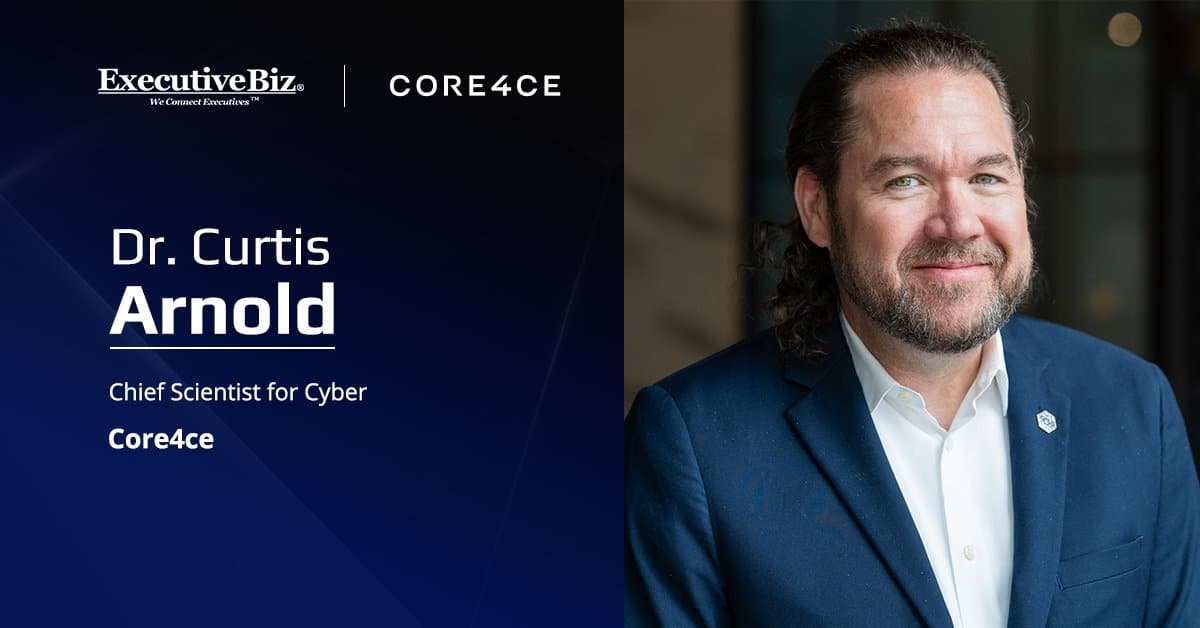
- Dr. Curtis Arnold says “decision latency” is becoming one of the biggest cybersecurity risks facing government and industry organizations.
- Dr. Arnold warns AI is accelerating cyberattack timelines, making rapid executive decision-making and operational resilience more critical than ever.
- Ahead of the 2026 Cyber Summit on May 21, the Core4ce cyber executive argues cybersecurity must be treated as a core business and leadership function rather than solely a technical responsibility.
As cyber threats evolve at machine speed and artificial intelligence accelerates attack timelines, organizations can no longer afford delays in decision-making, according to Core4ce’s Chief Cyber Scientist Dr. Curtis Arnold.
Ahead of his appearance on a panel at the 2026 Cyber Summit on May 21, Dr. Arnold shared insights on one of the industry’s most overlooked vulnerabilities: “decision latency,” or the gap between identifying cyber risk and acting on it.
“Many organizations could see threats, but they struggle to prioritize or assign ownership or make timely decisions,” Dr. Arnold said in an interview with ExecutiveBiz. “Our adversaries are exploiting that hesitation more than technical weaknesses.”
The conversation comes as federal agencies and government contractors continue adapting to increasingly sophisticated cyberattacks, growing regulatory pressure and the expanding role of AI in both offensive and defensive cyber operations.
Why Must Cybersecurity Move Beyond the Technical Level?
Dr. Arnold said organizations must begin translating cyber threats into operational and mission risks that executives can act on in real time.
“Too often cybersecurity stays trapped at the technical level while executives are making decisions without clear insight into what’s truly at stake,” he said.
Rather than treating cybersecurity as an isolated IT responsibility, Dr. Arnold argued that cyber risk must become embedded within leadership strategy, continuity planning and resource allocation.
“It’s about aligning security, operations and leadership so cyber risk informs real decisions,” he said. “That really means prioritization, resource allocation and response rather than just compliance checklists.”
For contractors supporting federal missions, the implications are significant. As agencies modernize hybrid environments and increasingly rely on cloud infrastructure, executives face mounting pressure to make rapid, informed decisions during cyber incidents.
How Is AI Compressing Response Timelines?
Dr. Arnold warned that AI technologies are accelerating cyber operations on both sides of the battlefield.
“As people start using artificial intelligence more, it’s only going to get faster,” he said. “A lot of times things are being exploited within the time the decision’s made, and AI’s only going togonna make that worse and harder.”
That growing “decision latency” gap is becoming increasingly dangerous as AI compresses attack timelines and automates adversary operations.
At the same time, organizations are already overwhelmed by the volume of available cyber data, creating additional strain on analysts and leadership teams.
“We already know we have a problem with responding. We’re overwhelmed with data,” Dr. Arnold said.
Rather than replacing cybersecurity professionals, Arnold said organizations should focus on using AI to accelerate analysis, reduce manual workloads and support faster executive decision-making.
For government agencies and contractors operating in high-stakes environments, the ability to make informed cyber decisions in near real time may increasingly determine operational resilience and mission success.
Why Should Organizations Shift From Prevention to Resilience?
Another key theme Dr. Arnold plans to discuss at the 2026 Cyber Summit is the growing industry shift from prevention to resilience.
“I think the conversation needs to shift from prevention to resilience,” he said. “We have to assume compromise and focus on how organizations continue to operate, make decisions and recover when defenses fail.”
According to Dr. Arnold, cyber resilience is no longer solely a technical issue. It has become an operational and leadership challenge directly tied to mission assurance and continuity planning.
“Cyber resilience just really isn’t about a technical capability. It’s an operational one,” he said.
He pointed to scenarios involving multiple facilities or mission sites under attack, requiring leaders to rapidly determine where to allocate limited defensive resources.
“Those are the kind of business decisions that, when you start talking about resiliency, you need to account for,” Dr. Arnold explained.
Cybersecurity Must Become a Core Business Function
Dr. Arnold emphasized that cybersecurity must now be viewed as a foundational business discipline rather than a niche technical specialty.
“Cybersecurity is not a novice prima donna thing like it was back in the early 2000s,” he said. “It’s a profession that needs to be treated as a core business function.”
That mindset shift, he added, requires organizations to integrate cyber considerations into daily operational planning and executive-level decision-making.
“It’s something that affects your entire bottom line,” Dr. Arnold said.
Organizations that successfully integrate people, processes and technology rather than simply deploying more tools will ultimately be better positioned to withstand future cyber threats, he argued.
“The winners really won’t be those with the most technology, but those that can best integrate people, processes and technology to act decisively,” Dr. Arnold said.
Dr. Arnold’s comments reflect broader conversations expected to shape this year’s Cyber Summit, where government leaders, industry executives and cybersecurity experts will discuss emerging threats, AI-driven security strategies and resilience across federal missions. Make sure your organization is not left out of these critical conversations.
Who Is Dr. Curtis Arnold?
Dr. Curtis Arnold serves as chief scientist for cyber at Core4ce, where he helps shape strategic direction and senior-level planning efforts for the Department of War, Department of Homeland Security and other federal customers.
Before joining Core4ce, Dr. Arnold was president of Arnold & Associates Inc., a cybersecurity services company focused on future cyber innovations that was acquired by Core4ce.
Previously, he served as chief of the Sustaining Base Network Assurance Branch at the U.S. Army Research Laboratory. In that role, Dr. Arnold oversaw a wide range of defensive cyber operations activities spanning research and development initiatives and 24/7 cybersecurity services. The organization also managed Cybersecurity Service Provider responsibilities supporting more than 300 external customers and monitoring over 500 intrusion detection sensors worldwide.
Dr. Arnold has more than 20 years of experience supporting DOW and federal agencies across leadership, policy and technical cybersecurity roles. Earlier in his career, he served as a non-commissioned officer in the U.S. Army Judge Advocate General’s Corps.
He holds a bachelor’s degree in information security and a master’s degree in information technology from Johns Hopkins University, as well as a doctor of science degree in cybersecurity from Capitol Technology University.